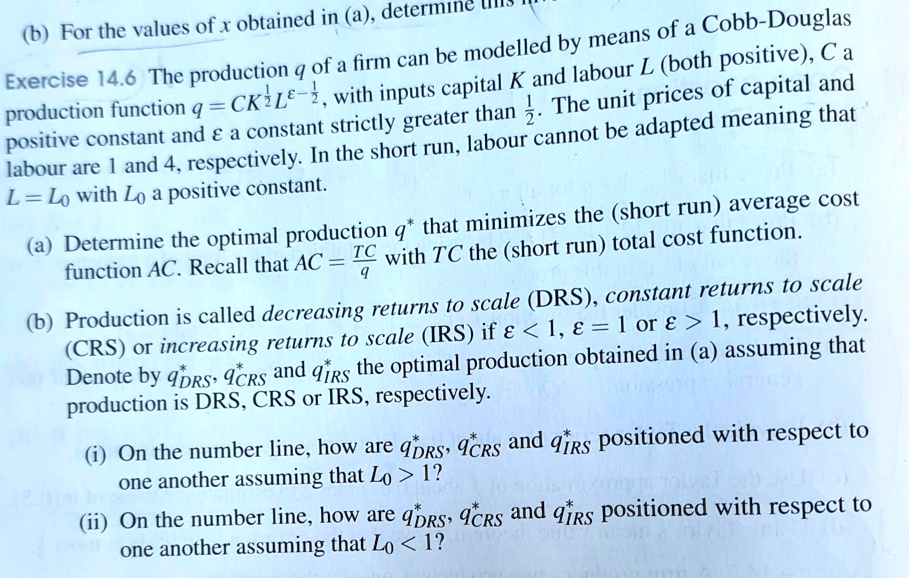
(b) For the values of x obtained in (a), determine
Exercise 14.6 The production $q$ of a firm can be modelled by means of a Cobb-Douglas
production function $q = CK^{\frac{1}{2}}L^{\frac{\epsilon}{2}}$, with inputs capital $K$ and labour $L$ (both positive), $C$ a
positive constant and $\epsilon$ a constant strictly greater than $\frac{1}{2}$. The unit prices of capital and
labour are 1 and 4, respectively. In the short run, labour cannot be adapted meaning that
$L = L_0$ with $L_0$ a positive constant.
(a) Determine the optimal production $q^*$ that minimizes the (short run) average cost
function $AC$. Recall that $AC = \frac{TC}{q}$ with $TC$ the (short run) total cost function.
(b) Production is called decreasing returns to scale (DRS), constant returns to scale
(CRS) or increasing returns to scale (IRS) if $\epsilon < 1$, $\epsilon = 1$ or $\epsilon > 1$, respectively.
Denote by $q^*_{DRS}$, $q^*_{CRS}$ and $q^*_{IRS}$ the optimal production obtained in (a) assuming that
production is DRS, CRS or IRS, respectively.
(i) On the number line, how are $q^*_{DRS}$, $q^*_{CRS}$ and $q^*_{IRS}$ positioned with respect to
one another assuming that $L_0 > 1$?
(ii) On the number line, how are $q^*_{DRS}$, $q^*_{CRS}$ and $q^*_{IRS}$ positioned with respect to
one another assuming that $L_0 < 1?$