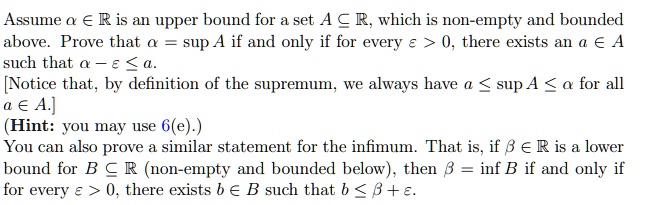
Assume $a \in \mathbb{R}$ is an upper bound for a set $A \subseteq \mathbb{R}$, which is non-empty and bounded above. Prove that $a = \sup A$ if and only if for every $\varepsilon > 0$, there exists an $a \in A$ such that $a - \varepsilon < a$.
[Notice that, by definition of the supremum, we always have $a \le \sup A \le a$ for all $a \in A$.]
(Hint: you may use 6(e).)
You can also prove a similar statement for the infimum. That is, if $\beta \in \mathbb{R}$ is a lower bound for $B \subseteq \mathbb{R}$ (non-empty and bounded below), then $\beta = \inf B$ if and only if for every $\varepsilon > 0$, there exists $b \in B$ such that $b \le \beta + \varepsilon$.