Ace - AI Tutor
Ask Our Educators
Textbooks
My Library
Flashcards
Scribe - AI Notes
Notes & Exams
Download App
Zabir Islam

Zabir I.

Divider

Viewed Questions

State the order of the given ordinary differential equation. Determine whether the equation is linear or nonlinear by matching it with (6).
$$x \frac{d^{3} y}{d x^{3}}-\left(\frac{d y}{d x}\right)^{4}+y=0$$

State the order of the given ordinary differential equation. Determine whether the equation is linear or nonlinear by matching it with (6). $$x \frac{d^{3} y}{d x^{3}}-\left(\frac{d y}{d x}\right)^{4}+y=0$$

A First Course in Differential Equations with Modeling Applications

Introduction to Differential Equations

Definitions and Terminology

State the order of the given ordinary differential equation. Determine whether the equation is linear or nonlinear by matching it with (6).
$$(1-x) y^{\prime \prime}-4 x y^{\prime}+5 y=\cos x$$

State the order of the given ordinary differential equation. Determine whether the equation is linear or nonlinear by matching it with (6). $$(1-x) y^{\prime \prime}-4 x y^{\prime}+5 y=\cos x$$

A First Course in Differential Equations with Modeling Applications

Introduction to Differential Equations

Definitions and Terminology

Questions asked

ANSWERED

Ethan Deweese verified

Numerade educator

Ex 13.1 CHAPTER 13 Time period (T) Frequency (f) : 1/T (Hz) a) Amplitude / Peak value b) Instantaneous values at 0.3 and 0.6 s c) Peak to Peak value d) Period e) Total cycles f) Frequency

View Answer
divider
ANSWERED

Supratim Pal verified

Numerade educator

EXAMPLE 10.19 Find the voltage across and the charge on each capacitor of the network in Fig. 10.75(a) after each has charged up to its final value. Solution: See Fig. 10.75(b). VC2 = (7 ?)(72 V) / (7 ? + 2 ?) = 56 V VC1 = (2 ?)(72 V) / (2 ? + 7 ?) = 16 V Q1 = C1VC1 = (2 × 10?? F)(16 V) = 32 µC Q2 = C2VC2 = (3 × 10?? F)(56 V) = 168 µC FIG. 10.74 Determining the final (steady-state) value for vC. FIG. 10.75

View Answer
divider
INSTANT ANSWER

EXAMPLE 10.17 Find the voltage across and the charge on each capacitor for the network in Fig. 10.71. Solution: FIG. \( 10.71 \) \[ \begin{aligned} C_{T}^{\prime} &=C_{2}+C_{3}=4 \mu \mathrm{F}+2 \mu \mathrm{F}=6 \mu \mathrm{F} \\ C_{T} &=\frac{C_{1} C_{T}^{\prime}}{C_{1}+C_{T}^{\prime}}=\frac{(3 \mu \mathrm{F})(6 \mu \mathrm{F})}{3 \mu \mathrm{F}+6 \mu \mathrm{F}}=2 \mu \mathrm{F} \\ Q_{T} &=C_{T} E=\left(2 \times 10^{-6} \mathrm{~F}\right)(120 \mathrm{~V})=\mathbf{2 4 0} \mu \mathrm{C} \end{aligned} \] Example 10.17.

View Answer
divider
INSTANT ANSWER

EXAMPLE 10.11 For the network in Fig. 10.57: a. Find the mathematical expression for the transient behavior of the voltage \( v_{C} \) and the current \( i_{C} \) following the closing of the switch (position 1 at \( t=0 \mathrm{~s} \) ). b. Find the mathematical expression for the voltage \( v_{C} \) and the current \( i_{C} \) as a function of time if the switch is thrown into position 2 at \( t= \) \( 9 \mathrm{~ms} \). c. Draw the resultant waveforms of parts (a) and (b) on the same time axis. FIG. \( 10.57 \) Example 10.11.

View Answer
divider
INSTANT ANSWER

EXAMPLE 10.10 The capacitor in Fig. \( 10.52 \) has an initial voltage of \( 4 \mathrm{~V} \). a. Find the mathematical expression for the voltage across the capacitor once the switch is closed. b. Find the mathematical expression for the current during the transient period. c. Sketch the waveform for each from initial value to final value. FIG. \( 10.52 \) Example 10.10.

View Answer
divider
INSTANT ANSWER

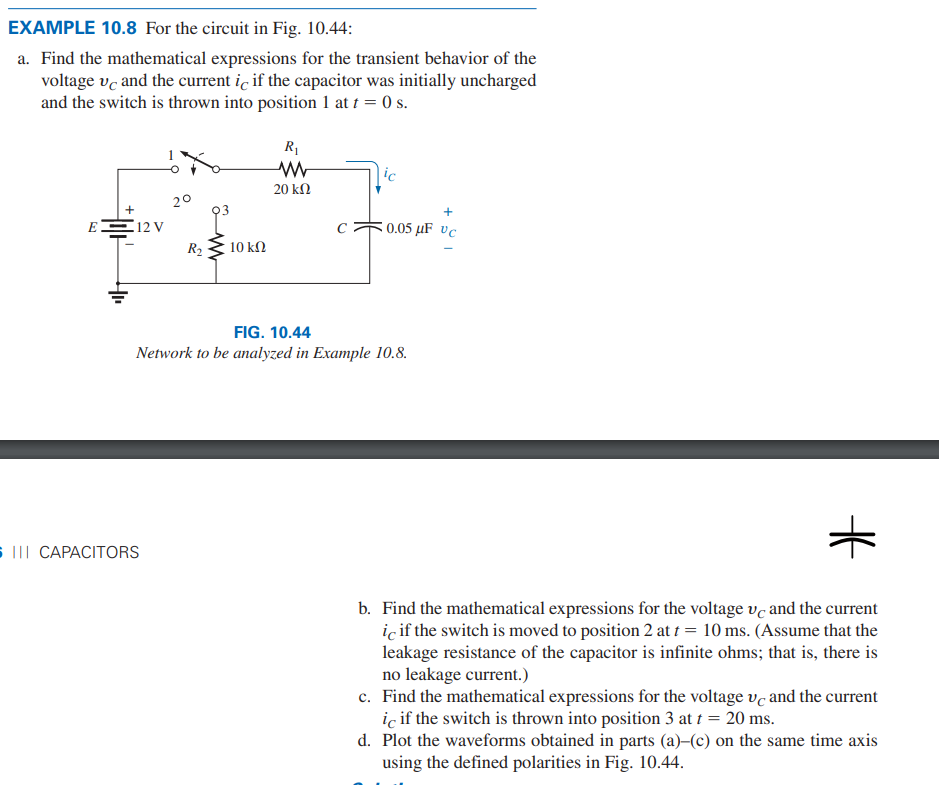
EXAMPLE 10.8 For the circuit in Fig. 10.44: a. Find the mathematical expressions for the transient behavior of the voltage \( v_{C} \) and the current \( i_{C} \) if the capacitor was initially uncharged and the switch is thrown into position 1 at \( t=0 \mathrm{~s} \). FIG. \( 10.44 \) Network to be analyzed in Example 10.8. III CAPACITORS b. Find the mathematical expressions for the voltage \( v_{C} \) and the current \( i_{C} \) if the switch is moved to position 2 at \( t=10 \mathrm{~ms} \). (Assume that the leakage resistance of the capacitor is infinite ohms; that is, there is no leakage current.) c. Find the mathematical expressions for the voltage \( v_{C} \) and the current \( i_{C} \) if the switch is thrown into position 3 at \( t=20 \mathrm{~ms} \). d. Plot the waveforms obtained in parts (a)-(c) on the same time axis using the defined polarities in Fig. 10.44.
View Answer
divider
ANSWERED

Supratim Pal verified

Numerade educator

37. Reduce the network in Fig. 11.108 to the fewest elements.

View Answer
divider
ANSWERED

Supratim Pal verified

Numerade educator

36. Reduce the network in Fig. 11.107 to the fewest number of components.

View Answer
divider
ANSWERED

Supratim Pal verified

Numerade educator

35. Find the total inductance of the circuits in Fig. 11.106.

View Answer
divider
ANSWERED

Nishant Kumar verified

Numerade educator

EXAMPLE 11.12 Find the energy stored by the inductor in the circuit in Fig. 11.66 when the current through it has reached its final value. FIG. 11.66 Example 11.12.

View Answer
divider