Ace - AI Tutor
Ask Our Educators
Textbooks
My Library
Flashcards
Scribe - AI Notes
Notes & Exams
Download App
kayla valbuena

kayla v.

Divider

Questions asked

BEST MATCH

If $E[X] = 0$ and $\text{Var}(X) = 2$, then $E[(3 + 5X)^2] = \boxed{\phantom{0}}$ and $\text{Var}(4 + 5X) = \boxed{\phantom{0}}$

View Answer
divider
BEST MATCH

After removing the brain and peeling off the arachnoid layer of meninges you'd be looking at: Dura mater spiders that lived in the animal's brain Cranial nerves Pia mater

View Answer
divider
BEST MATCH

6. How does the standard error of the mean relate to the law of large numbers (very brief explanation; 6 points). Hint: can derive it from the standard error equation.

View Answer
divider
BEST MATCH

Question 30 True or false: Whether an argument is intended to be inductive or deductive is decided by the speaker. O True O False 1 pts

View Answer
divider
BEST MATCH

56. In the rheumatoid factor test, what is being detected?

View Answer
divider
BEST MATCH

The Field Health Services and Information System (FHSIS) is the recording and reporting system in public health care in the Philippines. The Monthly Field Health Service Activity Report is a form used in which of the components of the FHSIS? A. Tally report B. Output report C. Target/client list D. Individual health record

View Answer
divider
BEST MATCH

After cell lysis and centrifugation, which components do you expect to find in the supernatant? Insoluble proteins and cellular components Cellular organelles Solubilized proteins Insoluble proteins, cellular components, and organelles.

View Answer
divider
BEST MATCH

(1 point) Write a triple integral, including limits of integration, that gives the volume between 4x + 3y + z = 6 and 6x + 4y + z = 6 and above x + y ? 1, x ? 0, y ? 0. volume = \int_a^b \int_c^d \int_e^f \, dz \, dy \, dx where a = \underline{\qquad}, b = \underline{\qquad}, d = \underline{\qquad} and f = \underline{\qquad} e = 6-4x-3y (Note: values for all answer blanks must be supplied for this problem to be able to check the answers provided.)

View Answer
divider
BEST MATCH

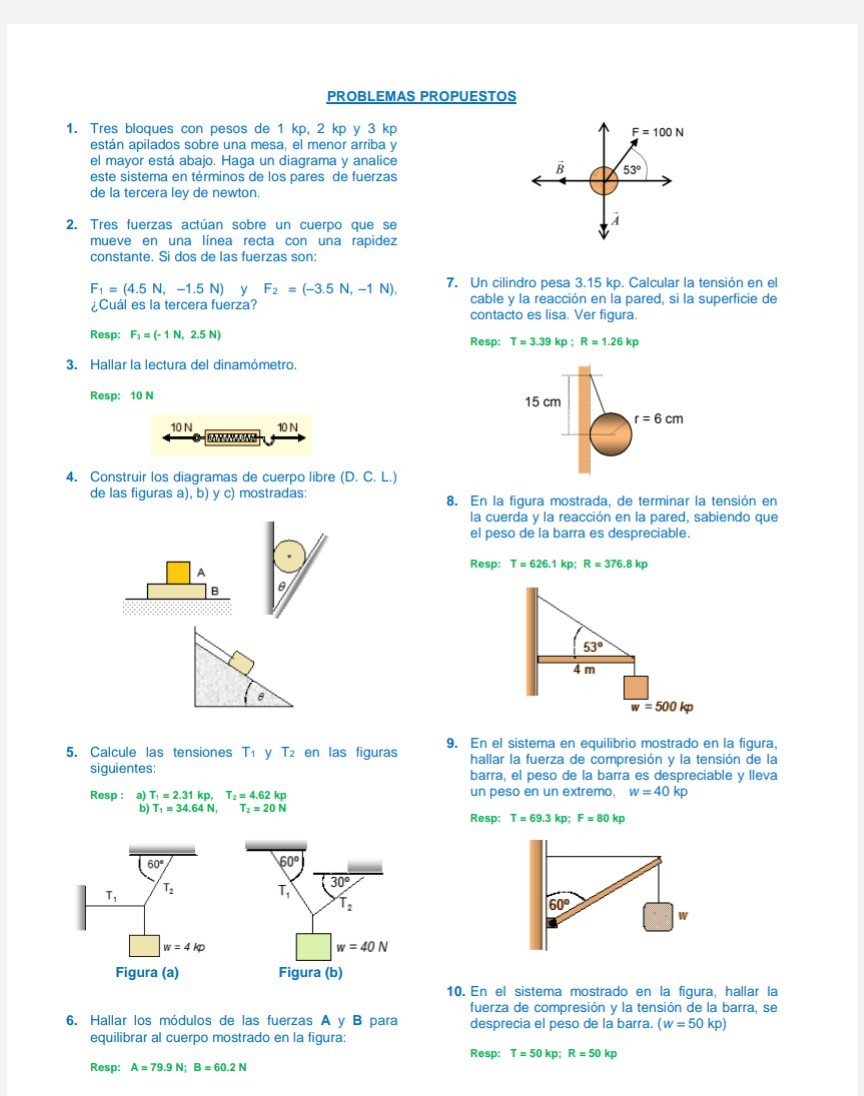
PROBLEMAS PROPUESTOS 1. Tres bloques con pesos de \( 1 \mathrm{kp}, 2 \mathrm{kp} \) y \( 3 \mathrm{kp} \) est谩n apilados sobre una mesa, el menor arriba y el mayor est谩 abajo. Haga un diagrama y analice este sistema en t茅rminos de los pares de fuerzas de la tercera ley de newton. 2. Tres fuerzas act煤an sobre un cuerpo que se mueve en una l铆nea recta con una rapidez constante. Si dos de las fuerzas son: \( F_{1}=(4.5 \mathrm{~N},-1.5 \mathrm{~N}) \) y \( \mathrm{F}_{2}=(-3.5 \mathrm{~N},-1 \mathrm{~N}) \), 驴Cu谩l es la tercera fuerza? Resp: \( F_{3}=(-1 \mathrm{~N}, 2.5 \mathrm{~N}) \) 3. Hallar la lectura del dinam贸metro. Resp: \( 10 \mathrm{~N} \) 4. Construir los diagramas de cuerpo libre (D. C. L.) de las figuras a), b) y c) mostradas: 5. Calcule las tensiones \( T_{1} \) y \( T_{2} \) en las figuras siguientes: Resp: a) \( \mathrm{T}_{1}=\mathbf{2 . 3 1} \mathrm{kp}, \mathrm{T}_{2}=\mathbf{4 . 6 2} \mathrm{kp} \) b) \( T_{1}=34.64 \mathrm{~N}, \quad \mathrm{~T}_{2}=20 \mathrm{~N} \) Figura (a) Figura (b) 6. Hallar los m贸dulos de las fuerzas A y B para equilibrar al cuerpo mostrado en la figura: Resp: \( A=79.9 \mathrm{~N} ; B=60.2 \mathrm{~N} \) 7. Un cilindro pesa \( 3.15 \mathrm{kp} \). Calcular la tensi贸n en el cable y la reacci贸n en la pared, si la superficie de contacto es lisa. Ver figura. Resp: \( T=3.39 \mathrm{kp} ; \quad R=1.26 \mathrm{kp} \) 8. En la figura mostrada, de terminar la tensi贸n en la cuerda y la reacci贸n en la pared, sabiendo que el peso de la barra es despreciable. Resp: \( \mathbf{T}=626.1 \mathrm{kp} ; \mathbf{R}=376.8 \mathrm{kp} \) 9. En el sistema en equilibrio mostrado en la figura, hallar la fuerza de compresi贸n y la tensi贸n de la barra, el peso de la barra es despreciable y lleva un peso en un extremo, \( w=40 \mathrm{kp} \) Resp: \( T=69.3 \mathrm{kp} ; \mathrm{F}=80 \mathrm{kp} \) 10. En el sistema mostrado en la figura, hallar la fuerza de compresi贸n y la tensi贸n de la barra, se desprecia el peso de la barra. \( (w=50 \mathrm{kp}) \) Resp: \( \mathbf{T}=\mathbf{5 0} \mathrm{kp} ; \mathbf{R}=\mathbf{5 0} \mathbf{~ k p} \)
View Answer
divider
BEST MATCH

beginning in the 1960s, psychological science returned to its earlier interest in mental processes

View Answer
divider