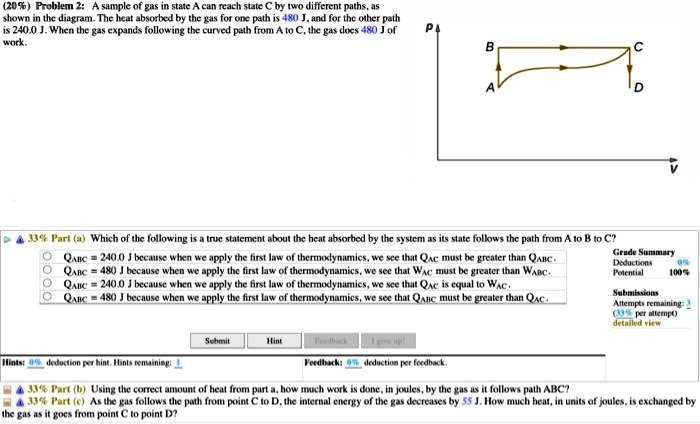
(20%) Problem 2: A sample of gas in state A can reach state C by two different paths, as shown in the diagram. The heat absorbed by the gas for one path is 480 J, and for the other path is 240.0 J. When the gas expands following the curved path from A to C, the gas does 480 J of work.
33% Part (a) Which of the following is a true statement about the heat absorbed by the system as its state follows the path from A to B to C?
$Q_{ABC} = 240.0$ J because when we apply the first law of thermodynamics, we see that $Q_{AC}$ must be greater than $Q_{ABC}$.
$Q_{ABC} = 480$ J because when we apply the first law of thermodynamics, we see that $W_{AC}$ must be greater than $W_{ABC}$.
$Q_{ABC} = 240.0$ J because when we apply the first law of thermodynamics, we see that $Q_{AC}$ is equal to $W_{AC}$
$Q_{ABC} = 480$ J because when we apply the first law of thermodynamics, we see that $Q_{ABC}$ must be greater than $Q_{AC}$
33% Part (b) Using the correct amount of heat from part a, how much work is done, in joules, by the gas as it follows path ABC?
33% Part (c) As the gas follows the path from point C to D, the internal energy of the gas decreases by 55 J. How much heat, in units of joules, is exchanged by the gas as it goes from point C to point D?