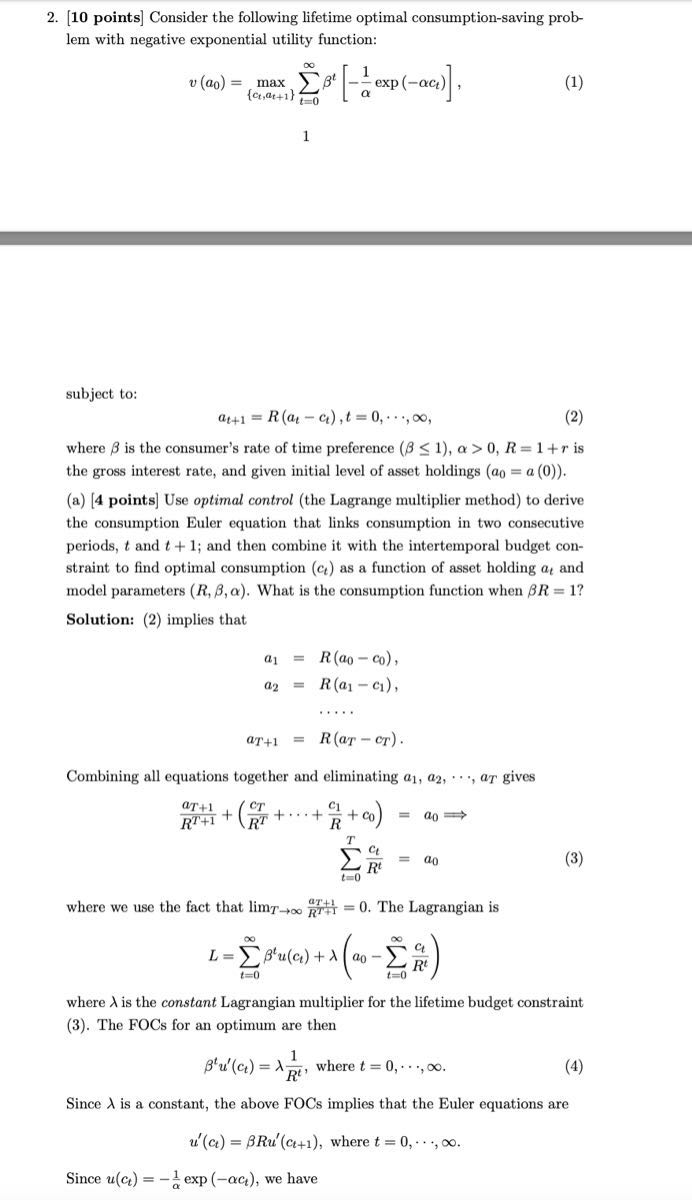
2. [10 points] Consider the following lifetime optimal consumption-saving problem with negative exponential utility function:
\[
v\left(a_{0}\right)=\max _{\left\{c_{t}, a_{t+1}\right\}} \sum_{t=0}^{\infty} \beta^{t}\left[-\frac{1}{\alpha} \exp \left(-\alpha c_{t}\right)\right]
\]
1
subject to:
\[
a_{t+1}=R\left(a_{t}-c_{t}\right), t=0, \cdots, \infty
\]
where \( \beta \) is the consumer's rate of time preference \( (\beta \leq 1), \alpha>0, R=1+r \) is the gross interest rate, and given initial level of asset holdings \( \left(a_{0}=a(0)\right. \) ).
(a) [4 points] Use optimal control (the Lagrange multiplier method) to derive the consumption Euler equation that links consumption in two consecutive periods, \( t \) and \( t+1 \); and then combine it with the intertemporal budget constraint to find optimal consumption \( \left(c_{t}\right) \) as a function of asset holding \( a_{t} \) and model parameters \( (R, \beta, \alpha) \). What is the consumption function when \( \beta R=1 \) ?
Solution: (2) implies that
\[
\begin{aligned}
a_{1}= & R\left(a_{0}-c_{0}\right) \\
a_{2}= & R\left(a_{1}-c_{1}\right) \\
& \cdots \cdots \\
a_{T+1}= & R\left(a_{T}-c_{T}\right)
\end{aligned}
\]
Combining all equations together and eliminating \( a_{1}, a_{2}, \cdots, a_{T} \) gives
\[
\begin{aligned}
\frac{a_{T+1}}{R^{T+1}}+\left(\frac{c_{T}}{R^{T}}+\cdots+\frac{c_{1}}{R}+c_{0}\right) & =a_{0} \Longrightarrow \\
\sum_{t=0}^{T} \frac{c_{t}}{R^{t}} & =a_{0}
\end{aligned}
\]
where we use the fact that \( \lim _{T \rightarrow \infty} \frac{a_{T+1}}{R^{T+1}}=0 \). The Lagrangian is
\[
L=\sum_{t=0}^{\infty} \beta^{t} u\left(c_{t}\right)+\lambda\left(a_{0}-\sum_{t=0}^{\infty} \frac{c_{t}}{R^{t}}\right)
\]
where \( \lambda \) is the constant Lagrangian multiplier for the lifetime budget constraint (3). The FOCs for an optimum are then
\[
\beta^{t} u^{\prime}\left(c_{t}\right)=\lambda \frac{1}{R^{t}}, \text { where } t=0, \cdots, \infty
\]
Since \( \lambda \) is a constant, the above FOCs implies that the Euler equations are
\[
u^{\prime}\left(c_{t}\right)=\beta R u^{\prime}\left(c_{t+1}\right), \text { where } t=0, \cdots, \infty
\]
Since \( u\left(c_{t}\right)=-\frac{1}{\alpha} \exp \left(-\alpha c_{t}\right) \), we have