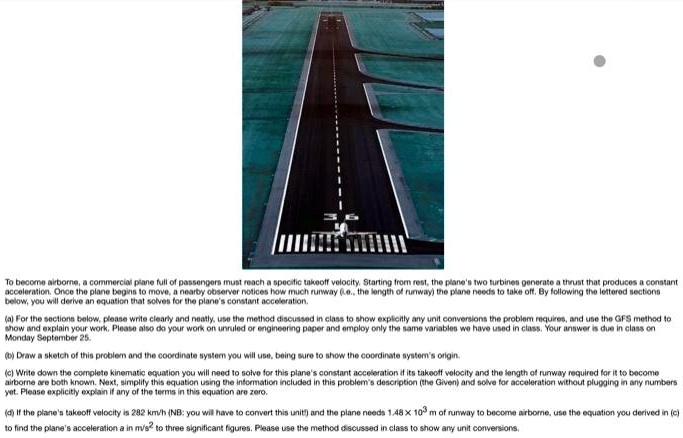
To become airborne, a commercial plane full of passengers must reach a specific takeoff velocity. Starting from rest, the plane's two turbines generate a thrust that produces a constant acceleration. Once the plane begins to move, a nearby observer notices how much runway (i.e., the length of runway) the plane needs to take off. By following the lettered sections below, you will derive an equation that solves for the plane's constant acceleration.
(a) For the sections below, please write clearly and neatly, use the method discussed in class to show explicitly any unit conversions the problem requires, and use the GFS method to show and explain your work. Please also do your work on unruled or engineering paper and employ only the same variables we have used in class. Your answer is due in class on Monday September 25.
(b) Draw a sketch of this problem and the coordinate system you will use, being sure to show the coordinate system's origin.
(c) Write down the complete kinematic equation you will need to solve for this plane's constant acceleration if its takeoff velocity and the length of runway required for it to become airborne are both known. Next, simplify this equation using the information included in this problem's description (the Given) and solve for acceleration without plugging in any numbers yet. Please explicitly explain if any of the terms in this equation are zero.
(d) If the plane's takeoff velocity is 282 km/h (NB: you will have to convert this unit!) and the plane needs $1.48 \times 10^3$ m of runway to become airborne, use the equation you derived in (c) to find the plane's acceleration a in m/s² to three significant figures. Please use the method discussed in class to show any unit conversions.