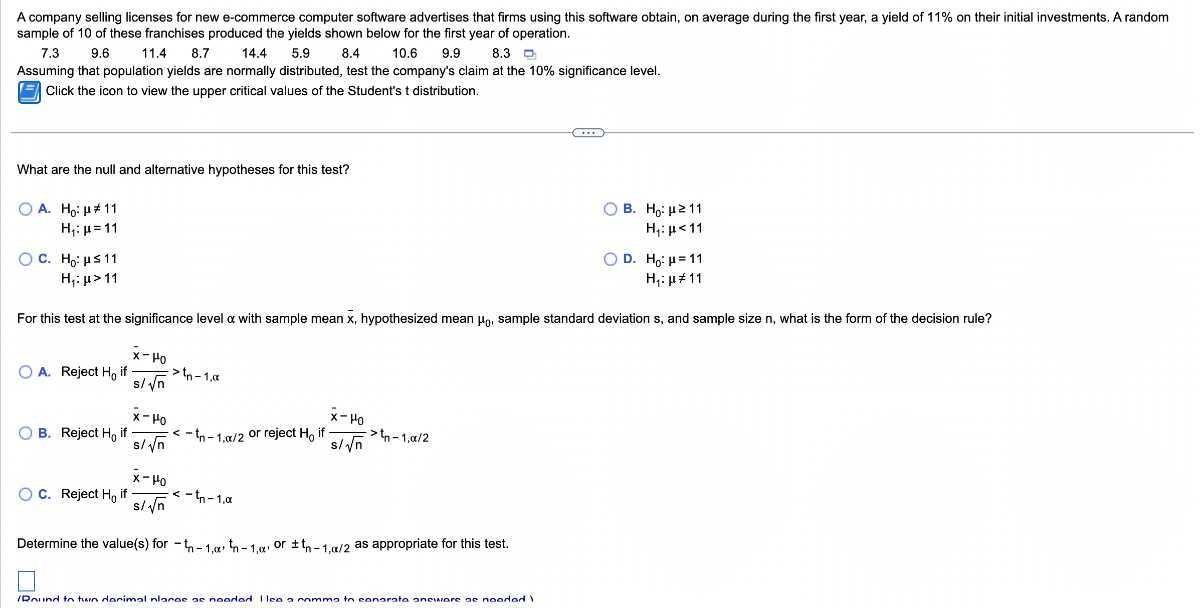
A company selling licenses for new e-commerce computer software advertises that firms using this software obtain, on average during the first year, a yield of \( 11 \% \) on their initial investments. A random sample of 10 of these franchises produced the yields shown below for the first year of operation.
\[
\begin{array}{llllllllll}
7.3 & 9.6 & 11.4 & 8.7 & 14.4 & 5.9 & 8.4 & 10.6 & 9.9 & 8.3
\end{array}
\]
Assuming that population yields are normally distributed, test the company's claim at the \( 10 \% \) significance level.
Click the icon to view the upper critical values of the Student's \( t \) distribution.
What are the null and alternative hypotheses for this test?
A. \( H_{0}: \mu \neq 11 \)
B. \( H_{0}: \mu \geq 11 \)
\( H_{1}: \mu=11 \) \( H_{1}: \mu<11 \)
C. \( H_{0}: \mu \leq 11 \)
D. \( H_{0}: \mu=11 \) \( H_{1}: \mu>11 \) \( H_{1}: \mu \neq 11 \)
For this test at the significance level \( \alpha \), with sample mean \( \bar{x} \), hypothesized mean \( \mu_{0} \), sample standard deviation \( s \), and sample size \( n \), what is the form of the decision rule?
A. Reject \( H_{0} \) if \( \frac{\bar{x}-\mu_{0}}{s / \sqrt{n}}>t_{n-1, \alpha} \)
B. Reject \( H_{0} \) if \( \frac{\bar{x}-\mu_{0}}{s / \sqrt{n}}<-t_{n-1, \alpha / 2} \) or reject \( H_{0} \) if \( \frac{\bar{x}-\mu_{0}}{s / \sqrt{n}}>t_{n-1, \alpha / 2} \)
C. Reject \( H_{0} \) if \( \frac{\bar{x}-\mu_{0}}{s / \sqrt{n}}<-t_{n}-1, \alpha \)
Determine the value(s) for \( -t_{n-1, \alpha}, t_{n-1, \alpha} \) or \( \pm t_{n-1, \alpha / 2} \) as appropriate for this test.
\( \square \)