Ace - AI Tutor
Ask Our Educators
Textbooks
My Library
Flashcards
Scribe - AI Notes
Notes & Exams
Download App
kimberly zurita

kimberly z.

Divider

Questions asked

BEST MATCH

Which effect does naloxone provide when administered for a heroin overdose? O Compete with opioids for receptors that control respiration O Prevents excessive withdrawal symptoms as heroin wears off O Accelerates metabolism of heroin and stimulates respiratory centers O Stimulates cortical sites that control consciousness and cardiovascular function

View Answer
divider
BEST MATCH

If your employer is a private university, then the salary reduction plan is called a Section 403(b) plan.

View Answer
divider
BEST MATCH

Question 7 Et=76, R1=206, R2=215, R3=183, R4=119, R5=331, R6=206, Find ER1 R6 R4 R5 V R2 R3 R1

View Answer
divider
BEST MATCH

A nurse is teaching a client who requires maximal support about how to use a two-wheeled walker. Which of the following actions by the client indicates an understanding of teaching? A.The client stoops slightly forward when moving the walker. B.The client moves the walker ahead 25.4 cm (10 in) with each step. C.The client stands with her elbows slightly flexed while holding the walker. D.The client picks up the walker with each step.

View Answer
divider
BEST MATCH

3. Jeremy Phobe hopes to determine the effectiveness of three different types of soaps on reducing the number of bacteria on a person's hands. He wants to know if one of the soaps kills bacteria at a higher rate than the others. Phobe invites 24 people to an amusement park for the day. After five hours of fun, Phobe divides the participants into three groups of eight. Each group tries a different soap (Mr. Meyer™™ vs. Branch Basic™™ vs. MethodTM). Phobe then measures the number of bacteria on each person's hands (data below). At $\alpha = .01$, test the claim that there is no difference among the means. Number of Bacteria per cm² Group 1 Method Person $X_1$ 1 2183 2 1374 3 1289 4 1255 5 1485 6 1699 7 2083 8 1444 Group 2 Method Person $X_2$ 9 1441 10 2126 11 1883 12 2181 13 1903 14 1461 15 1346 16 1410 Group 3 Mr. Meyers Person $X_3$ 17 1856 18 1504 19 2217 20 1290 21 1906 22 1169 23 1308 24 1131 Step 1: In terms of the problem, state the Null Hypothesis & Alternative Hypothesis (2 pts) Step 2: "Look Up" the critical value (2 pts) Step 3: Compute the F statistic (Formula in Chapter 7 for a one-way ANOVA test) (5 pts) Step 4: Decide to accept or reject the null (2 pts) Step 5: In terms of the problem, summarize the results in 2-3 sentences. (2 pts) Design clarity (1 pt)

View Answer
divider
BEST MATCH

In three sentences, how does the use of two different restrictions enzymes icreasess ligation efficiency?

View Answer
divider
BEST MATCH

A person who lacks awareness of their immediate surroundings because they are focused on a singular aspect of the environment is experiencing: sensory adaptation. automatic processing. hypnagogic hallucinations. inattentional blindness.

View Answer
divider
BEST MATCH

B. Predicting which molecules can diffuse through a membrane All cells are surrounded by a porous cell membrane. The cell membrane is selectively permeable - it allows some molecules to enter and exit while blocking others. Small molecules can diffuse through the pores in the cell membrane, while large molecules may be blocked. Glucose Water lodine (starch indicator) small molecules to pass through Explain why the dialysis tubing membrane is a "selectively permeable" membrane. Put an x in front of the molecules that you predict (based on the model above) will be able to diffuse through the pores in the dialysis membrane. water iodine glucose starch Why do you think these molecules will be able to diffuse through the membrane? Remember that you put: Water, starch, and glucose into the dialysis bag Water and iodine (starch indicator) in the cup outside the dialysis bag Put an x in front of the molecules you think will be present INSIDE the dialysis bag at the end of the experiment. water iodine glucose starch Put an x in front of the molecules you think will be present OUTSIDE the dialysis bag at the end of the experiment. water iodine glucose starch blocked. Ostarch O Glucose O Water lodine (starch indicator) Pores in the membrane allow some small molecules to pass through 1.Explain why the dialysis tubing membrane is a "selectively permeable" membrane. 2. Put an X in front of the molecules that you predict (based on the model above) will be able to diffuse through the pores in the dialysis membrane. water iodine glucose starch Why do you think these molecules will be able to diffuse through the membrane? Remember that you put: Water,starch,and glucose into the dialysis bag Water and iodine (starch indicator) in the cup outside the dialysis bag 3. Put an X in front of the molecules you think will be present INSIDE the dialysis bag at the end of the experiment. water iodine glucose starch 4. Put an X in front of the molecules you think will be present OUTSIDE the dialysis bag at the end of the experiment. water iodine glucose starch

View Answer
divider
BEST MATCH

Choose all true statements. Group of answer choices a. Transcription is activated at different times in different cells of the body. b. DNA is partially replicated but completely transcribed. c. DNA is completely replicated but only partially transcribed.

View Answer
divider
BEST MATCH

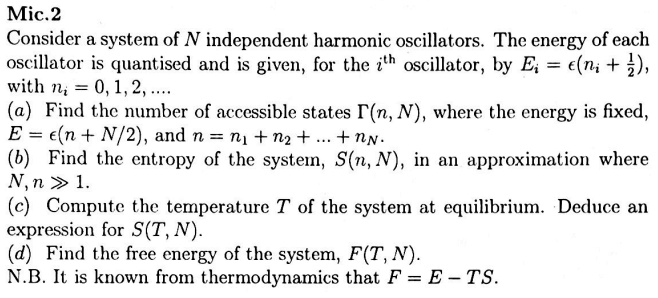
Mic.2 Consider a system of N independent harmonic oscillators. The energy of each oscillator is quantised and is given, for the $i^{th}$ oscillator, by $E_i = \epsilon(n_i + \frac{1}{2})$, with $n_i = 0, 1, 2, ...$ (a) Find the number of accessible states $\Gamma(n, N)$, where the energy is fixed, $E = \epsilon(n + N/2)$, and $n = n_1 + n_2 + ... + n_N$. (b) Find the entropy of the system, $S(n, N)$, in an approximation where $N, n \gg 1$. (c) Compute the temperature T of the system at equilibrium. Deduce an expression for $S(T, N)$. (d) Find the free energy of the system, $F(T, N)$. N.B. It is known from thermodynamics that $F = E - TS$.
View Answer
divider