Ace - AI Tutor
Ask Our Educators
Textbooks
My Library
Flashcards
Scribe - AI Notes
Notes & Exams
Download App
kristy ward

kristy w.

Divider

Questions asked

BEST MATCH

Bacteria have a larger fraction of protein-coding genes, relative to the size of their genome, than do eukaryotes

View Answer
divider
BEST MATCH

When a measurement is different each time and not close to the actual value it is highly accurate but not precise highly precise but not accurate highly precise and accurate neither precise nor accurate.

View Answer
divider
BEST MATCH

find the number of solutions of x1+x2+x3 = 6 where x1, x2, x3 are integers with x1 greater than or equal to 3, x2 greater than equal to 1 and smaller than equal to 3, x3 greater than equal to 2, and smaller than equal to 5

View Answer
divider
BEST MATCH

Respiratory volumes are the amounts of air that flow into or out of the lungs during a specific pulmonary event such as normal breathing. Respiratory capacities, by contrast, are the sum of two or more respiratory volumes. Thus, respiratory volumes can be measured, whereas respiratory capacities are calculated. Match the definitions below with the correct terms. Definition 1 - total volume of air in the lungs after a maximum inspiration. It is the sum of vital capacity and residual volume. Definition 2 - volume of air in the lungs at the end of a normal expiration. It is the sum of residual volume and expiratory reserve volume. Definition 3 - maximum volume of air that can be inspired after a normal inspiration. Definition 4 - volume of air that remains in the lungs after a maximum expiration. Definition 5 - maximum volume of air that can be inspired after a normal expiration. It is the sum of tidal volume and inspiratory reserve volume. Definition 6 - volume of air inspired or expired during a single breathing cycle under resting conditions. Definition 7 - maximum volume of air that can be expired after a maximum inspiration. It is equal to the sum of inspiratory reserve volume, tidal volume, and expiratory reserve volume. Definition 8 - maximum volume of air that can be expired after a normal expiration. Respiratory volumes are the amounts of air that flow into or out of the lungs during a specific pulmonary event such as normal breathing.Respiratory capacities,by contrast,are the sum of two or more respiratory volumes. Thus, respiratory volumes can be measured, whereas respiratory capacities are calculated. Match the definitions below with the correct terms. Definition 1 - total volume of air in the lungs after a maximum inspiration. It is the sum of vital capacity and residual volume. Definition 2 - volume of air in the lungs at the end of a normal expiration. It is the sum of residual volume and expiratory reserve volume. 22 Definition 3 - maximum volume of air that can be inspired after a normal inspiration Definition 4 - volume of air that remains in the lungs after a maximum expiration. Definition 5 - maximum volume of air that can be inspired after a normal expiration. It is the sum of tidal volume and inspiratory reserve volume. Definition 6 - volume of air inspired or expired during a single breathing cycle under resting conditions. Definition 7-maximum volume of air that can be expired after a maximum inspiration.It is equal to the sum of inspiratory reserve volume, tidal volume, and expiratory reserve volume. Definition 8-maximum volume of air that can be expired after a normal expiration.

View Answer
divider
BEST MATCH

According to Robert Sapolsky, where is the first place in the brain you should look if you are interested in appalling behavior? The basal ganglia The thalamus The hippocampus The frontal cortex The amygdala

View Answer
divider
BEST MATCH

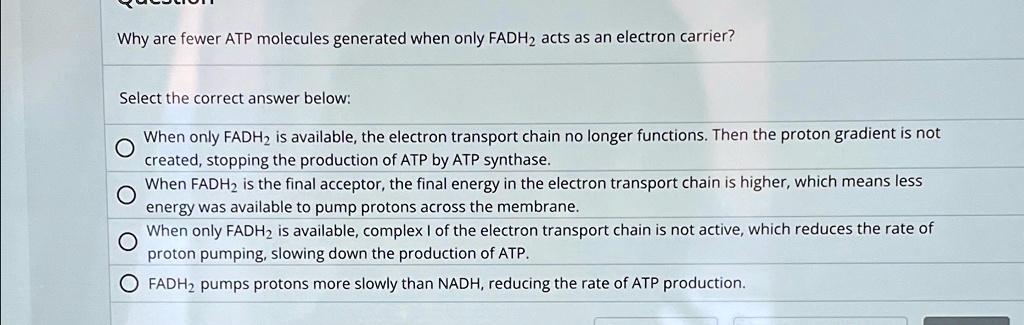
Why are fewer ATP molecules generated when only FADH_(2) acts as an electron carrier? Select the correct answer below: When only FADH_(2) is available, the electron transport chain no longer functions. Then the proton gradient is not created, stopping the production of ATP by ATP synthase. When FADH_(2) is the final acceptor, the final energy in the electron transport chain is higher, which means less energy was available to pump protons across the membrane. When only FADH_(2) is available, complex I of the electron transport chain is not active, which reduces the rate of proton pumping, slowing down the production of ATP. FADH_(2) pumps protons more slowly than NADH, reducing the rate of ATP production. Why are fewer ATP molecules generated when only FADH2 acts as an electron carrier? Select the correct answer below: When only FADH is available, the electron transport chain no longer functions.Then the proton gradient is not created,stopping the production of ATP by ATP synthase When FADH is the final acceptor,the final energy in the electron transport chain is higher,which means less energy was available to pump protons across the membrane When only FADH is available, complex I of the electron transport chain is not active, which reduces the rate of proton pumping.slowing down the production of ATP. FADH2 pumps protons more slowly than NADH, reducing the rate of ATP production.
View Answer
divider
BEST MATCH

Ongesnon 48 After a cardiac catheterization, the client complains of tingling sensations in the affected leg. The nurse should first: - Assess for bleeding at the catheter insertion site - Evaluate the affected leg for signs of infection - Compare femoral, popliteal, and pedal pulses in both legs.

View Answer
divider
BEST MATCH

A beam having the cross section shown is subjected to a vertical shear $V$. Determine (a) the horizontal line along which the shearing stress is maximum, (b) the constant $k$ in the following expression for the maximum shearing stress $\tau_{max} = k \frac{V}{A}$ where $A$ is the cross-sectional area of the beam.

View Answer
divider
BEST MATCH

A load P is applied horizontally while the other end is fixed to a structure. Top view Side view 40 mm 60 mm 50 mm P P where P = 215 N In previous problems we have already examined the axial stresses inside the plates. In this problem, the bolted connections will be analyzed. Failure means that the pieces come apart because the bolts cannot hold the force. How can you change the assembly to prevent bolt failure? [Select]

View Answer
divider
BEST MATCH

Question 2 (a) A unity feedback system has the following characteristic equation: $\Delta(s) = s^4 + 22s^3 + 10s^2 + 2s + K$ (i) List the characteristics of a stable system in terms of the output (in response to a bounded input) and also the location of the roots of the characteristic equation in the s-plane. [3 marks] (ii) Identify the range of K for the system to be stable using the Routh-Hurwitz criterion. [5 marks] (iii) If the value of K is chosen such that the system is marginally stable, determine the exact location of the roots on the imaginary axis in the s- plane. [2 marks] (b) A system with a forward transfer function $G(s) = \frac{K}{s^2 + 15s + 36}$ and negative unity feedback is to be designed to have critical damping. Find the value of K to meet the specification and determine the steady-state error, $e_{ss}$ for a unit step input. [3 marks] (c) A negative feedback system has a loop transfer function given by $G(s)H(s) = \frac{K(s^2 - 3s + 5)}{(s + 1)(s + 3)}$ Sketch the root locus of the system and hence determine the range of K for stability. [12 marks]

View Answer
divider