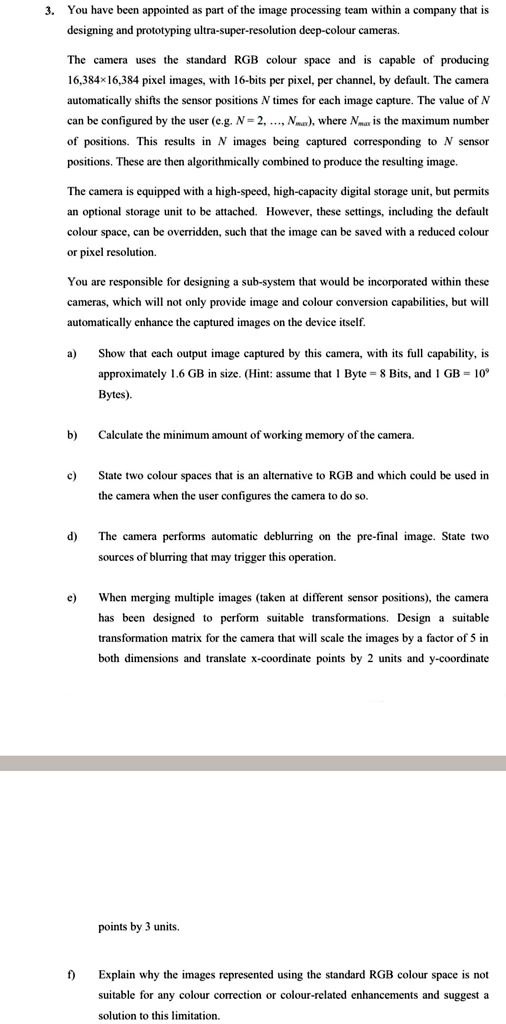
You have been appointed as part of the image processing team within a company that is designing and prototyping ultra-super-resolution deep-colour cameras.
The camera uses the standard RGB colour space and is capable of producing 16,384 imes 16,384 pixel images, with 16 -bits per pixel, per channel, by default. The camera automatically shifts the sensor positions N times for each image capture. The value of N can be configured by the user (e.g. N=2,dots,N_(max) ), where N_(max) is the maximum number of positions. This results in N images being captured corresponding to N sensor positions. These are then algorithmically combined to produce the resulting image.
The camera is equipped with a high-speed, high-capacity digital storage unit, but permits an optional storage unit to be attached. However, these settings, including the default colour space, can be overridden, such that the image can be saved with a reduced colour or pixel resolution.
You are responsible for designing a sub-system that would be incorporated within these cameras, which will not only provide image and colour conversion capabilities, but will automatically enhance the captured images on the device itself.
a) Show that each output image captured by this camera, with its full capability, is approximately 1.6GB in size. (Hint: assume that 1Byte=8Bits, and 1GB=10^(9) Bytes).
b) Calculate the minimum amount of working memory of the camera.
c) State two colour spaces that is an alternative to RGB and which could be used in the camera when the user configures the camera to do so.
d) The camera performs automatic deblurring on the pre-final image. State two sources of blurring that may trigger this operation.
e) When merging multiple images (taken at different sensor positions), the camera has been designed to perform suitable transformations. Design a suitable transformation matrix for the camera that will scale the images by a factor of 5 in both dimensions and translate x-coordinate points by 2 units and y-coordinate
points by 3 units.
f) Explain why the images represented using the standard RGB colour space is not suitable for any colour correction or colour-related enhancements and suggest a solution to this limitation.
3. You have been appointed as part of the image processing team within a company that is
designing and prototyping ultra-super-resolution deep-colour cameras.
The camera uses the standard RGB colour space and is capable of producing 16,38416,384 pixel images, with 16-bits per pixel, per channel, by default. The camera automatically shifts the sensor positions N times for each image capture. The value of N can be configured by the user (e.g. N = 2, .., Nm.), where Nm is the maximum number of positions. This results in N images being captured corresponding to N sensor positions. These are then algorithmically combined to produce the resulting image.
The camera is equipped with a high-speed, high-capacity digital storage unit, but permits
an optional storage unit to be attached. However, these settings, including the default
colour space, can be overridden, such that the image can be saved with a reduced colour
or pixel resolution.
You are responsible for designing a sub-system that would be incorporated within these cameras, which will not only provide image and colour conversion capabilities, but will automatically enhance the captured images on the device itself.
a)
Show that each output image captured by this camera, with its full capability, is approximately 1.6 GB in size. (Hint: assume that 1 Byte = 8 Bits, and 1 GB = 103 Bytes).
b)
Calculate the minimum amount of working memory of the camera.
c)
State two colour spaces that is an alternative to RGB and which could be used in
the camera when the user configures the camera to do so.
(p
The camera performs automatic deblurring on the pre-final image. State two sources of blurring that may trigger this operation.
e)
When merging multiple images (taken at different sensor positions), the camera has been designed to perform suitable transformations. Design a suitable transformation matrix for the camera that will scale the images by a factor of 5 in both dimensions and translate x-coordinate points by 2 units and y-coordinate
points by 3 units.
f)
Explain why the images represented using the standard RGB colour space is not
suitable for any colour correction or colour-related enhancements and suggest a solution to this limitation.