Ace - AI Tutor
Ask Our Educators
Textbooks
My Library
Flashcards
Scribe - AI Notes
Notes & Exams
Download App
larry sanchez

larry s.

Divider

Questions asked

BEST MATCH

Correct answers are hidden. Score for this quiz: 5.17 out of 16 Submitted Oct 1 at 9:01pm Partial pt took 27 minutes. Question 1 0.5 / 1 pts ScLI-1. Identify peer-reviewed and non-peer reviewed literature The following are excerpts from real articles about ovarian cancer. Classify them as peer-reviewed or non-peer reviewed based on their content: Article 1: Title: Ovarian Cancer Author: Mayo Clinic staff "Ovarian cancer is a growth of cells that forms in the ovaries. The cells multiply quickly and can invade and destroy healthy body tissue. The female reproductive system contains two ovaries, one on each side of the uterus. The ovaries — each about the size of an almond — produce eggs (ova) as well as the hormones estrogen and progesterone. Ovarian cancer treatment usually involves surgery and chemotherapy." Article 2 Comments Files (0) Rubric

View Answer
divider
BEST MATCH

Jackie has the following information to evaluate—her current salary of $74,000 versus total revenues of $100,000 and expenses of $65,000 from starting a new business. Required: How much is the opportunity cost associated with staying at her current job? $ .00

View Answer
divider
BEST MATCH

Q17: A metal plate is connected by a conductor to a ground through a switch. The switch is initially closed. A charge \( +Q \) is brought close to the plate without touching it, and then the switch is opened. After the switch is opened, the charge \( +Q \) is removed. What is the charge on the plate then?

View Answer
divider
BEST MATCH

(1 point) If $f(x, y) = \int_x^y \frac{5}{t} dt$, compute the following function values: f(3, 2) = f(6, 4) = f(9, 2) = f(2, 8) = f(3, 4) = f(1, z) = (assume z is positive)

View Answer
divider
BEST MATCH

Determine if the following statements are true or false. You do not need to show work or provide justification for this problem. (a) $\emptyset \in \{\emptyset\}$ (b) $\emptyset \in \{\emptyset, \{\emptyset\}\}$ (c) $\{\emptyset\} \in \{\emptyset\}$ (d) $\{\emptyset\} \in \{\{\emptyset\}\}$ (e) $\{\emptyset\} \in \{\emptyset, \{\emptyset\}\}$ (f) $\{\{\emptyset\}\} \subseteq \{\emptyset, \{\emptyset\}\}$ (g) $\{\{\emptyset\}\} \subseteq \{\{\emptyset\}, \emptyset\}$ (h) $\{\emptyset\} \subseteq \mathcal{P}(\emptyset)$

View Answer
divider
BEST MATCH

Texts: 6. A population of 50 mice was introduced into a field where there hadn't been any mice before. Even with predators, the population grew at 2% per month. a) Write an exponential model where p is the mice population and t is the time in months since the initial population was introduced to the field. b) Fill in this table to show the mouse population for the first few months: Number of Months | Mouse Population 0 | 50 1 | 2 | 3 | 4 | 5 | c) How many months does your model say it will take the population to reach 100? How about 200? Fill in the blanks. You can figure this out through trial and error, solve an equation with algebra, or use an online solver - it's up to you! Show or explain how you did it in the space below your answers. It will take ______ months from the initial introduction to reach 100 mice, and ______ months to reach 200 mice. d) The "Rule of 70" says that if a number grows at p% per time period, it will take about 70/p time periods to double. For example, an amount that grows at 5% per year should take about 70/5 = 14 years to double, an amount that grows at 10% per year should take about 70/10 = 7 years to double. Explain how your results in the previous exercise part demonstrate that the "Rule of 70" was followed by the mouse population.

View Answer
divider
BEST MATCH

Q3 APPLICATION (PROBLEM SOLVING) (1 X 25 marks = 25marks) Use superposition to find the steady state current given the values of the following: $R_1 = 30k\Omega$, $R_2 = 60 k\Omega$, $L_1 = 150mH$, $L_2 = 2500mH$, $C_1 = 70\mu F$, connected in series with $V_{s1} = 50 \cos(40000t + 60^\circ)$, $V_{s2} = 25\cos(50000t - 30^\circ)$, $V_{s3} = 40 \cos(30000t + 50^\circ)$. Draw the equivalent circuit diagram for each condition and show the appropriate labels (say $I_1$, $I_1'$, $I_1''$). Find also the total current.

View Answer
divider
BEST MATCH

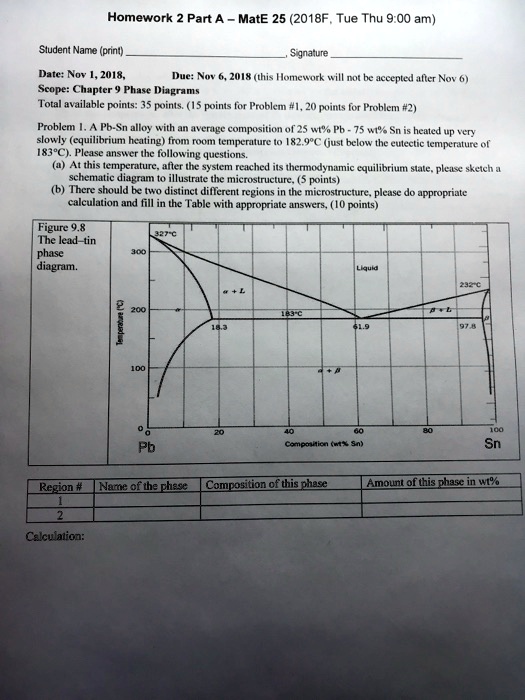
Homework 2 Part A - MatE 25 (2018F, Tue Thu 9:00 am) Student Name (print)____Signature_____ Date: Nov 1, 2018, Due: Nov 6, 2018 (this Homework will not be accepted after Nov 6) Scope: Chapter 9 Phase Diagrams Total available points: 35 points. (15 points for Problem #1, 20 points for Problem #2) Problem 1. A Pb-Sn alloy with an average composition of 25 wt% Pb - 75 wt% Sn is heated up very slowly (equilibrium heating) from room temperature to 182.9°C (just below the eutectic temperature of 183°C). Please answer the following questions. (a) At this temperature, after the system reached its thermodynamic equilibrium state, please sketch a schematic diagram to illustrate the microstructure, (5 points) (b) There should be two distinct different regions in the microstructure, please do appropriate calculation and fill in the Table with appropriate answers, (10 points) Figure 9.8 The lead-tin phase diagram. 327°C 300 Liquid 232°C Temperature (°C) 200 18.3 100 $\alpha + L$ 183°C 61.9 97.8 0 20 40 60 80 100 Pb Composition (wt% Sn) Sn Region # Name of the phase Composition of this phase Amount of this phase in wt% 1 2 Calculation:
View Answer
divider
BEST MATCH

b) Optical transition rate between the conduction and the valence bands in an LED is given by: $W = \frac{q^2 n_e n_h}{3m^* \epsilon_0 \omega}$ Discuss how the transition rate varies if the temperature is increased? c) The I-V characteristic of a silicon p-n junction solar cell at T = 300K is depicted in the Figure below. i) How is the fill-factor (FF) extracted from this characteristic? ii) Discuss, with mathematical reasoning, what happens to the curve and the fill factor if doping density of the cell is increased significantly (let's say by two orders of magnitude)? Q3. (12 + 16 + 7 = 35 points) (a) The C-V characteristic of an MOS structure is shown here. (i) Calculate the oxide thickness and the threshold voltage. (ii) Why does capacitance gradually decrease in the inversion region of operation? $q = 1.6 \times 10^{-19} C$, $\epsilon_s = 8.85 \times 10^{-14} F/cm$, and $K_{ox} = 3.9.$

View Answer
divider
BEST MATCH

Use the worked example above to help you solve this problem. Find $I_1$, $I_2$, and $I_3$ in figure a, where $\mathcal{E} = 11$ V. $I_1 = $____ A $I_2 = $____ A $I_3 = $____ A Find the three currents in figure b, where $R = 2.7 \Omega$. (Note that the direction of one current may have been chosen wrongly!) $I_1 = $____ A $I_2 = $____ A $I_3 = $____ A

View Answer
divider