1) (2 pt) Why does it make biochemical sense that protein phosphorylation in liver upregulates FBPase-2 and downregulates PFK-2. (When does protein phosphorylation increase in liver? In terms of liver's role in the body, what is the result of FBPase-2 upregulation?)
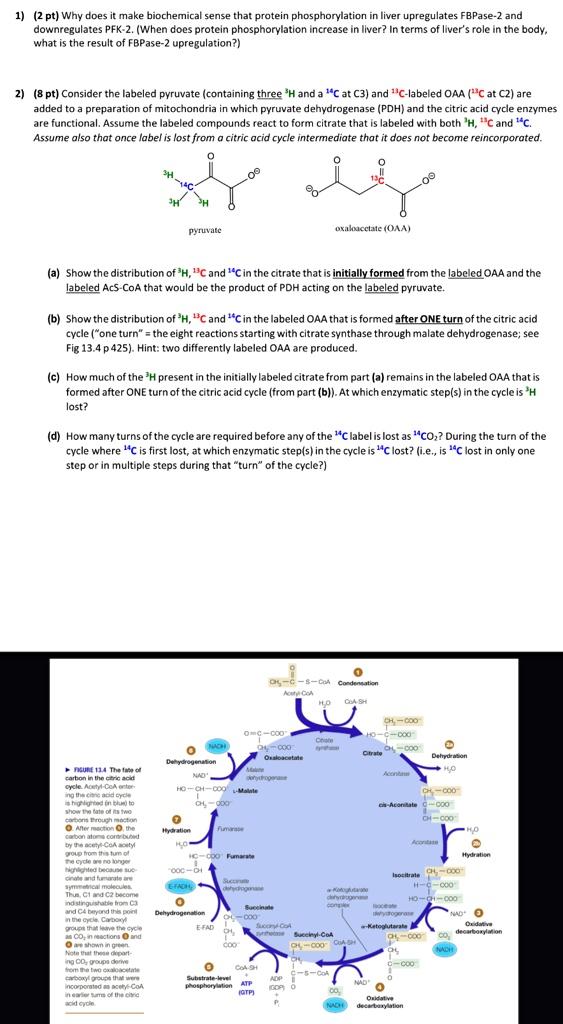
2) (8 pt) Consider the labeled pyruvate (containing three H and a 14C at C3) and 13C-labeled OAA (13C at C2) are added to a preparation of mitochondria in which pyruvate dehydrogenase (PDH) and the citric acid cycle enzymes are functional. Assume the labeled compounds react to form citrate that is labeled with both H, 13C, and 14C. Assume also that once label is lost from a citric acid cycle intermediate that it does not become reincorporated.
pyruvate
oxaloacetate (OAA)
(a) Show the distribution of 3H, 13C, and 14C in the citrate that is initially formed from the labeled OAA and the labeled AcS-CoA that would be the product of PDH acting on the labeled pyruvate.
(b) Show the distribution of 3H, 13C, and 14C in the labeled OAA that is formed after ONE turn of the citric acid cycle ("one turn" = the eight reactions starting with citrate synthase through malate dehydrogenase; see Fig 13.4 p 425). Hint: two differently labeled OAA are produced.
(c) How much of the H present in the initially labeled citrate from part (a) remains in the labeled OAA that is formed after ONE turn of the citric acid cycle (from part (b)). At which enzymatic step(s) in the cycle is H lost?
(d) How many turns of the cycle are required before any of the C label is lost as 14CO2? During the turn of the cycle where 14C is first lost, at which enzymatic step(s) in the cycle is 14C lost? (i.e., is 14C lost in only one step or in multiple steps during that "turn" of the cycle?)