Ace - AI Tutor
Ask Our Educators
Textbooks
My Library
Flashcards
Scribe - AI Notes
Notes & Exams
Download App
linda arribas

linda a.

Divider

Questions asked

BEST MATCH

Coukd you further elaborate in depth why the reduction in force at faster speeds is smaller in the eccentric phse due to elongation of myofilaments? And how why do viscoelastic properties produce higher forces with greater velocities? "Faster lengthening velocities cause attached actin-myosin crossbridges to detach more quickly, and this reduces the active force exerted at faster speeds. This reduction in force at faster speeds is probably smaller than in the lifting (concentric) phase, because of the elongation of myofilaments that occurs when fibers are stretched.However, passive forces are also produced during fiber lengthening, by titin and other structural elements inside the muscle fiber. These passive elements have viscoelastic properties, which means that the forces they produce are higher at faster lengthening velocities.These increasing passive forces compensate for the reduced active forces, as fiber lengthening speed increases. This is why the force-velocity relationship of eccentric contractions is flatter than the force-velocity relationship for concentric contractions."

View Answer
divider
BEST MATCH

Solve by substitution. \[ \left\{\begin{aligned} -12 x+9 y & =-6 \\ x+25 & =5 y \end{aligned}\right. \]

View Answer
divider
BEST MATCH

Dickinson defines poetry as “the music of the soul.” True False

View Answer
divider
BEST MATCH

1. Compute the vectors a × b, b × c and c · (a × b) for the vectors X a = (1,3,4), b = (2, -5,6).

View Answer
divider
BEST MATCH

Suppose gx is given by the following graph. y 1.0 0.5 -0.5 1.0 -1.5 -2.0 Compute each of the following values gxdx= (b xpx c) 9xax=

View Answer
divider
BEST MATCH

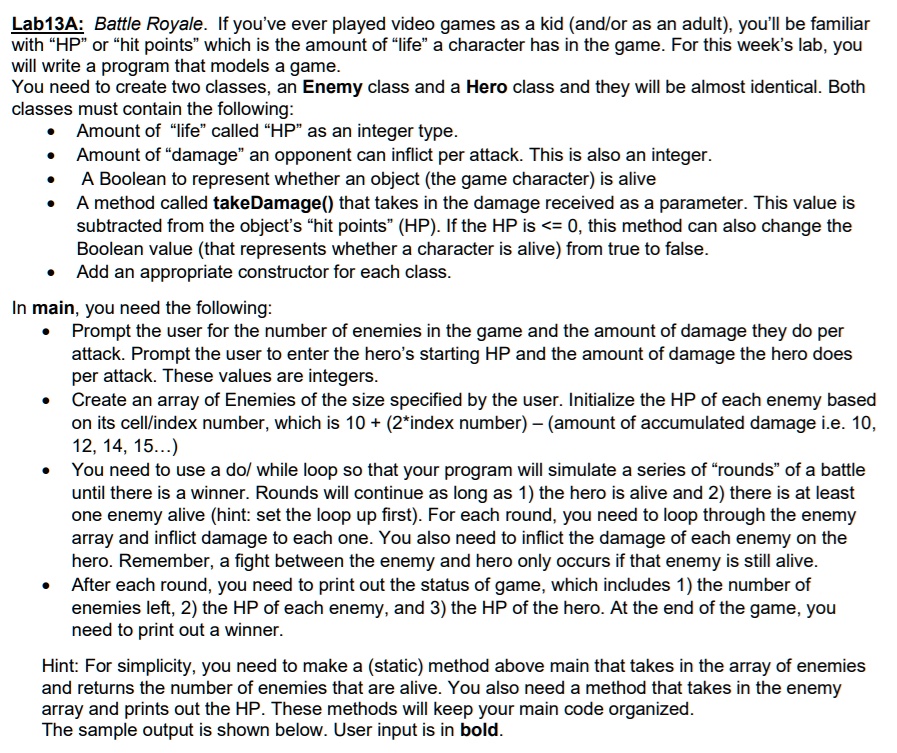
Lab 13A: Battle Royale. If you've ever played video games as a kid (and/or as an adult), you'll be familiar with "HP" or "hit points," which is the amount of "life" a character has in the game. For this week's lab, you will write a program that models a game. You need to create two classes, an Enemy class and a Hero class, and they will be almost identical. Both classes must contain the following: - Amount of "life" called "HP" as an integer type - A Boolean to represent whether an object (the game character) is alive - A method called takeDamage that takes in the damage received as a parameter. This value is subtracted from the object's "hit points" (HP). If the HP is <= 0, this method can also change the Boolean value (that represents whether a character is alive) from true to false. - Add an appropriate constructor for each class. In main, you need the following: - Prompt the user for the number of enemies in the game and the amount of damage they do per attack. - Prompt the user to enter the hero's starting HP and the amount of damage the hero does per attack. These values are integers. - Create an array of Enemies of the size specified by the user. Initialize the HP of each enemy based on its cell/index number, which is 10 + (2 * index number) - (amount of accumulated damage i.e. 10, 12, 14, 15...). - You need to use a do/while loop so that your program will simulate a series of "rounds" of a battle until there is a winner. Rounds will continue as long as 1) the hero is alive and 2) there is at least one enemy alive (hint: set the loop up first). - For each round, you need to loop through the enemy array and inflict damage to each one. You also need to inflict the damage of each enemy on the hero. Remember, a fight between the enemy and hero only occurs if that enemy is still alive. - After each round, you need to print out the status of the game, which includes 1) the number of enemies left, 2) the HP of each enemy, and 3) the HP of the hero. - At the end of the game, you need to print out a winner. Hint: For simplicity, you need to make a (static) method above main that takes in the array of enemies and returns the number of enemies that are alive. You also need a method that takes in the enemy array and prints out the HP. These methods will keep your main code organized. The sample output is shown below. User input is in bold.
View Answer
divider
BEST MATCH

Problem #1 The 4.0 inches stroke of a pneumatic cylinder which has a cross sectional area of 10.0 square inches is filled by air at standard pressure. The air inside the cylinder is compressed by a piston to 28.0 psi at constant temperature. Find the volume of the air inside the cylinder. Problem #2 A 30 cubic inches volume of air at temperature of 78 degree F is expanded at constant pressure until the temperature increases to 200 degree F. Find the new volume of the gas. Problem # 3 A gas occupying a volume of 200 cubic inches at 68 degree F and standard pressure is expanded to a new volume of 300 cubic inches. The pressure is then found to be half of the atmospheric pressure. What is the final temperature of the air? Problem #4 Gas at 1000. psig and 100 degree F is contain in the 2000 cubic inches cylinder. A piston compresses the volume to 1500 cubic inches, While the gas is heated to 200 degree F. What is the final pressure in the cylinder.

View Answer
divider
BEST MATCH

1. A student determined the molar absorptivity (?) to be 4800 L/mol.cm for the thiocyanatoiron (III) ion. What is the % T for a solution that is 1.2 x 10?? M in thiocyanatoiron (III) ion? The path length for the light is 1.00 cm? 2. At a given temperature, the K$_{eq}$ for the systems studied in this experiment is 1.4 x 10². Suppose 100.0 mL of 2.00 x 10?³ M KSCN was mixed with 100.0 mL of 2.00 x 10?³ M Fe(NO?)?. Calculate the equilibrium molar concentration of thiocyanatoiron (III) ion? Show complete calculations.

View Answer
divider
BEST MATCH

1. If the vectors \( \vec{a} = (k, 3, 2) \) and \( \vec{b} = (-3, 2, k) \) are perpendicular, determine the value of k

View Answer
divider
BEST MATCH

Which of the following situations will result in the auditors concluding that the risk of material misstatement is too high when using nonstatistical sampling for substantive tests? a) The projected misstatement exceeds the tolerable misstatement. b) The allowance for sampling risk exceeds the projected misstatement. c) The risk of incorrect acceptance exceeds the risk of incorrect rejection. d) The tolerable misstatement exceeds the sample net misstatement.

View Answer
divider