Questions asked
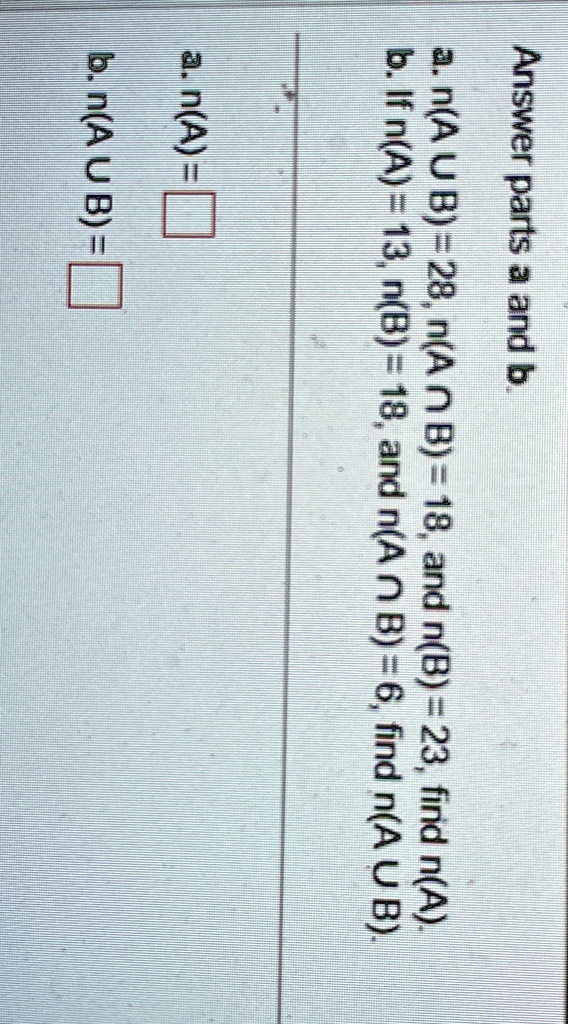
Answer parts a and b. a. n(A U B) = 28, n(A ∩ B) = 18, and n(B) = 23, find n(A). b. If n(A) = 13, n(B) = 18, and n(A ∩ B) = 6, find n(AUB). a. n(A) = b. n(AUB) =
If you are potty training a child and you give them a piece of candy every time they go pee on the potty, this is an example of operant conditioning. Question 2 options: TrueFalse
Suppose (Pc/Pf) is lower in India as compared to the US. Thus, relatively worker in ______ industry in India will be ______ than a worker in the same industry in the US. none of the available choices are correct. food; more clothing; more clothing; less.
On a residential street, a camera takes pictures of any cars exceeding the speed limit by more than 5 miles per hour, and the license numbers are traced to mail speeding tickets to the car's owners. These speed-trap cameras can best be understood as creating a(n) positive and direct incentive. negative and direct incentive. positive and indirect incentive. • negative and indirect incentive.
TRUE or FALSE Most immigrants in the USA are unauthorized (i.e., "illegal") immigrants.
You are asked to examine a vaginal swab from an alleged sexual assault. The presumptive test for semen is positive, but microscopic examination reveals no presence of spermatozoa.
EXAMPLE 1 Determine if the parabola opens up or down, the coordinates of the vertex, and if the vertex is a maximum or minimum. a. $f(x) = -2x^2 - 4x + 6$
Economic evaluations are used to make systematic decisions concerning Question 8 options: the number of successful surgeries. the returns to scale. the market-clearing price. the allocation of resources.
Governing equation Assume that the flow is two-dimensional, and incompressible. The governing equations are as follows. $\frac{\partial u}{\partial x} + \frac{\partial v}{\partial y} = 0$ $\frac{\partial u}{\partial t} + u\frac{\partial u}{\partial x} + v\frac{\partial u}{\partial y} = -\frac{\partial P}{\partial x} + \nu \left(\frac{\partial^2 u}{\partial x^2} + \frac{\partial^2 u}{\partial y^2}\right)$ $\frac{\partial v}{\partial t} + u\frac{\partial v}{\partial x} + v\frac{\partial v}{\partial y} = -\frac{\partial P}{\partial y} + \nu \left(\frac{\partial^2 v}{\partial x^2} + \frac{\partial^2 v}{\partial y^2}\right)$ $\frac{\partial \theta}{\partial t} + u\frac{\partial \theta}{\partial x} + v\frac{\partial \theta}{\partial y} = \kappa \left(\frac{\partial^2 \theta}{\partial x^2} + \frac{\partial^2 \theta}{\partial y^2}\right)$ Here, $u$ and $v$ are the velocity components in the $x$ and $y$ directions, respectively. $P$ denotes the pressure. $\theta$ is the passive scalar. $\nu$ and $\kappa$ are kinematic viscosity and passive-scalar diffusion coefficients, respectively. The boundary conditions are as follows.
Solve: 3. Jillian is trying to figure out her projected Christmas bonus. She hasn't seen her bonus check yet but talked with a co-worker who makes $32,000 per year and got a $1500 bonus. The company always gives the same rate of bonus and has made it clear that the bonuses are all proportionate to the salary. She makes $47,000 per year. What would her bonus be?