Ace - AI Tutor
Ask Our Educators
Textbooks
My Library
Flashcards
Scribe - AI Notes
Notes & Exams
Download App
logan lynch

logan l.

Divider

Questions asked

BEST MATCH

Ben has $70 in his savings account. He plans to deposit $35 per week to build his account balance. a. Complete the following equation to represent the amount of money (A) Ben will have in his account after any number of weeks. Let x represent the number of weeks. A = b. Which of the following values could be the value of the variable in this context? 0 -5 18 3 c. Ben wants to use his savings to buy a computer for $770. Use your algebraic expression to determine the number of weeks it will take to buy the computer. weeks

View Answer
divider
BEST MATCH

+678pes /1600 Question 13 of 16 The amino acid asparagine is required by cancer cells to proliferate. ETreating patients with the enzyme asparaginase is sometimes used as a chemotherapy treatment. Asparaginase hydrolyzes asparagine సo aspartate and ammonia. The adjoining illustration shows the 5 Michaelis-Menten curves for two asparaginases from different Qsources, as well as the concentration of asparagine in the environment (indicated by the arrow). Which enzyme would make a better chemotherapeutic agent? ◻ asparaginase 1 ◻ asparaginase 2 ◻ Both enzymes would likely work equally well. ◻ It cannot be determined.

View Answer
divider
BEST MATCH

A plane wall of thickness 0.1 m and thermal conductivity 25 W/mK having uniform heat generation of 0.3 MW/m^3 is insulated on one side, while the other side is exposed to a fluid of 32 degree C. The convection heat transfer coefficient between the wall and the fluid is 300 W/m^2K. Determine the maximum temperature in the wall.

View Answer
divider
BEST MATCH

Sick role refers to the cultural-dependent ways that we communicate being unwell. the role that doctors take on to treat sick people. the development of chronic illness as a result of stress. the ways that infectious diseases are spread in a society.

View Answer
divider
BEST MATCH

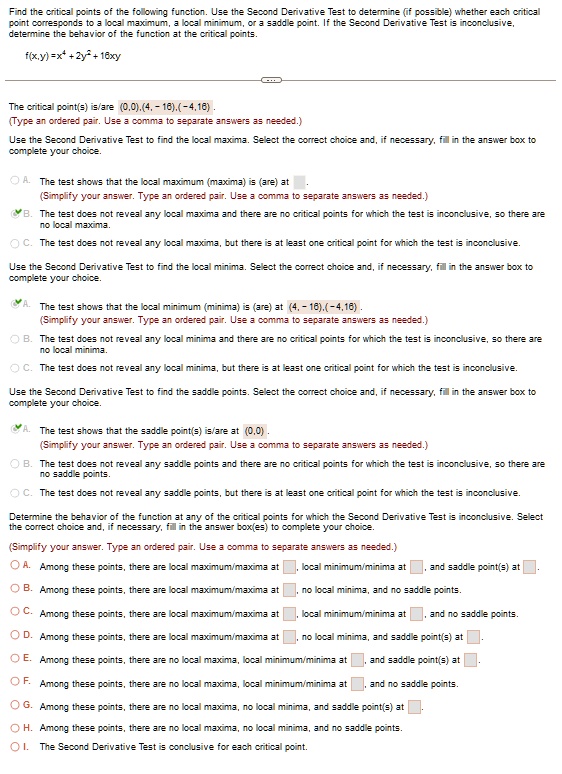
f(x,y)=x⁴+2y² + 16xy The critical point(s) is/are (0,0),(4,-16), (-4,16). (Type an ordered pair. Use a comma to separate answers as needed.) Use the Second Derivative Test to find the local maxima. Select the correct choice and, if necessary, fill in the answer box to complete your choice. A. The test shows that the local maximum (maxima) is (are) at (Simplify your answer. Type an ordered pair. Use a comma to separate answers as needed.) B. The test does not reveal any local maxima and there are no critical points for which the test is inconclusive, so there are no local maxima. OC. The test does not reveal any local maxima, but there is at least one critical point for which the test is inconclusive. Use the Second Derivative Test to find the local minima. Select the correct choice and, if necessary, fill in the answer box to complete your choice. A. The test shows that the local minimum (minima) is (are) at (4,-16), (-4,16). (Simplify your answer. Type an ordered pair. Use a comma to separate answers as needed.) OB. The test does not reveal any local minima and there are no critical points for which the test is inconclusive, so there are no local minima. OC. The test does not reveal any local minima, but there is at least one critical point for which the test is inconclusive. Use the Second Derivative Test to find the saddle points. Select the correct choice and, if necessary, fill in the answer box to complete your choice. A. The test shows that the saddle point(s) is/are at (0,0). (Simplify your answer. Type an ordered pair. Use a comma to separate answers as needed.) OB. The test does not reveal any saddle points and there are no critical points for which the test is inconclusive, so there are no saddle points. OC. The test does not reveal any saddle points, but there is at least one critical point for which the test is inconclusive. Determine the behavior of the function at any of the critical points for which the Second Derivative Test is inconclusive. Select the correct choice and, if necessary, fill in the answer box(es) to complete your choice. (Simplify your answer. Type an ordered pair. Use a comma to separate answers as needed.) A. Among these points, there are local maximum/maxima at local minimum/minima at and saddle point(s) at B. Among these points, there are local maximum/maxima at no local minima, and no saddle points. local minimum/minima at and no saddle points. no local minima, and saddle point(s) at OC. Among these points, there are local maximum/maxima at OD. Among these points, there are local maximum/maxima at E. Among these points, there are no local maxima, local minimum/minima at OF. Among these points, there are no local maxima, local minimum/minima at OG. Among these points, there are no local maxima, no local minima, and saddle OH. Among these points, there are no local maxima, no local minima, and no saddle points. 1. The Second Derivative Test is conclusive for each critical point. and saddle point(s) at and no saddle points. point(s) at
View Answer
divider
BEST MATCH

Price $40 of sweaters ($ per $32 sweter) $24 $16 $8 $0 0 1 2 3 4 5 6 Quantity of sweaters (sweaters per year) an individual supply curve for sweaters an individual demand curve for sweaters a market supply curve for sweaters a market demand curve for sweaters Need help on this question?

View Answer
divider
BEST MATCH

Consider the statement S: For every integer $n$, if $n^2 + 2n + 3$ is odd, then $n$ is even. (1) Write the contrapositive of the statement S. (2) Prove by contrapositive the statement S. Note: you can use n^2 etc in your typing if you wish.

View Answer
divider
BEST MATCH

The tiles below are pieces of a normal ECG tracing representing a little less than two heartbeats at a resting rate of 80 bpm. Arrange the tiles in their correct order. Drag and drop the images in the correct order of an ECG tracing.

View Answer
divider
BEST MATCH

\begin{pmatrix} 18 \\ 12 \end{pmatrix} \circ \begin{bmatrix} 4 & 7 \\ 15 & 18 \end{bmatrix}

View Answer
divider
BEST MATCH

3 a Find the value of 2 + \log 3. b Find the value of x when \log (x) = 1. c Find the value of x when \log (x) = 3.

View Answer
divider