Subjects of Interest
Organic…
Viewed Questions
Rank the compounds in each of the following series in order of increasing oxidation level: (FIGURE CANNOT COPY)
Match each of the following key terms (a-i) with its description below: Key: (a) alleles (b) autosomes (c) dominant allele (d) genotype (e) heterozygote (f) homozygote (g) phenotype (h) recessive allele (i) sex chromosomes _____(1) genetic makeup _____(2) how genetic makeup is expressed _____(3) chromosomes that dictate most body characteristics _____(4) alternate forms of the same gene _____(5) an individual bearing two alleles that are the same for a particular trait _____(6) an allele that is expressed whether in single or double dose _____(7) an individual bearing two alleles that differ for a particular trait _____(8) an allele that must be present in double dose to be expressed
A color-blind man marries a woman with normal vision. The woman's father was also color-blind. (a) What is the chance that their first child will be a color-blind son? A color-blind daughter? (b) If they have four children, what is the chance that two will be color-blind sons? (Be careful on this one.)
Compare and contrast amniocentesis and chorionic villus sampling as to the time at which they can be performed and the techniques used to obtain information on the fetus's genetic status.
Questions asked
Ronald Prasad
Numerade educator
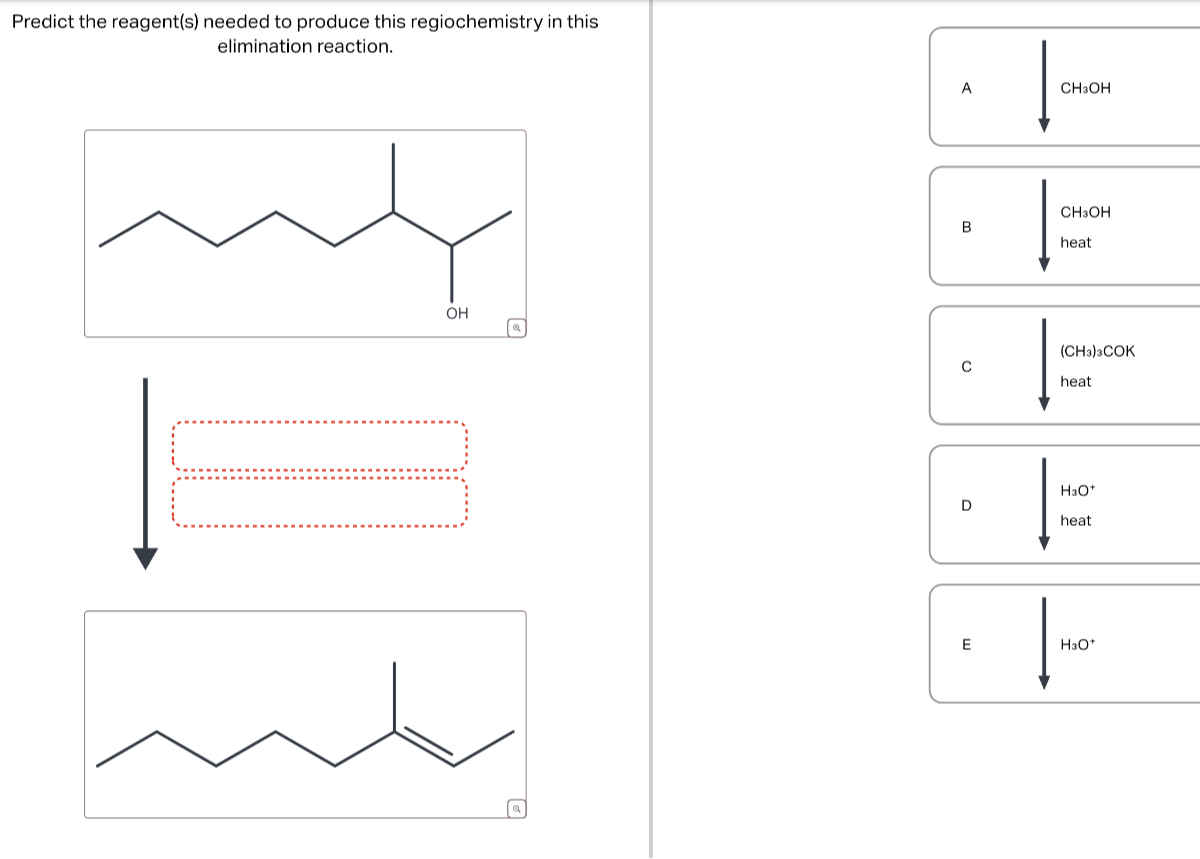
Predict the reagent(s) needed to produce this regiochemistry in this elimination reaction. A CH3OH B CH3OH, heat C (CH3)3COK, heat D H3O+, heat E H3O+
Ivan Kochetkov
Predict reagents needed to complete this E2 elimination reaction. Br A H3O+ heat B NaH heat C (CH3)3COK heat D CH3ONa E (CH3)3COH heat
The ratio of reactivity of tertiary:secondary:primary hydrogen atoms in a bromination reaction at 400 K is 1600:82:1. Using this information, calculate the percentage of 1-bromo-2methylpropane that would be expected in a monochlorination reaction of of 2-methylpropane. 1 \( \qquad \) (
In radical reactions, there are sometimes non-halogenated side products formed from other termination steps. Choose the possible side product of the reaction shown below? A I B II C III D IV
George Bennett
Curved arrows are used to illustrate the flow of electrons. Using the provided starting and product structures, draw the curved electron-pushing arrows for the dehydration of a ?-hydroxyester. Be sure to account for all bond-breaking and bond-making steps. dehydratase dehydratase
Draw the product of the reaction shown below. Ignore inorganic byproducts. + Pd(PPh3)4, Na2CO3 benzene
Lijeesh Krishnan
Draw all of the possible monochlorinated products resulting from the radical halogenation of 2-methylbutane. Ignore any inorganic byproducts. Ignore stereochemistry. Cl2 (1 eq) hv Draw a Monochlorinated Product + Draw a Monochlorinated Product + Draw a Monochlorinated Product + Draw a Monochlorinated Product
Shalini Tyagi
Curved arrows are used to illustrate the flow of electrons. Using the provided resonance structures, draw the curved electron-pushing arrows to show the interconversion between resonance hybrid contributors. Be sure to account for all bond-breaking and bond-making steps.
Q#28. Curved arrows are used to illustrate the flow of electrons. Using the provided resonance structures, draw the curved electron-pushing arrows to show the interconversion between resonance hybrid contributors. Be sure to account for all bond-breaking and bond- making steps.
Curved arrows are used to illustrate the flow of electrons. Use the reaction conditions provided and follow the curved arrows to draw the products of the following reaction. Include all lone pairs and charges as appropriate. Incorrect, 3 attempts remaining HBr