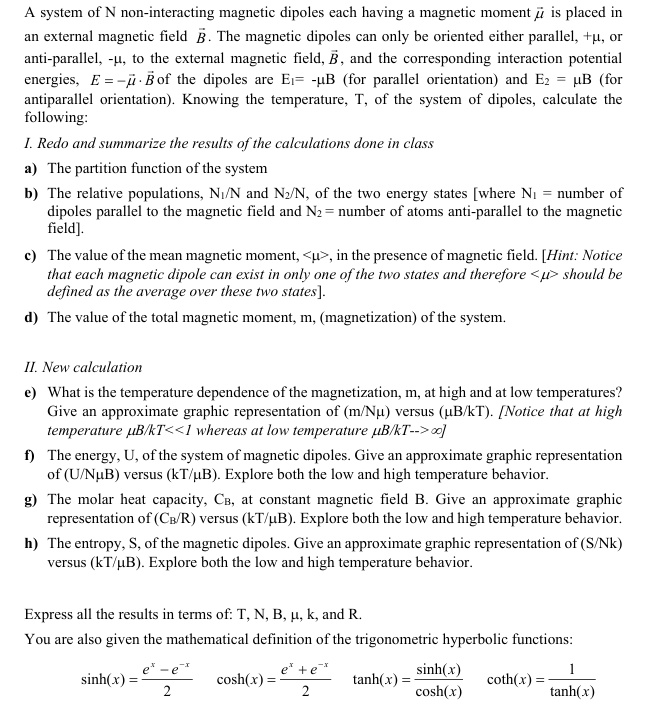
A system of N non-interacting magnetic dipoles each having a magnetic moment $\mu$ is placed in an external magnetic field $\vec{B}$. The magnetic dipoles can only be oriented either parallel, $+\mu$, or anti-parallel, $-\mu$, to the external magnetic field, $\vec{B}$, and the corresponding interaction potential energies, $E_i$, of the dipoles are $E_1 = -\mu B$ (for parallel orientation) and $E_2 = \mu B$ (for antiparallel orientation). Knowing the temperature, T, of the system of dipoles, calculate the following:
I. Redo and summarize the results of the calculations done in class
a) The partition function of the system
b) The relative populations, $N_1/N$ and $N_2/N$, of the two energy states [where $N_1$ = number of dipoles parallel to the magnetic field and $N_2$ = number of atoms anti-parallel to the magnetic field].
c) The value of the mean magnetic moment, $\langle\mu\rangle$, in the presence of magnetic field. [Hint: Notice that each magnetic dipole can exist in only one of the two states and therefore $\langle\mu\rangle$ should be defined as the average over these two states].
d) The value of the total magnetic moment, m, (magnetization) of the system.
II. New calculation
e) What is the temperature dependence of the magnetization, m, at high and at low temperatures? Give an approximate graphic representation of $(m/N\mu)$ versus $(\mu B/kT)$. [Notice that at high temperature $\mu B/kT << 1$ whereas at low temperature $\mu B/kT \to \infty$]
f) The energy, U, of the system of magnetic dipoles. Give an approximate graphic representation of $(U/N\mu B)$ versus $(kT/\mu B)$. Explore both the low and high temperature behavior.
g) The molar heat capacity, $C_B$, at constant magnetic field B. Give an approximate graphic representation of $(C_B/R)$ versus $(kT/\mu B)$. Explore both the low and high temperature behavior.
h) The entropy, S, of the magnetic dipoles. Give an approximate graphic representation of $(S/Nk)$ versus $(kT/\mu B)$. Explore both the low and high temperature behavior.
Express all the results in terms of: T, N, B, $\mu$, k, and R.
You are also given the mathematical definition of the trigonometric hyperbolic functions:
$\sinh(x) = \frac{e^x - e^{-x}}{2}$
$\cosh(x) = \frac{e^x + e^{-x}}{2}$
$\tanh(x) = \frac{\sinh(x)}{\cosh(x)}$
$\coth(x) = \frac{1}{\tanh(x)}$