Ace - AI Tutor
Ask Our Educators
Textbooks
My Library
Flashcards
Scribe - AI Notes
Notes & Exams
Download App
mackenzie stone

mackenzie s.

Divider

Questions asked

BEST MATCH

29. Show that if X is a random variable with the mean u for which f(x)=0 for x<0, then for any positive constant a

View Answer
divider
BEST MATCH

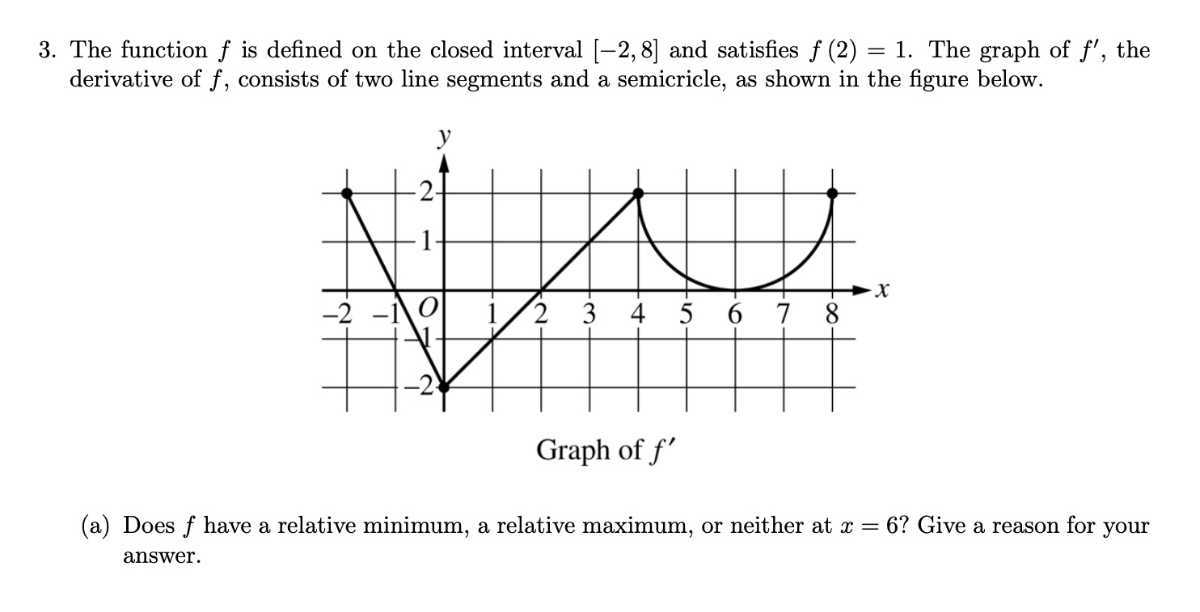
3. The function \( f \) is defined on the closed interval \( [-2,8] \) and satisfies \( f(2)=1 \). The graph of \( f^{\prime} \), the derivative of \( f \), consists of two line segments and a semicricle, as shown in the figure below. (a) Does \( f \) have a relative minimum, a relative maximum, or neither at \( x=6 \) ? Give a reason for your answer.
View Answer
divider
BEST MATCH

Question 24 24. Which theorist coined the term Symbolic Interactionism? Dubois Durkheim Blumer Marx

View Answer
divider
BEST MATCH

Use the graph below to answer the following questions. Price f 12 10 8 6 4 2 0 Demand curve Price Quantity 10 0 8 2 6 4 4 6 2 8 0 10 0 2 4 6 8 10 Quantity WWW.ECONOMICSHELP.ORG 5 pt Question 1 Use the space here to calculate the price elasticity of demand using the midpoint formula when the price falls from $8 to $6. Show your work and record your answer in the next question. Edit View Incert Format Tools Table

View Answer
divider
BEST MATCH

Use the References to access important values if needed for this question. When Fe3O4(s) reacts with H2(g) to form Fe(s) and H2O(g), 36.1 kcal of energy are absorbed for each mole of Fe3O4(s) that reacts. Write a balanced equation for the reaction with an energy term in kcal as part of the equation. Use the SMALLEST INTEGER coefficients possible and put the energy term in an appropriate box. If a box is not needed, leave it blank.

View Answer
divider
BEST MATCH

Perform a first derivative test on the function $f(x) = 2x^3 + 3x^2 - 36x + 9$; $[-3, 5]$. a. Locate the critical points of the given function. b. Use the First Derivative Test to locate the local maximum and minimum values. c. Identify the absolute maximum and minimum values of the function on the given interval (when they exist). a. Locate the critical points of the given function. Select the correct choice below and, if necessary, fill in the answer box within your choice. A. The critical point(s) is/are at $x = $ (Type an integer or a simplified fraction. Use a comma to separate answers as needed.) B. There are no critical points.

View Answer
divider
BEST MATCH

Figure 1: two-to-one MUX Four-to-One-line Multiplexer (8x1 MUX) An eight-to-one-line multiplexer is a combinational circuit where one of the four inputs is connected to one output. D0, D1, D2 and D3 are the four inputs. There are two select lines S0 and S1 to select input Experiment: 1) Build the two-to-one MUX circuit of figure 1. 2) Fill in the truth table (Table 1) Table 1 S Y

View Answer
divider
BEST MATCH

*1.36 A problem was posed as follows: The equation for the velocity of a fluid stream measured with a Pitot tube is $v = \sqrt{\frac{2\Delta p}{\rho}}$ where $v$ = velocity $\Delta p$ = pressure drop $\rho$ = density of fluid If the pressure drop is 15 mm Hg, and the density of the fluid is 1.20 g/cm³, calculate the velocity in ft/s. The solution given was $\frac{2}{1} \left| 15 \text{ mmHg} \times \frac{1.013 \times 10^5 \text{ Pa}}{760 \text{ mm Hg}} \times \frac{1 \text{ N}}{1 \text{ Pa}} \times \frac{10^3 (\text{g})(\text{cm})}{(1 \text{ N})(\text{s}^2)} \times \frac{(\text{cm}^2)}{1.20 \text{ g}} \times \left( \frac{1 \text{ m}}{100 \text{ cm}} \right)^2 \right|$ $= \left[ 33322.4 \frac{\text{cm}^2}{\text{s}^2} \right]^{1/2} = 182.5 \frac{\text{cm}}{\text{s}}$ Check that the answer is correct by (a) Repeating the calculations but carrying them out in reverse order starting with the answer. (b) Consolidating the units and making sure the final set of units are correct.

View Answer
divider
BEST MATCH

The loading on a floor beam used in the airplane is shown in (Figure 1). Suppose that $w = 31 \text{ lb/in}$. Use discontinuity functions and determine the reactions at the supports A and B.

View Answer
divider
BEST MATCH

5y^3z^4 e^t e(sin(t) + cos(t)) e^7t(2sin^5(t) + 5sin^4(t) + 3e^tsin^2(t)cos(t))(sin(t) + cos(t)) + 5e^t(cos^3(t)(sin^4(t)cos(t)) - sin^5(t)(cos(t) - sin(t))) cos^3(t)(sin^4(t)cos(t)sin(t)) v = x^2y^5 + yz^5, x = e, y = e*sin(t), z = e*cos(t)

View Answer
divider