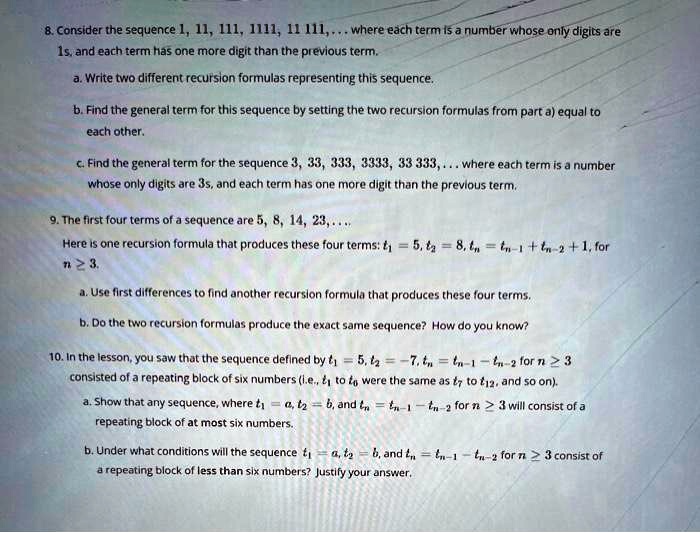
8. Consider the sequence 1, 11, 111, 1111, 11 111,... where each term is a number whose only digits are
1s, and each term has one more digit than the previous term.
a. Write two different recursion formulas representing this sequence.
b. Find the general term for this sequence by setting the two recursion formulas from part a) equal to
each other.
c. Find the general term for the sequence 3, 33, 333, 3333, 33 333,... where each term is a number
whose only digits are 3s, and each term has one more digit than the previous term.
9. The first four terms of a sequence are 5, 8, 14, 23,....
Here is one recursion formula that produces these four terms: $t_1 = 5$, $t_2 = 8$, $t_n = t_{n-1} + t_{n-2} + 1$, for
$n \ge 3$.
a. Use first differences to find another recursion formula that produces these four terms.
b. Do the two recursion formulas produce the exact same sequence? How do you know?
10. In the lesson, you saw that the sequence defined by $t_1 = 5$, $t_2 = 7$, $t_n = t_{n-1} - t_{n-2}$ for $n \ge 3$
consisted of a repeating block of six numbers (i.e., $t_1$ to $t_6$ were the same as $t_7$ to $t_{12}$, and so on).
a. Show that any sequence, where $t_1 = a$, $t_2 = b$, and $t_n = t_{n-1} - t_{n-2}$ for $n \ge 3$ will consist of a
repeating block of at most six numbers.
b. Under what conditions will the sequence $t_1 = a$, $t_2 = b$, and $t_n = t_{n-1} - t_{n-2}$ for $n \ge 3$ consist of
a repeating block of less than six numbers? Justify your answer.