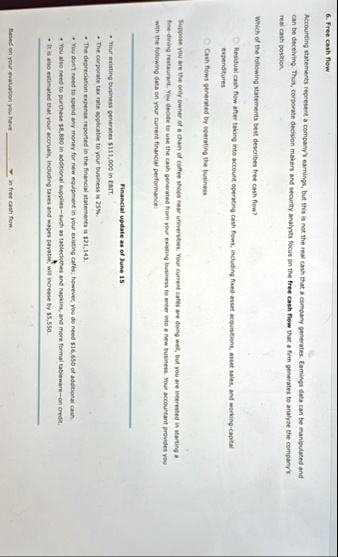
6. Free cash flow
Accounting statements represent a company's earnings, but this is not the real cash that a company generates. Earnings data can be manipulated and can be deceiving. Thus, corporate decision makers and security analysts focus on the free cash flow that a firm generates to analyze the company's real cash position.
Which of the following statements best describes free cash flow?
O Cash flows generated by operating the business
O Residual cash flow after taking into account operating cash flows, including fixed asset acquisitions, asset sales, and working-capital expenditures
Financial update as of June 15
Suppose you are the only owner of a chain of coffee shops near universities. Your current cafés are doing well, but you are interested in starting a fine-dining restaurant. You decide to use the cash generated from your existing business to enter into a new business. Your accountant provides you with the following data on your current financial performance:
• Your existing business generates $111,000 in EBIT.
• The corporate tax rate applicable to your business is 25%.
• The depreciation expense reported in the financial statements is $21,143.
• You don't need to spend any money for new equipment in your existing cafés; however, you do need $16,650 of additional cash.
• You also need to purchase $8,880 in additional supplies—such as tablecloths and napkins, and more formal tableware—on credit.
• It is also estimated that your accruals, including taxes and wages payable, will increase by $5,550.
Based on your evaluation you have
in free cash flow.