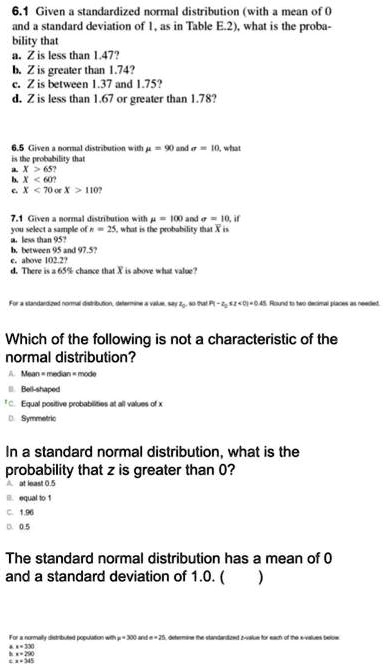
6.1 Given a standardized normal distribution (with a mean of 0 and a standard deviation of 1, as in Table E.2), what is the probability that
a. Z is less than 1.47?
b. Z is greater than 1.74?
c. Z is between 1.37 and 1.75?
d. Z is less than 1.67 or greater than 1.78?
6.5 Given a normal distribution with ? = 90 and ? = 10, what is the probability that
a. X > 65?
b. X < 60?
c. X < 70 or X > 110?
7.1 Given a normal distribution with ? = 100 and ? = 10, if you select a sample of n = 25, what is the probability that X is
a. less than 95?
b. between 95 and 97.5?
c. above 102.2?
d. There is a 65% chance that X is above what value?
For a standardized normal distribution, determine a value, say z0, so that P(- z0 ? z ? 0) = 0.45. Round to two decimal places as needed.
Which of the following is not a characteristic of the normal distribution?
A. Mean = median = mode
B. Bell-shaped
C. Equal positive probabilities at all values of x
D. Symmetric
In a standard normal distribution, what is the probability that z is greater than 0?
A. at least 0.5
B. equal to 1
C. 1.96
D. 0.5
The standard normal distribution has a mean of 0 and a standard deviation of 1.0. ( )
For a normally distributed population with ? = 300 and n = 25, determine the standardized z-value for each of the x-values below:
a. x = 330
b. x = 290
c. x = 345