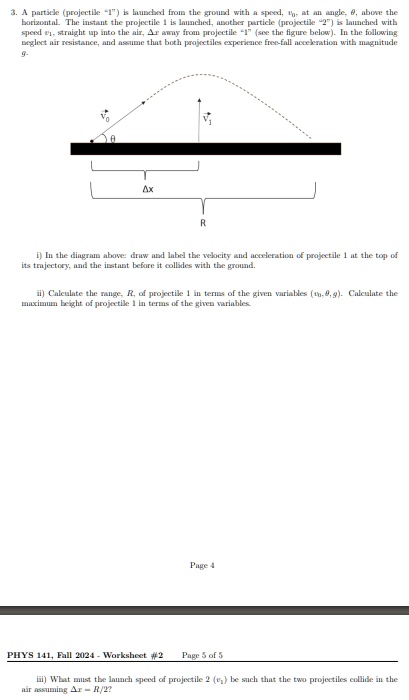
3. A particle (projectile "1") is launched from the ground with a speed, $v_0$, at an angle, $\theta$, above the
horizontal. The instant the projectile 1 is launched, another particle (projectile "2") is launched with
speed $v_1$, straight up into the air, $\Delta x$ away from projectile "1" (see the figure below). In the following
neglect air resistance, and assume that both projectiles experience free-fall acceleration with magnitude
g.
$v_0$
$\theta$
$\Delta x$
R
i) In the diagram above: draw and label the velocity and acceleration of projectile 1 at the top of
its trajectory, and the instant before it collides with the ground.
ii) Calculate the range, R, of projectile 1 in terms of the given variables ($v_0$, $\theta$, g). Calculate the
maximum height of projectile 1 in terms of the given variables.
Page 4
PHYS 141, Fall 2024 - Worksheet #2
Page 5 of 5
iii) What must the launch speed of projectile 2 ($v_1$) be such that the two projectiles collide in the
air assuming $\Delta x = R/2$?