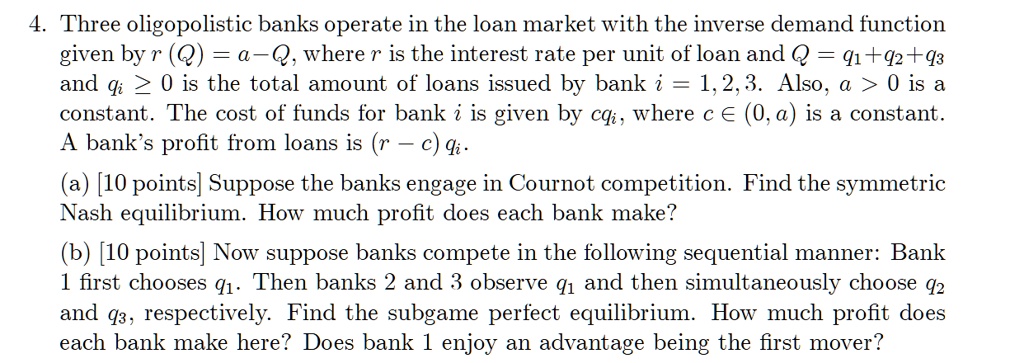
4. Three oligopolistic banks operate in the loan market with the inverse demand function given by $r(Q) = a - Q$, where $r$ is the interest rate per unit of loan and $Q = q_1 + q_2 + q_3$ and $q_i \ge 0$ is the total amount of loans issued by bank $i = 1, 2, 3$. Also, $a > 0$ is a constant. The cost of funds for bank $i$ is given by $cq_i$, where $c \in (0, a)$ is a constant. A bank's profit from loans is $(r - c)q_i$.
(a) [10 points] Suppose the banks engage in Cournot competition. Find the symmetric Nash equilibrium. How much profit does each bank make?
(b) [10 points] Now suppose banks compete in the following sequential manner: Bank 1 first chooses $q_1$. Then banks 2 and 3 observe $q_1$ and then simultaneously choose $q_2$ and $q_3$, respectively. Find the subgame perfect equilibrium. How much profit does each bank make here? Does bank 1 enjoy an advantage being the first mover?