Questions asked
6 2 points What one idea is considered Biology's unifying theme?
A B C D F E directed [Choose] weighted [Choose] connected [Choose] complete [Choose] cyclic [Choose]
Ethan is creating a college investment fund for his daughter. He will put in $24,000 per year for the next 13 years and expects to earn a 8% annual rate of return. How much money will his daughter have when she starts college? Use Appendix C to calculate the answer. Multiple Choice $503,854 $504,867 $516,607 $515,880
(dy)/(dx) = (y sin(xy))/(x sin(xy) - cos(y))
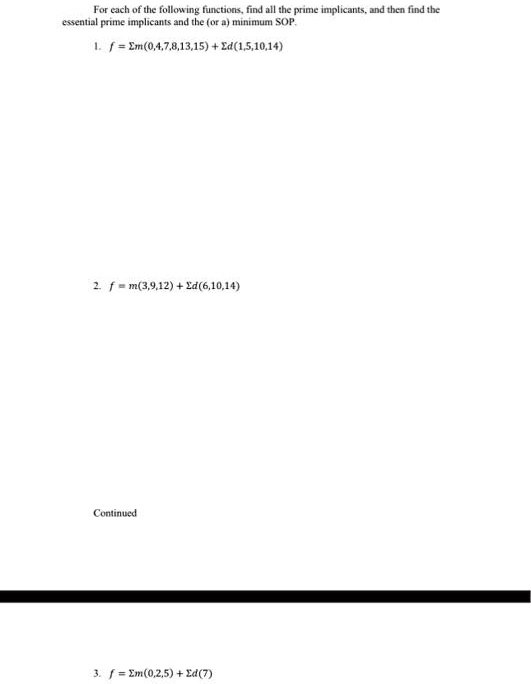
For each of the following functions, find all the prime implicants, and then find the essential prime implicants and the (or a) minimum SOP. 1. f = ?m(0,4,7,8,13,15) + ?d(1,5,10,14) 2. f = m(3,9,12) + ?d(6,10,14) Continued 3. f = ?m(0,2,5) + ?d(7)
8. Let G = (V, E) be a directed graph with n vertices and m edges. Let s be a vertex in V and w: E -> R be a weight function on the edges. Let d[v] be the length of the shortest path from s to v for all v ∈ V. Let d[v] = ∞ if there is no path from s to v. Let d[s] = 0. Let p[u] be the predecessor of v in the shortest path from s to v for all u ∈ V. Let p[u] = NIL if there is no path from s to v. Let p[s] = NIL. Let Q be a priority queue that stores the vertices of V and supports the following operations: - INSERT(Q, v): Inserts vertex v into Q. - DECREASE-KEY(Q, v, k): Decreases the key of vertex v to k. - EXTRACT-MIN(Q): Removes and returns the vertex with the minimum key from Q. - EMPTY(Q): Returns true if Q is empty, otherwise returns false. - CONTAINS(Q, v): Returns true if Q contains vertex v, otherwise returns false. - SIZE(Q): Returns the number of vertices in Q. - KEYS(Q): Returns the keys of all vertices in Q. - VERTICES(Q): Returns all vertices in Q. - BUILD-HEAP(Q): Builds a heap from the vertices in Q. - HEAPIFY(Q, i): Heapifies the subtree rooted at index i. - PARENT(i): Returns the index of the parent of the vertex at index i. - LEFT(i): Returns the index of the left child of the vertex at index i. - RIGHT(i): Returns the index of the right child of the vertex at index i. - SWAP(Q, i, j): Swaps the vertices at indices i and j. Give an algorithm that computes d[v] and p[v] for all v ∈ V using the above operations. Prove that your algorithm is correct and analyze its running time.
3. You are studying the pathway for nucleotide development in yeast. You perform a mutational screen that identifies a large number of mutants that are unable to synthesize the nucleotide uracil. You have already done complementation tests with these, and have identified 7 complementation groups. You are now interested in putting together a pathway for uracil biosynthesis. You have found several compounds which are in the URA pathway, and try to grow your mutants on them. OPRT CPSII DHO OMPDC ACT DHODH Ura1 + - + + - + Ura2 - - - - - - Ura3 + - + + + + Ura4 + + + + + + Ura5 - - + + - - Ura6 + - - + - + Ura7 + - - + - - Draw the Uracil biosynthesis pathway, including the compounds and the mutants. Ura4 Ura3 Ura1 Ura6 Ura7 Ura5 Ura2 $\rightarrow$CPSII$\rightarrow$ACT$\rightarrow$DHO$\rightarrow$DHODH$\rightarrow$OPRT$\rightarrow$OMPOC$\rightarrow$Growth! 4 You are studying col
Texts: Financial Management 3.1 How can marketing expenses be optimized to achieve the best return on investment (ROI)? 10 3.2 What are the key financial metrics and performance indicators that can be used to evaluate the effectiveness of marketing campaigns? 10 3.3 How can marketing budgets be allocated strategically to optimize revenue generation and profitability? 10 3.4 What are the financial considerations for pricing strategies in marketing, including factors such as cost of production, competition, and customer demand? 10 3.5 How can financial analysis and forecasting be utilized to assess the long-term financial impact of marketing decisions and initiatives, and support strategic planning and budgeting? 10
QUESTION 2 Which of the following models of leadership suggests the motivational function of the leader consists of increasing personal payoffs to organizational members by work attainment and reducing barriers in order employees to be more successful? Blake & Mouton's Managerial grid the Ohio States University Studies transformational leadership path-goal Fiedler's contingency model
Determine the current $i_1$ and $V_o$ in the given circuit: 10 A $i_1$ 10 ? $i_2$ 20 ? $i_3$ 30 ? 2 A 60 ? $V_o$ ? $i_1 = 4 A$ and $V_o = 40 V$ ? $i_1 = 5 A$ and $V_o = 50 V$ ? $i_1 = 3 A$ and $V_o = 30 V$ ? $i_1 = 4 A$ and $V_o = 50 V$