Ace - AI Tutor
Ask Our Educators
Textbooks
My Library
Flashcards
Scribe - AI Notes
Notes & Exams
Download App
melvin murray

melvin m.

Divider

Questions asked

BEST MATCH

Select all that apply The LIFO recapture tax: ☐ requires a C corporation to include a LIFO recapture amount in income the last year of C corporation status. ☐ is calculated based on a flat 15% tax rate. ☐ prevents former C corporations from avoiding built-in gains by using the LIFO method. ☐ is due in four annual instaliments, starting with the due date of the final C corporation return.

View Answer
divider
BEST MATCH

1. All digital systems manipulate data in Binary form. But reading long strings of 0s and ones pauses a challenge in the way we process the information. Hence its always convenient for us to convert to other Binary Code forms. 1.1.Carry out the following number conversions 1.1.1. 43758 = X9 F9.D16 = Y8 [4 Marks] 1.2.Carry out the following complement operations 1.2.1. 10s complement of 856.21 BCD code [2 Marks] 1.2.2. 2’s complement of a binary number 1011.012 [2 Marks] 1.3. Convert 10101 (Gray Code) to Binary code [2 Marks] 1.4. Encrypt this data stream {11001011} using even parity hamming code. [3 Marks] Give two advantages that a digital signal has over an analogue signal

View Answer
divider
BEST MATCH

Group cohesion is not multidimensional or dynamic. True False Group cohesion is not multidimensional or dynamic. True False

View Answer
divider
BEST MATCH

Question 20 10-year plans that are put out by the government that drives initiatives for key health objectives are_______ called 2 pts T A 1

View Answer
divider
BEST MATCH

Calculate the deceleration of a snow boarder going up a 3.7ΒΊ, slope assuming the coefficient of friction for waxed wood on wet snow is 0.14 and 0.1 for static and kinetic coefficients, respectively.

View Answer
divider
BEST MATCH

Elfalan Corporation produces a single product. The cost of producing and selling a single unit of this product at the company's normal activity level of 56,000 units per month is as follows: Direct materials $ 50.60 Direct labor $ 9.70 Variable manufacturing overhead $ 2.70 Fixed manufacturing overhead $ 20.50 Variable selling & administrative expense $ 5.60 Fixed selling & administrative expense $ 24.00 The normal selling price of the product is $118.10 per unit An order has been received from an overseas customer for 3,600 units to be delivered this month at a special discounted price. This order would not change the total amount of the company's fixed costs. The variable selling and administrative expense would be $2.80 less per unit on this order than on normal sales. Direct labor is a variable cost in this company. Suppose there is not enough idle capacity to produce all of the units for the overseas customer and accepting the special order would require cutting back on production of 1,500 units for regular customers. The minimum acceptable price per unit for the special order is closest to (Round your intermediate calculations to 2 decimal places.) Multiple Choice $96.10 per unit $118.10 per unit $69.10 per unit

View Answer
divider
BEST MATCH

βˆ’1 Compute the volume of a solid obtained by rotating a region below the graph of y = (xΒ² + 25) about the x-axis for -8 < x < 0. (Use symbolic notation and fractions where needed.) Compute the volume of a solid obtained by rotating a region below the graph of y = x + 25 about the x-axis for -8 < x < 0. (Use symbolic notation and fractions where needed.)

View Answer
divider
BEST MATCH

Q7. Let $f \in L^1(T)$ and $S_N(f) = \sum_{|n| \le N} \hat{f}(n)e^{inx}$. (a) Show that $S_N(f) = D_N * f$, where $D_N(x) = \sum_{|n| \le N} e^{inx} = \frac{\sin((N+\frac{1}{2})x)}{\sin(\frac{1}{2}x)}$ is the Dirichlet kernel. (b) Show that $\frac{1}{2\pi} \int D_N(x)dx = 1$ and that $|D_N(x)| \le \csc(\frac{1}{2}\delta)$ for $0 < \delta \le |x| \le \pi$. (c)Show that $||D_N||_1 = \frac{4}{\pi^2} \log N + O(1)$. Deduce that the Fourier series $S_n(f)$ diverges for some $f \in L^1$.

View Answer
divider
BEST MATCH

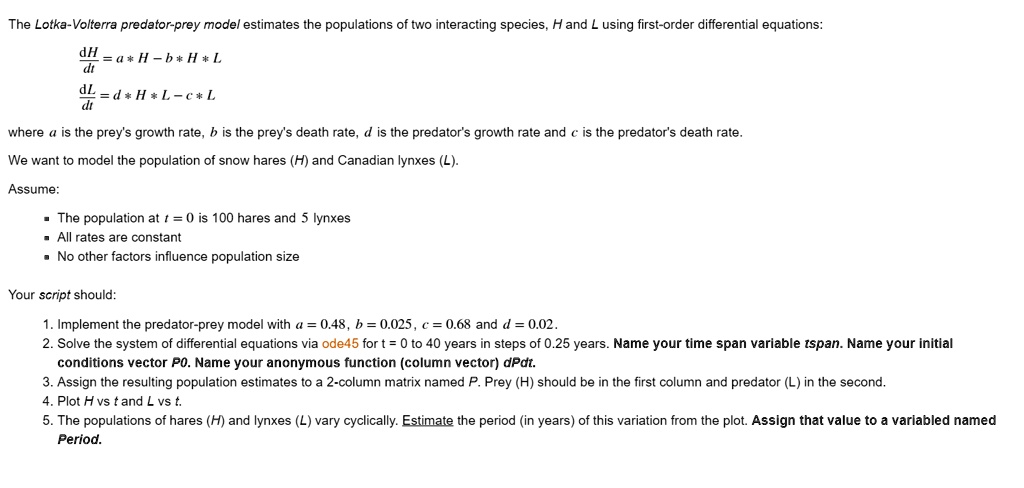
The Lotka-Volterra predator-prey model estimates the populations of two interacting species, H and L using first-order differential equations: \frac{dH}{dt} = a \* H - b \* H \* L \frac{dL}{dt} = d \* H \* L - c \* L where a is the prey's growth rate, b is the prey's death rate, d is the predator's growth rate and c is the predator's death rate. We want to model the population of snow hares (H) and Canadian lynxes (L). Assume: \begin{itemize} \item The population at $t = 0$ is 100 hares and 5 lynxes \item All rates are constant \item No other factors influence population size \end{itemize} Your script should: 1. Implement the predator-prey model with $a = 0.48$, $b = 0.025$, $c = 0.68$ and $d = 0.02$. 2. Solve the system of differential equations via ode45 for $t = 0$ to 40 years in steps of 0.25 years. Name your time span variable tspan. Name your initial conditions vector P0. Name your anonymous function (column vector) dPdt. 3. Assign the resulting population estimates to a 2-column matrix named P. Prey (H) should be in the first column and predator (L) in the second. 4. Plot H vs t and L vs t. 5. The populations of hares (H) and lynxes (L) vary cyclically. Estimate the period (in years) of this variation from the plot. Assign that value to a variabled named Period.
View Answer
divider
BEST MATCH

P5 Consider two current loops that carry $I_1$ and $I_2$, respectively. We have already learned that the force between these two current loops are: $\vec{F}_1 = \frac{\mu_0 I_1 I_2}{4\pi} \oint_{L_1} \oint_{L_2} \frac{d\vec{l}_1 \times (d\vec{l}_2 \times \vec{R}_{21})}{|\vec{R}_{21}|^3}$ $\vec{F}_2 = \frac{\mu_0 I_1 I_2}{4\pi} \oint_{L_1} \oint_{L_2} \frac{d\vec{l}_2 \times (d\vec{l}_1 \times \vec{R}_{12})}{|\vec{R}_{12}|^3}$ where $\vec{F}_1$ is the total force on current loop 1 due to current loop 2, and $\vec{F}_2$ is the total force on current loop 2 due to current loop 1. Please show that $\vec{F}_1 = -\vec{F}_2$. Hint: vector curl product satisfies $\vec{A} \times (\vec{B} \times \vec{C}) = (\vec{A} \cdot \vec{C})\vec{B} - (\vec{A} \cdot \vec{B})\vec{C}$; you also need to apply Stokes's theorem which converts a closed line integral to a surface integral.

View Answer
divider