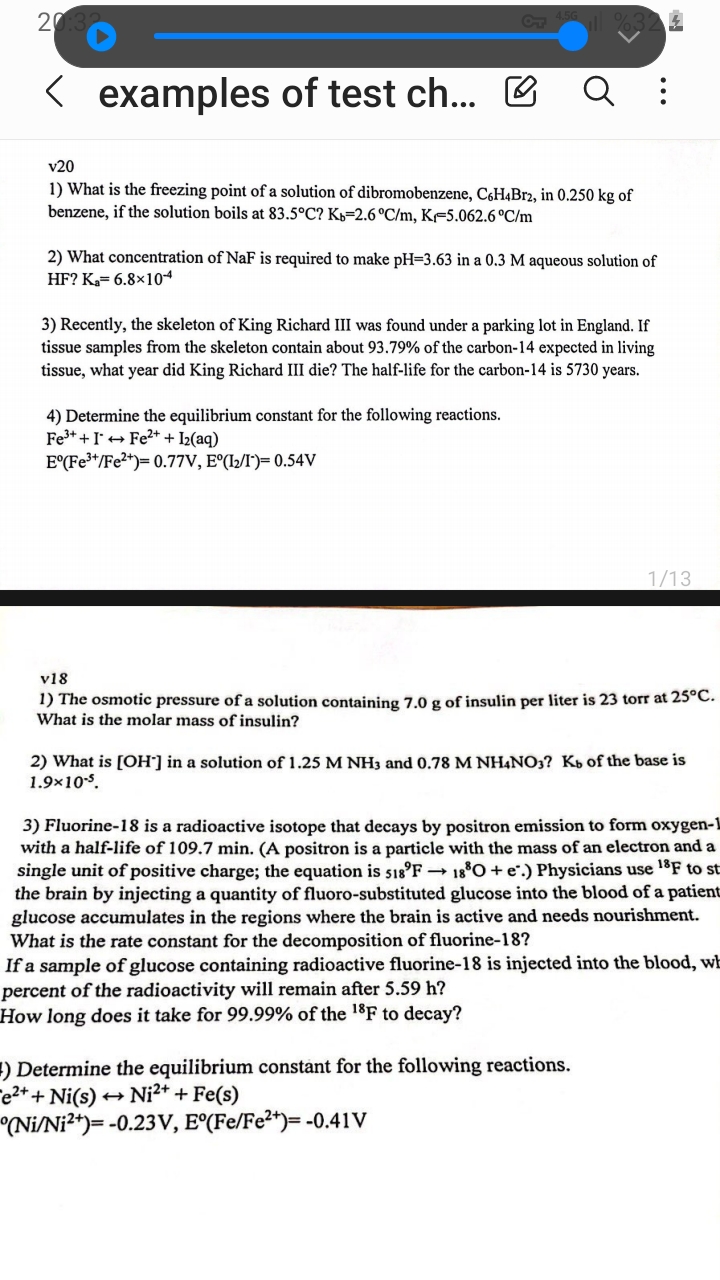
v20
1) What is the freezing point of a solution of dibromobenzene, C6H4Br2, in 0.250 kg of benzene, if the solution boils at 83.5°C? Kb=2.6°C/m, Kf=5.062.6 °C/m
2) What concentration of NaF is required to make pH=3.63 in a 0.3 M aqueous solution of HF? Ka= 6.8×10⁻⁴
3) Recently, the skeleton of King Richard III was found under a parking lot in England. If tissue samples from the skeleton contain about 93.79% of the carbon-14 expected in living tissue, what year did King Richard III die? The half-life for the carbon-14 is 5730 years.
4) Determine the equilibrium constant for the following reactions.
Fe3+ + I- ? Fe2+ + I2(aq)
E°(Fe3+/Fe2+)= 0.77V, E°(I2/I-)= 0.54V
v18
1) The osmotic pressure of a solution containing 7.0 g of insulin per liter is 23 torr at 25°C. What is the molar mass of insulin?
2) What is [OH-] in a solution of 1.25 M NH3 and 0.78 M NH4NO3? Kb of the base is 1.9×10⁻⁵.
3) Fluorine-18 is a radioactive isotope that decays by positron emission to form oxygen-18 with a half-life of 109.7 min. (A positron is a particle with the mass of an electron and a single unit of positive charge; the equation is 18/9 F ? 18/8 O + e+.) Physicians use 18F to study the brain by injecting a quantity of fluoro-substituted glucose into the blood of a patient; glucose accumulates in the regions where the brain is active and needs nourishment.
What is the rate constant for the decomposition of fluorine-18?
If a sample of glucose containing radioactive fluorine-18 is injected into the blood, what percent of the radioactivity will remain after 5.59 h?
How long does it take for 99.99% of the 18F to decay?
4) Determine the equilibrium constant for the following reactions.
Fe2+ + Ni(s) ? Ni2+ + Fe(s)
E°(Ni/Ni2+)= -0.23V, E°(Fe/Fe2+)= -0.41V