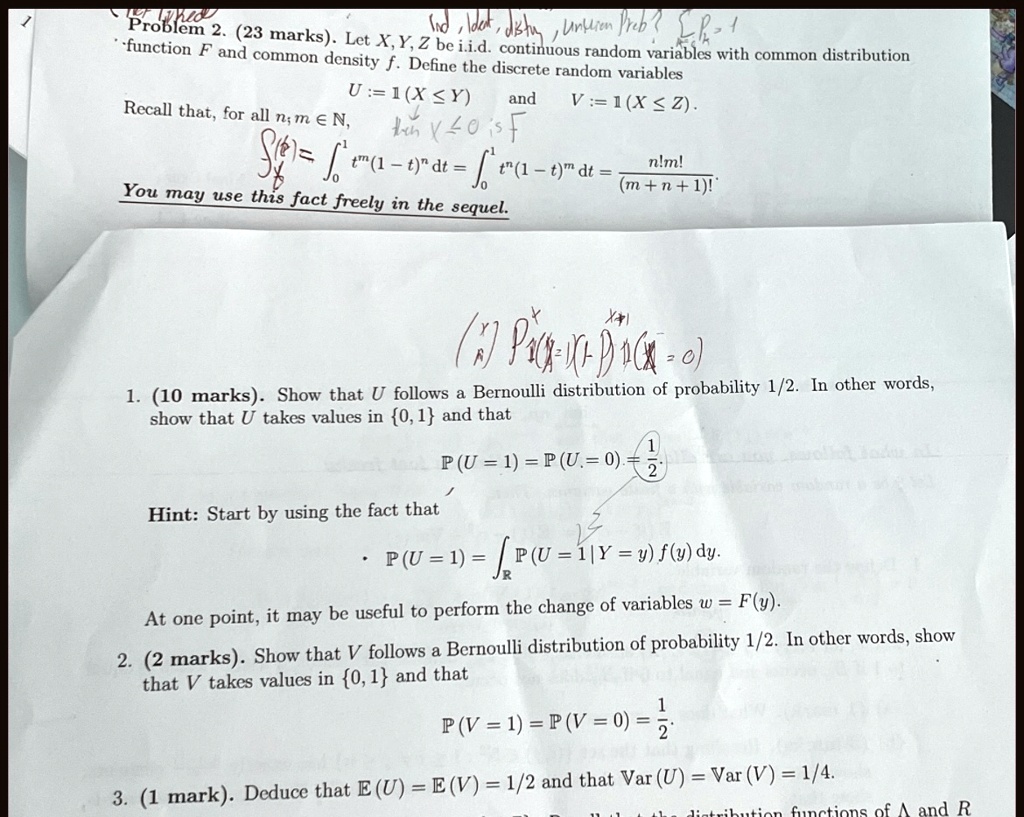
Problem 2. (23 marks). Let X, Y, Z be i.i.d. continuous random variables with common distribution function F and common density f. Define the discrete random variables
U := 1 (X ≤ Y)
and
V := 1 (X ≤ Z).
Recall that, for all n; m ∈ N,
then x=0 is F
$$ \int_0^1 t^m (1-t)^n dt = \int_0^1 t^n (1-t)^m dt = \frac{n!m!}{(m+n+1)!}$$
You may use this fact freely in the sequel.
$$ \int_0^1 P(X \le Y | X = y) f(y) dy $$
1. (10 marks). Show that U follows a Bernoulli distribution of probability 1/2. In other words, show that U takes values in {0,1} and that
$$ P(U = 1) = P(U = 0) = \frac{1}{2}. $$
Hint: Start by using the fact that
$$ P(U = 1) = \int_R P(U = 1 | Y = y) f(y) dy. $$
At one point, it may be useful to perform the change of variables w = F(y).
2. (2 marks). Show that V follows a Bernoulli distribution of probability 1/2. In other words, show that V takes values in {0,1} and that
$$ P(V = 1) = P(V = 0) = \frac{1}{2}. $$
3. (1 mark). Deduce that E (U) = E (V) = 1/2 and that Var (U) = Var (V) = 1/4.