Exercise 6: Human Osteology: Dentition
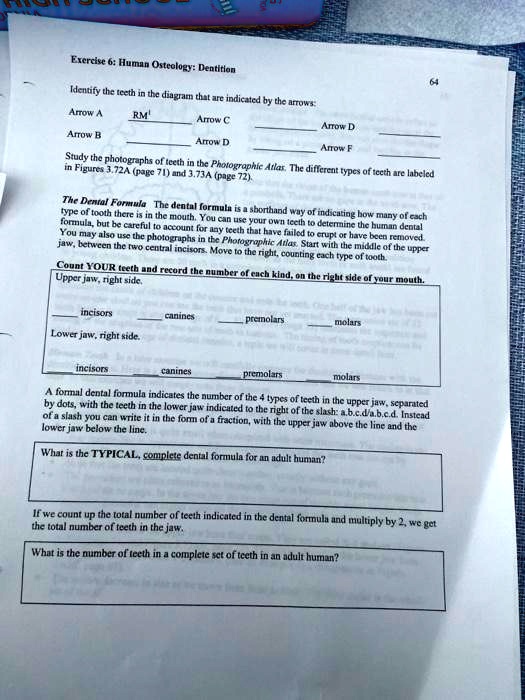
Identify the teeth in the diagram that are indicated by the arrows:
Arrow A
RM
Arrow B
Arrow C
Arrow D
Arrow D
Arrow F
64
Study the photographs of teeth in the Photographic Atlas. The different types of teeth are labeled
in Figures 3.72A (page 71) and 3.73A (page 72).
The Dental Formula The dental formula is a shorthand way of indicating how many of each
type of tooth there is in the mouth. You can use your own teeth to determine the human dental
formula, but be careful to account for any teeth that have failed to erupt or have been removed.
You may also use the photographs in the Photographic Atlas. Start with the middle of the upper
jaw, between the two central incisors. Move to the right, counting each type of tooth.
Count YOUR teeth and record the number of each kind, on the right side of your mouth.
Upper jaw, right side.
incisors
canines
premolars
molars
Lower jaw, right side.
incisors
canines
premolars
molars
A formal dental formula indicates the number of the 4 types of teeth in the upper jaw, separated
by dots, with the teeth in the lower jaw indicated to the right of the slash: a.b.c.d/a.b.c.d. Instead
of a slash you can write it in the form of a fraction, with the upper jaw above the line and the
lower jaw below the line.
What is the TYPICAL, complete dental formula for an adult human?
If we count up the total number of teeth indicated in the dental formula and multiply by 2, we get
the total number of teeth in the jaw.
What is the number of teeth in a complete set of teeth in an adult human?