Ace - AI Tutor
Ask Our Educators
Textbooks
My Library
Flashcards
Scribe - AI Notes
Notes & Exams
Download App
michelle sharp

michelle s.

Divider

Questions asked

BEST MATCH

The 50-kg pod on a spinning Ferris wheel (R=30 m) at the 40 deg position shown breaks loose and falls into a 200-kg cart full of hay. Note that A and B are not on the same level. A's initial position is at y=R-R*sin40, and B is at y=0. The hay cart B has no size despite the drawing and is basically on the ground level, while the pod A is high in the air. The cart is moving at 2 m/s to the left right before impact. Determine the magnitude of the velocity (m/s) of the cart right after impact. Assume the cart survives the impact and remains functional. Hint: Impact occurs in a split of second, from right before impact to right after impact. You must do projectile motion first to get the velocity of the pod right before it hits B to set up the stage for impact. You cannot apply the momentum equation when the pod is still so far away and so high up. $\omega = 0.1 \text{ rad/s}$ $\alpha = 0.2 \text{ rad/s}$ $g$ $40^\circ$ $R=30 \text{ m}$ $50 \text{ kg}$ A hay $v_B = 2 \text{ m/s}$ B $200 \text{ kg}$

View Answer
divider
BEST MATCH

At the point (x,y)=(10,2), what is the MRS of the utility function U(x,y)=23x+6y? Group of answer choices 5 9 563 19

View Answer
divider
BEST MATCH

The nurse has provided discharge instructions to a client who delivered a healthy newborn by cesarean delivery. Which statement made by the client indicates a need for further instruction?

View Answer
divider
BEST MATCH

2. A hospitalized patient is sitting upright and displays tongue deviation (unilateral tongue paralysis and the tongue shifts to one side) from a stroke in the brain stem. Which signs of dysphagia will most likely be observed? The bolus spits out of the mouth Liquids "drool" out of the mouth The bolus spits out of the mouth; Liquids "drool" out of the mouth; The bolus causes an esophageal obstruction in the chest cavity The bolus spits out of the mouth; Liquids "drool" out of the mouth The bolus causes an esophageal obstruction in the chest cavity

View Answer
divider
BEST MATCH

The mean expenditure on food and candy by movie patrons is  = $1.40, and the population standard deviation is  = 0.36. Assume a normal population. Find the probability of the following: a) a randomly selected observation is greater than $1.60 b) a randomly selected observation is between $1.30 and $1.50.

View Answer
divider
BEST MATCH

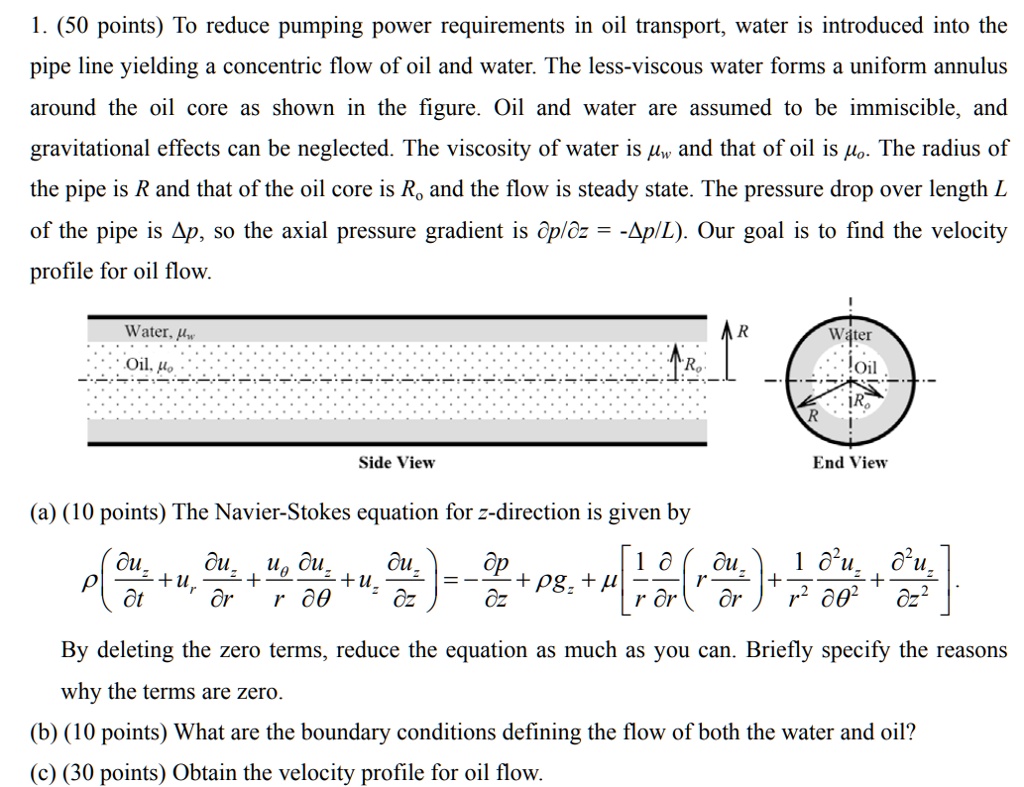
(50 points) To reduce pumping power requirements in oil transport, water is introduced into the pipe line yielding a concentric flow of oil and water. The less-viscous water forms a uniform annulus around the oil core as shown in the figure. Oil and water are assumed to be immiscible, and gravitational effects can be neglected. The viscosity of water is mu _(w) and that of oil is mu _(o). The radius of the pipe is R and that of the oil core is R_(o) and the flow is steady state. The pressure drop over length L of the pipe is Delta p, so the axial pressure gradient is del(p)/(d)elz=-Delta (p)/(L). Our goal is to find the velocity profile for oil flow. (a) (10 points) The Navier-Stokes equation for z-direction is given by ho ((delu_(z))/(delt)+u_(r)(delu_(z))/(delr)+(u_( heta ))/(r)(delu_(z))/(del heta )+u_(z)(delu_(z))/(delz))=-(delp)/(delz)+ ho g_(z)+mu [(1)/(r)(del)/(delr)(r(delu_(z))/(delr))+(1)/(r^(2))(del^(2)u_(z))/(del heta ^(2))+(del^(2)u_(z))/(delz^(2))]. By deleting the zero terms, reduce the equation as much as you can. Briefly specify the reasons why the terms are zero. (b) (10 points) What are the boundary conditions defining the flow of both the water and oil? (c) (30 points) Obtain the velocity profile for oil flow. 1. (50 points) To reduce pumping power requirements in oil transport, water is introduced into the pipe line yielding a concentric flow of oil and water. The less-viscous water forms a uniform annulus around the oil core as shown in the figure. Oil and water are assumed to be immiscible, and gravitational effects can be neglected. The viscosity of water is w and that of oil is o. The radius of the pipe is R and that of the oil core is R, and the flow is steady state. The pressure drop over length L of the pipe is p, so the axial pressure gradient is Op/Oz = -p/L). Our goal is to find the velocity profile for oil flow. Water, Oil, R Water Oi Side View End View (a) (10 points) The Navier-Stokes equation for z-direction is given by au u Ou Ou -u Oz Ou. 1 ou. Ou 20 - Ot or Oz ar r2 o02 az By deleting the zero terms, reduce the equation as much as you can. Briefly specify the reasons why the terms are zero. (b) (10 points) What are the boundary conditions defining the flow of both the water and oil? (c) (30 points) Obtain the velocity profile for oil flow.
View Answer
divider
BEST MATCH

[7] Let P = R[X, Y] be the ring of polynomials in two non-commuting indeterminates X and Y with real coefficients R, and let I be the ideal of P generated by the polynomials $X^2 + 1$, $Y^2 + 1$, XY, and YX. Prove that I = <$X^2$ + 1, $Y^2$ + 1, XY, YX > is an ideal of P, and describe P/I in the way similar to DQR Examples 4, 5, and 6.

View Answer
divider
BEST MATCH

Use the reduction formula: $\int (\ln x)^n dx = x(\ln x)^n - n \int (\ln x)^{n-1} dx$ to evaluate $\int (\ln x)^3 dx$. To achieve this, you will need to apply the reduction formula 3 times. First application of the reduction formula ($n = 3$): $\int (\ln x)^3 dx = \square + \int \square dx$. Second application of the reduction formula ($n = 2$): $\int (\ln x)^3 dx = \square + \int \square dx$. Third application of the reduction formula: ($n = 1$) $\int (\ln x)^3 dx = \square + \int \square dx$. Wrap-up: So completing the final integration above, $\int (\ln x)^3 dx = \square + C$.

View Answer
divider
BEST MATCH

Problem 6.4 What is the total capacitance (in uF) for this circuit? $v_s$ 3 k$\Omega$ 2 k$\Omega$ 5 k$\Omega$ + 3 $\mu$F 5 $\mu$F $v_{out}(t)$ ECE 2110 2

View Answer
divider
BEST MATCH

Questions 002_Exercise 12.13 Algorithmic 1. Question 2 of 7 Check My Work 2. 3. RE 4. O 5. 6. 7. O eBook Exercise 12.13 (Algorithmic) Calculation of Value-Added and Non-Value-Added Costs, Activity Volume and Unused Capacity Variances Maquina Company produces custom-made machine parts. Maquina recently has implemented an activity-based management (ABM) system with the objective of reducing costs. Maquina has begun analyzing each activity to determine ways to increase its efficiency. Setting up equipment was among the first group of activities to be carefully studied. The study revealed that setup hours was a good driver for the activity. During the last year, the company incurred fixed setup costs of $612,000 (salaries of 16 employees). The fixed costs provide a capacity of 36,000 hours (2,250 per employee at practical capacity). The setup activity was viewed as necessary, and the value-added standard was set at 2,250 hours. Actual setup hours used in the most recent period were 33,980. Required: 1. Calculate the volume and unused capacity variances for the setup activity. Enter all amounts as positive values. Volume Variance Unused Capacity Variance Select your answer - ? Select your answer? Hide 9:27

View Answer
divider