Ace - AI Tutor
Ask Our Educators
Textbooks
My Library
Flashcards
Scribe - AI Notes
Notes & Exams
Download App
miguel gasc-n

miguel g.

Divider

Questions asked

BEST MATCH

Determine how each change in the left hand column will stress the system and in which equilibrium reaction will shift in response

View Answer
divider
BEST MATCH

Public Health Submit a possible topic and provide a scientific rationale behind choosing this topic [1 page max

View Answer
divider
BEST MATCH

The simplified Boolean expression of the following Karnaugh Map is? \begin{tabular}{|c|c|c|c|c|} \hline & 00 & 01 & 11 & 10 \\ \hline 00 & 1 & & 1 & \\ \hline 01 & & 1 & & 1 \\ \hline 11 & 1 & & 1 & \\ \hline 10 & & 1 & & 1 \\ \hline \end{tabular} Select one: a. \( (A \oplus B \oplus C \oplus D) \) b. M0.M3.M5.M6.M12.M14.M9.M11 c. \( m 0+m 3+m 5+m 6+m 12+m 14+m 9+m 11 \) d. \( (A \oplus B \oplus C \oplus D)^{\prime} \)

View Answer
divider
BEST MATCH

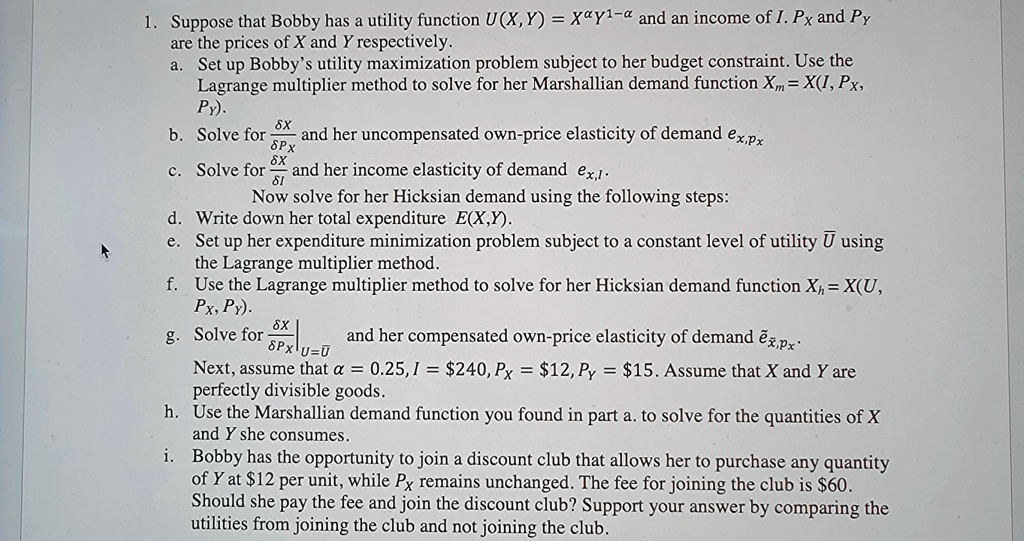
Suppose that Bobby has a utility function U(x,Y)=x^(alpha )Y^(1-alpha ) and an income of I. P_(x) and P_(Y) are the prices of x and Y respectively. a. Set up Bobby's utility maximization problem subject to her budget constraint. Use the Lagrange multiplier method to solve for her Marshallian demand function , P_(Y). b. Solve for (delta x)/(delta P_(x)) and her uncompensated own-price elasticity of demand e_(x,p_(x)) c. Solve for (delta x)/(delta I) and her income elasticity of demand e_(x,I). Now solve for her Hicksian demand using the following steps: d. Write down her total expenditure E(x,Y). e. Set up her expenditure minimization problem subject to a constant level of utility /bar (U) using the Lagrange multiplier method. f. Use the Lagrange multiplier method to solve for her Hicksian demand function , P_(x),P_(Y). g. Solve for (delta x)/(delta P_(x))|_(U()/(b))|=ar (U) and her compensated own-price elasticity of demand tilde(e)_(tilde(x),p_(x)). Next, assume that alpha =0.25,I=$240,P_(x)=$12,P_(Y)=$15. Assume that x and Y are perfectly divisible goods. h. Use the Marshallian demand function you found in part a. to solve for the quantities of x and Y she consumes. i. Bobby has the opportunity to join a discount club that allows her to purchase any quantity of Y at $12 per unit, while P_(x) remains unchanged. The fee for joining the club is $60. Should she pay the fee and join the discount club? Support your answer by comparing the utilities from joining the club and not joining the club. please show your work, dont just give conceptually, we will thumbs down if you dont explain 1.Suppose that Bobby has a utility function UX,Y)=Xy1- and an income of I.Px and Py are the prices of X and Y respectively. a. Set up Bobby's utility maximization problem subject to her budget constraint.Use the Lagrange multiplier method to solve for her Marshallian demand function Xm = X(I, Px, PY). Now solve for her Hicksian demand using the following steps d.Write down her total expenditure E(X,Y. e. Set up her expenditure minimization problem subject to a constant level of utility U using the Lagrange multiplier method. f. Use the Lagrange multiplier method to solve for her Hicksian demand function X = X(U, Px,Py). and her compensated own-price elasticity of demand ez,px: 8PxU=U Next, assume that a = 0.25, I = $240, Px =$12, Py = $15. Assume that X and Y are perfectly divisible goods. h. Use the Marshallian demand function you found in part a. to solve for the quantities of X and Y she consumes. i.Bobby has the opportunity to join a discount club that allows her to purchase any quantity of Y at $12 per unit,while Px remains unchanged.The fee for joining the club is $60. Should she pay the fee and join the discount club? Support your answer by comparing the utilities from joining the club and not joining the club.
View Answer
divider
BEST MATCH

Identify the four chambers of the heart in longitudinal section: right atrium, right ventricle, left atrium, left ventricle. Which ventricle is more muscular? Why is this appropriate?

View Answer
divider
BEST MATCH

(1 point) Suppose the angle A satisfies $0 < A \le 2\pi$. If $cos(A) = -0.87$ and $sin(A) > 0$, determine: The quadrant for the angle A/2 = Quadrant? Then, $sin(A) = $ $sin(A/2) = $ $cos(A/2) = $ $tan(A/2) = $ Be certain to express all answers to at least four decimal places.

View Answer
divider
BEST MATCH

Assume that $MP_L = 10$ and $MP_K = 6$. Assume also that $P_L = \$4$ and $P_K = \$2$. The firm should use labor and capital in order to $MP_L$ and $MP_K$, making the firm's rate of substitution the market's rate of substitution.

View Answer
divider
BEST MATCH

Glanville Sage, and Lccy measured specific volume of vapor and liquid mix of propane and benzene over wide ranges of temperature and pressure. Use the R-K equation of state to estimate the partial fugacity coefficients of propane and benzene of a vapor mixture containing 26.92 wt% propane at 400°F/477.6K and a saturation pressure of 4103 psia/2.2 kPa. For the binary system ethanol (1) - isooctane (2) at 50°C, the infinite-dilution liquid-phase activity coefficients can be calculated using the constants A12 and A21 in the van Laar equations. Calculate the constants A12 and A21 in the van Laar equations. Calculate the constants A12 and A21 in the van Laar equations by calculating the constants Ap and Ag in the Wilson equations. Using the constants from a and b, calculate Y and Y over the entire composition range and plot the calculated points as log Y versus X. How well do the van Laar and Wilson predictions agree with the azeotropic point where x1 = 0.5941, Y = 1.44, and Y = 2.18? Lecture 4 EXERCISES for lecture 4: 1. Find the bubble-point and dew-point temperatures of a mixture of 0.4 mole fraction toluene (1) and 0.6 mole fraction n-butanol (2) at 101.3 kPa. The K-values can be calculated from the modified Raoult's law using vapor pressure data, and Y and from the van Laar equation with A12 = 0.855 and A21 = 1.306. If the same mixture is flashed at a temperature midway between the bubble point and dew point, and 101.3 kPa, what fraction is vaporized, and what are the compositions of the two phases? 2. The mixture shown in Figure 4.39 is partially condensed and separated into two phases. Calculate the amounts and compositions of the equilibrium phases V and L.

View Answer
divider
BEST MATCH

QUESTION 1 If a current flows in the solenoid shown on the left as shown, which end of the solenoid would be N-pole? A) End on LEFT B) End on RIGHT C) Neither end as there is no current D) Neither end as the Magnetic field is zero E) Both ends or LEFT (Front and Rear) act as N-pole QUESTION 2 In order to produce the field shown in the figure below, how would you have to change the current? A) Increase current to 2x0 B) Increase current to 1.15x0 C) Decrease current to 0.75x0 D) Decrease current to 0.5x0 E) Reverse the Current

View Answer
divider
BEST MATCH

How does a community achieve leadership with UNITY in a diverse population? How does a community achieve leadership with TRUST in a diverse population? How does a community achieve leadership with TEAMWORK in a diverse population? (Rap)

View Answer
divider