Ace - AI Tutor
Ask Our Educators
Textbooks
My Library
Flashcards
Scribe - AI Notes
Notes & Exams
Download App
Mohammed Aljaafari

Mohammed A.

Divider

Questions asked

ANSWERED

Ravindra Yadav verified

Numerade educator

Two large conducting parallel disks, each with charge +/- 36.0 µC and diameter 0.280 m are separated by 2.4 m. A particle with a mass of 54 g and charge 5.3 nC is shot from the lower negative disk with an initial velocity of 2.34 m/s toward the upper positive disk. What distance from the negative plate will the particle reach? [0.168 m]

View Answer
divider
ANSWERED

Caryl Abrenica verified

Numerade educator

The figure provided shows a section of a very long rod of radius a = 1.63 mm and linear charge density 4.18 nC/m. The rod is inside a coaxial cylindrical shell of radius b = 12.1 mm and linear charge density -6.71 nC/m. What is the magnitude of the electric field at a radial distance of 18.3 mm?

View Answer
divider
ANSWERED

Ankur S verified

Numerade educator

The figure provided shows a section of a very long rod of radius a = 1.63 mm and linear charge density 4.18 nC/m. The rod is inside a coaxial cylindrical shell of radius b = 12.1 mm and linear charge density -6.71 nC/m. What is the magnitude of the electric field at a radial distance of 18.3 mm?

View Answer
divider
ANSWERED

Ankur S verified

Numerade educator

The figure provided shows a section of a very long rod of radius a = 1.63 mm and linear charge density 4.18 nC/m. The rod is inside a coaxial cylindrical shell of radius b = 12.1 mm and linear charge density -6.71 nC/m. What is the magnitude of the electric field at a radial distance of 18.3 mm?

View Answer
divider
ANSWERED

Supratim Pal verified

Numerade educator

A very long charged conducting wire, of radius a = 9.00 cm, is enclosed by a concentric, conducting neutral hollow cylinder, as shown in the diagram above. If the electric field is E1 = 1.50×10^4 N/C at b = 13.0 cm from the center of the wire and in the direction shown, what is the linear charge density ?2 of the inner surface of the hollow cylinder? 6.11×10^-8 C/m 1.50×10^-7 C/m 7.51×10^-8 C/m 1.08×10^-7 C/m

View Answer
divider
ANSWERED

Mahendra Kumar verified

Numerade educator

In the figure above, the negative charge has a magnitude of 43.0 nC (and lies inside the doughnut shape) and the positive charge has a magnitude of 90.0 nC. What is the flux through the doughnut surface? -1.02×10? Nm²/C -4.86×10³ Nm²/C 4.86×10³ Nm²/C 1.02×10? Nm²/C

View Answer
divider
ANSWERED

Patha Sharma verified

Numerade educator

47. Charge Q is uniformly distributed along a thin, flexible rod of length L. The rod is then bent into the semicircle shown in FIGURE P23.47. a. Find an expression for the electric field E at the center of the semicircle. Hint: A small piece of arc length ?s spans a small angle ?? = ?s/R, where R is the radius. b. Evaluate the field strength if L = 10 cm and Q = 30 nC.

View Answer
divider
ANSWERED

David Morabito verified

Numerade educator

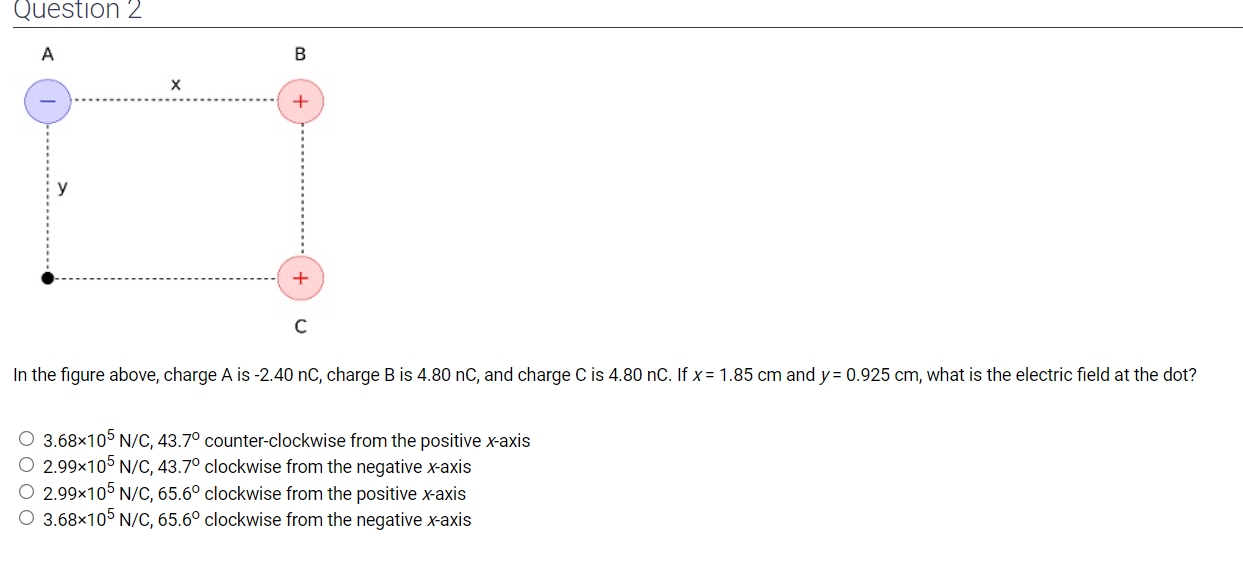
A B x y + + C In the figure above, charge A is -2.40 nC, charge B is 4.80 nC, and charge C is 4.80 nC. If x = 1.85 cm and y = 0.925 cm, what is the electric field at the dot? 3.68×10^5 N/C, 43.7° counter-clockwise from the positive x-axis 2.99×10^5 N/C, 43.7° clockwise from the negative x-axis 2.99×10^5 N/C, 65.6° clockwise from the positive x-axis 3.68×10^5 N/C, 65.6° clockwise from the negative x-axis
View Answer
divider
ANSWERED

Urvashi Arora verified

Numerade educator

The charges in the figure above both have a magnitude of 1.00 nC, and the distance d is 5.60 cm. What is the magnitude of the electric field at the dot? 4.06E+03 N/C 5.74E+03 N/C 2.87E+03 N/C 2.03E+03 N/C

View Answer
divider
ANSWERED

Dominique Jan Tan verified

Numerade educator

An electron gun creates a beam of electrons moving horizontally at. 3.3x10^7 m/s. The electrons enter a uniform electric field of 5.0x10^4 N/C. What is the acceleration of the electrons?

View Answer
divider