Questions asked
Tianyu Li
Numerade educator
26. A box is 1 ft and 4.21 inch long, 2.51 inch wide, and 1.51 inch high. What is its volume in ml? a. 101 ml b. 10.1 ml c. 1.01 x 10^5 ml d. 1.01 x 10^3 ml e. 0.101 ml
11. Determine the mass of 45.22 cm³ piece of silver. a. 4.74 g b. 47.48 g c. 474.8 g d. 0.116 g e. 703 g
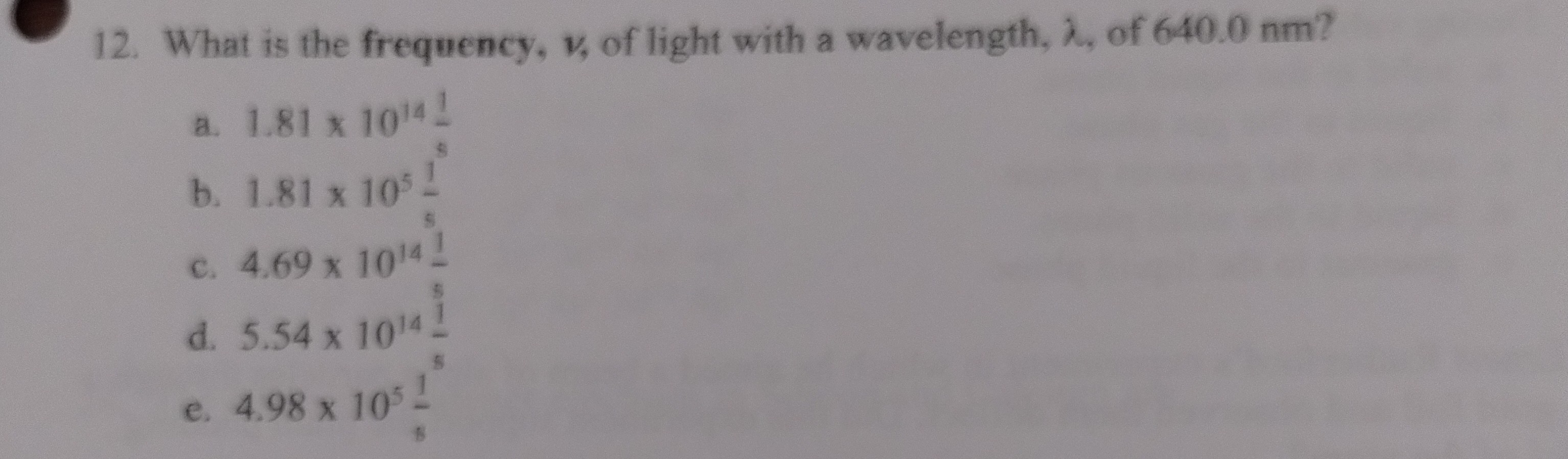
12. What is the frequency, v, of light with a wavelength, ?, of 640.0 nm? a. 1.81 x 10^14 s^-1 b. 1.81 x 10^15 s^-1 c. 4.69 x 10^14 s^-1 d. 5.54 x 10^14 s^-1 e. 4.98 x 10^15 s^-1
14. Silicon has the following three isotopes: 27.977 amu - 92.23% (Si-28) 28.976 amu - 4.68% (Si-29) 29.974 amu - 3.09% (Si-30) Calculate the weighted average atomic mass of this element. a. 28.08 amu b. 29.00 amu c. 27.05 amu d. 25.06 amu e. 30.08 amu
26. Write down the non-abbreviated electron configuration for a neutral atom of bromine.
27. Write down the abbreviated electron configuration for a neutral atom of barium.
Draw an orbital diagram for a neutral atom of fluorine.
29. How much energy is required to convert 125 g of ice at 0 °C to water at 37.0 °C. a. 2.26 x 10? J b. 1.79 x 10? J c. 6.11 x 10? J d. 6.91 x 10? J e. 2.17 x 10? J
Susan Hallstrom
30. 5866 J of energy is applied to a 250 g metal bar to change its temperature 22.0 °C to 100.0 °C. What is the specific heat capacity of the metal? a. 0.301 J/g °C b. 0.161 J/g °C c. 0.462 J/g °C d. 0.807 J/g °C
31. A 43.1 g piece of Lead at 20.0 °C is heated by applying 75.4 J of energy. To what temperature will the sample rise? a. 41.5 °C b. 34.9 °C c. 55.0 °C d. 43.6 °C e. 33.7 °C