This is a question on Fourier transformation.
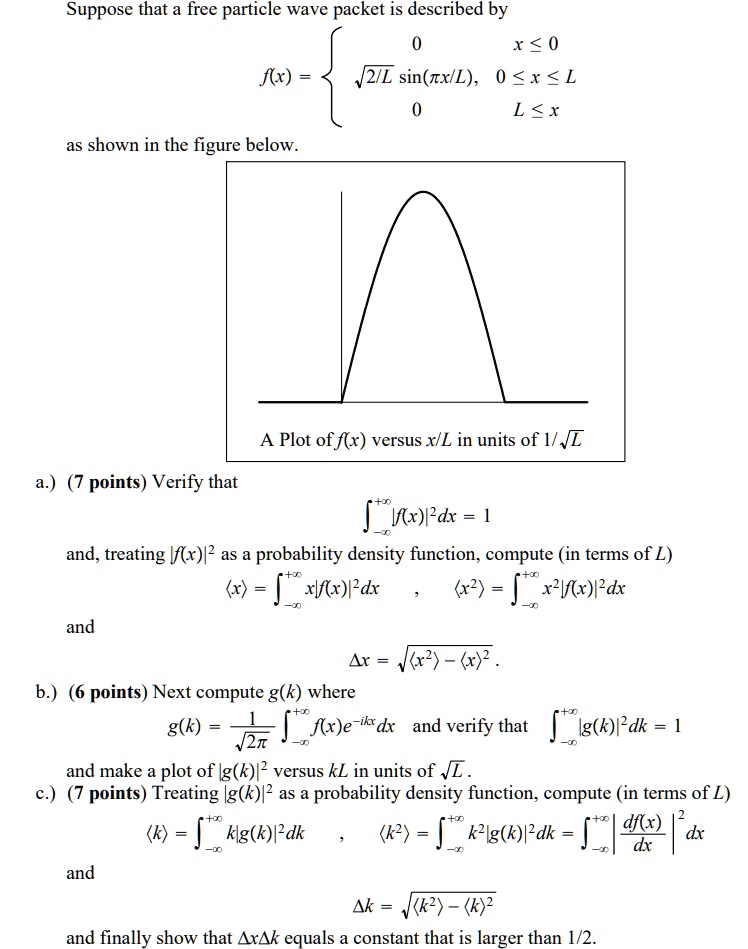
Suppose that a free particle wave packet is described by
f(x) = (2/L) * sin((Ï€x)/L)
as shown in the figure below.
A Plot of f(x) versus x/L in units of 1/L
a.) (7 points) Verify that
∫[0,L] |f(x)|^2 dx = 1
and, treating |f(x)|^2 as a probability density function, compute (in terms of L)
∫[x1,x2] |f(x)|^2 dx = x2 - x1
and
∫[0,L] x^2 |f(x)|^2 dx = (L^2)/3
and
∫[0,L] x |f(x)|^2 dx = L/2
b.) (6 points) Next compute g(k) where g(k) = ∫[0,L] f(x) e^(-ikx) dx and verify that
∫[-∞,∞] |g(k)|^2 dk = 1
and make a plot of |g(k)|^2 versus kL in units of π/L
c.) (7 points) Treating |g(k)|^2 as a probability density function, compute (in terms of L)
∫[k1,k2] df(x) = 1 - k2 + k1
∫[k1,k2] k |g(k)|^2 dk = (k2^2 - k1^2)/2
and
∫[k1,k2] k^2 |g(k)|^2 dk = (k2^3 - k1^3)/3
and finally show that ∆x ∆k equals a constant that is larger than π/2.