Ace - AI Tutor
Ask Our Educators
Textbooks
My Library
Flashcards
Scribe - AI Notes
Notes & Exams
Download App
nicholas goicoechea

nicholas g.

Divider

Questions asked

BEST MATCH

According to the lecture, opportunity costs are not as important as fixed and variable costs?

View Answer
divider
BEST MATCH

In competitive inhibition: Select one: a. an enzyme must compete with other enzymes for the substrate b. an enzyme must compete with other enzymes for the necessary energy c. two different substrates compete for the same active site on the enzyme d. an inhibitor competes with the substrate for the active site on the enzyme

View Answer
divider
BEST MATCH

Which of the following is true about having conversations with parents about the behavior of their child? A. These conversations should be as infrequent as possible and often work best through notes and emails B Parents sometimes benefit when you take the child’s point of view and try to explain the behavior through the child’s eyes C Asking parents for help is usually not helpful, because if parents had ideas to fix the behavior, it wouldn’t be happening in child care the first place Parents sometimes benefit when you take the child’s point of view and try to explain the behavior through the child’s eyes

View Answer
divider
BEST MATCH

2) Sternberg's (2008) triarchic theory of intelligence, defines creative thought as the ability to: A) generate ideas B) analyze which ideas are worth pursuing C) implement ideas D) convince others of the value or our ideas

View Answer
divider
BEST MATCH

Question 4 (2.5 points) According to the cognitive perspective, emotions are: A) caused by processing of stimuli in the environment B) automatically elicited by processing of stimuli C) kept unconscious because of conflict D) A and B

View Answer
divider
BEST MATCH

Exercise 1. Let $(M, d)$ be a metric space. Show that $d_1$ given by $d_1(x, y) = \frac{d(x, y)}{1 + d(x, y)}$, for $x, y \in M$ is a metric. The diameter of a subset $A$ of $M$ is defined as $\delta(A) = \sup_{x, y \in A} d(x, y) \leq \infty)$. Show that $\delta(A) = 0$ iff $A$ contains only one point. Show that $\delta_1(A) = \sup_{x, y \in A} d_1(x, y) \leq 1$ for all $A \subset M$. Is it possible to find a subset $A$ with $\delta_1(A) = 1$?

View Answer
divider
BEST MATCH

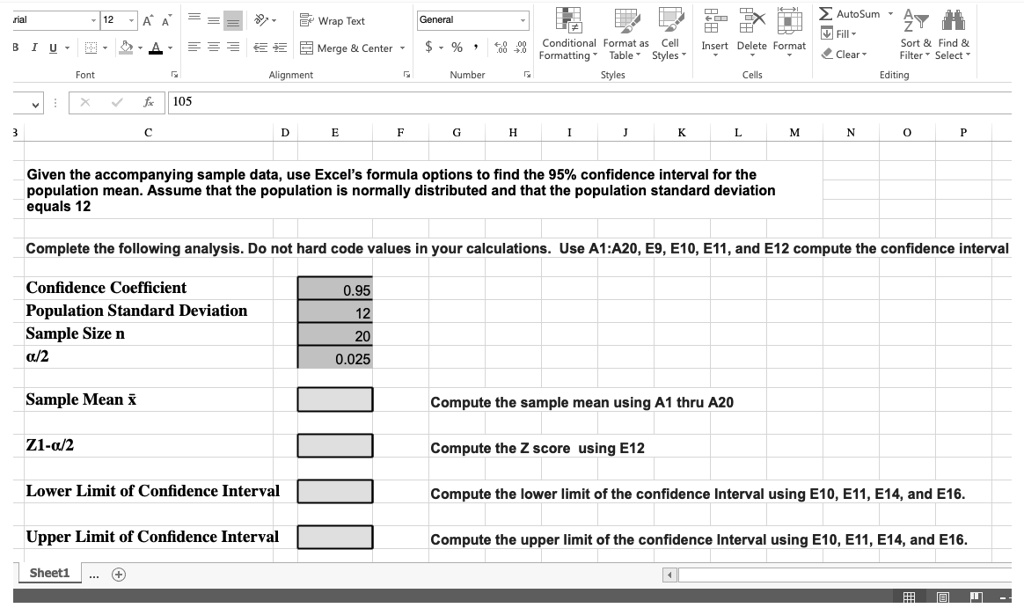
12 AA BIU A Wrap Text Merge & Center General Font Alignment Number ? $%,00 Conditional Format as Cell Formatting Table Styles? Styles ? AutoSum ?? Fill- Insert Delete Format Cells Clear? Editing Sort & Find & Filter Select X ? fx 105 3 C D E F G H I J K L M N O P Given the accompanying sample data, use Excel's formula options to find the 95% confidence interval for the population mean. Assume that the population is normally distributed and that the population standard deviation equals 12 Complete the following analysis. Do not hard code values in your calculations. Use A1:A20, E9, E10, E11, and E12 compute the confidence interval Confidence Coefficient 0.95 Population Standard Deviation 12 Sample Size n 20 ?/2 0.025 Sample Mean x Compute the sample mean using A1 thru A20 Z1-?/2 Compute the Z score using E12 Lower Limit of Confidence Interval Compute the lower limit of the confidence Interval using E10, E11, E14, and E16. Upper Limit of Confidence Interval Compute the upper limit of the confidence Interval using E10, E11, E14, and E16. Sheet1 +
View Answer
divider
BEST MATCH

Problem 1: An object of weight W = 100 N is suspended by two cables inclined at angles \alpha = 45^\circ and \beta = 30^\circ to the horizontal. What is the pulling force on the two ropes? See Figure 1. (30%) Problem 2: Determine the resultant of the three non-concurrent planar forces in Figure 2, analytically and graphically. (40%) Problem 3: A beam with a single overhang is loaded with a concentrated load $P_1 = 5 \text{kN}$ and $P_2 = 2 \text{kN}$ as shown in Figure 3. If known $a = 2 \text{m}$, $b = 3 \text{m}$ and $L = 6 \text{m}$, find the support reactions. (30%)

View Answer
divider
BEST MATCH

• Method 1: $\frac{1}{3}[v(n) + v(n - 1) + v(n - 2)]$, • Method 2: $v_{avg}(n) = 0.15v(n) + 0.85v_{avg}(n - 1)$, • Method 3: $\frac{1}{3}[v(n) - v(n - 3)] + v_{avg}(n - 1)$. 1. For each of these three methods, do the following: • (5 points) Draw a system block diagram. • (10 Points) Calculate the impulse response (i.e., response of the system with zero initial condition to the unit sample signal). This can be done manually or by writing an appropriate MATLAB code. Note that the algorithm used in Method 1 is a finite impulse response (FIR) filter, which means its impulse response function has a finite number of nonzero elements. On the other hand, the algorithms used in Methods 2 and 3 are recursive, therefore their impulse responses may be infinitely long. In the latter case, it is sufficient to calculate 5-10 samples of the impulse response functions.

View Answer
divider
BEST MATCH

1.- un horno tarda 2.125 horas en cocer 2.5 kg de carne, Âżcuanto tiempo tardara en cocer 8 kg? a) $6\frac{4}{5}$ H b) $4\frac{4}{5}$ H c) $5\frac{3}{6}$ H d) No tarda

View Answer
divider