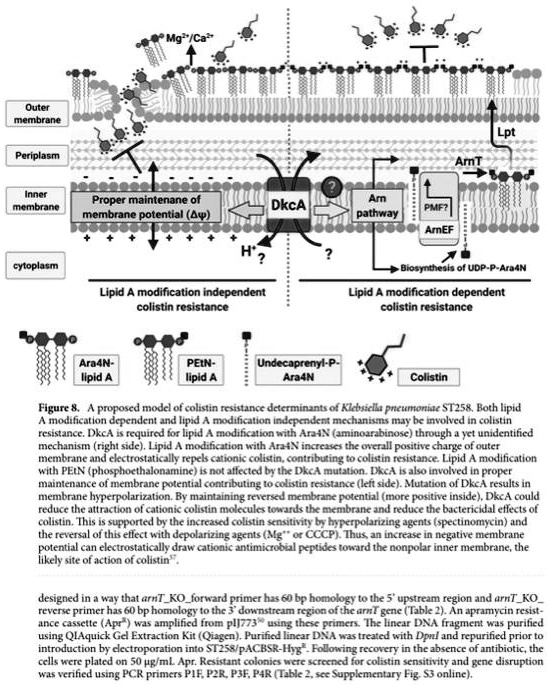
Texts: Explain the importance of figure 8 in detail. Explain what is being shown and discussed thoroughly for a like. Thank you.
Abstract of background information needed: Ineffectiveness of carbapenems against multidrug-resistant pathogens led to the increased use of colistin (polymyxin E) as a last resort antibiotic. A gene belonging to the DedA family encoding conserved membrane proteins was previously identified by screening a transposon library of K. pneumoniae ST258 for sensitivity to colistin. We have renamed this gene dkcA (dedA of Klebsiella required for colistin resistance). DedA family proteins are likely membrane transporters required for viability of Escherichia coli and Burkholderia spp. at alkaline pH and for resistance to colistin in a number of bacterial species. Colistin resistance is often conferred via modification of the lipid A component of bacterial lipopolysaccharide with aminoarabinose (Ara4N) and/or phosphoethanolamine. Mass spectrometry analysis of lipid A of the ∆dkcA mutant shows a near absence of Ara4N in the lipid A, suggesting a requirement for DkcA for lipid A modification with Ara4N. Mutation of K. pneumoniae dkcA resulted in a reduction of the colistin minimal inhibitory concentration to approximately what is found with a ΔarnT strain. We also identify a requirement of DkcA for colistin resistance that is independent of lipid A modification, instead requiring maintenance of optimal membrane potential. K. pneumoniae ΔdkcA displays reduced virulence in Galleria mellonella suggesting colistin sensitivity can cause loss of virulence.
Outer membrane
Lpt
Periplasm
inner membrane
Proper maintenance of membrane potential (Aw)
DkcA
Arn
pathway
AmEF
?
cytoplasm
Biosynthesis of UDP-P-Ara4N
Lipid A modification independent colistin resistance
Lipid A modification dependent colistin resistance
Ara4N-lipid A
PEIN-lipid A
Undecaprenyl-p. Ara4N
Colistin
Figure 8. A proposed model of colistin resistance determinants of Klebsiella pneumoniae ST258. Both lipid A modification-dependent and lipid A modification-independent mechanisms may be involved in colistin resistance. DkcA is required for lipid A modification with AraN (aminoarabinose) through a yet unidentified membrane and electrostatically repels cationic colistin, contributing to colistin resistance. Lipid A modification with PEtN (phosphoethanolamine) is not affected by the DkcA mutation. DkcA is also involved in proper maintenance of membrane potential, contributing to colistin resistance (left side). Mutation of DkcA results in membrane hyperpolarization. By maintaining reversed membrane potential (more positive inside), DkcA could reduce the attraction of cationic colistin molecules towards the membrane and reduce the bactericidal effects of colistin. This is supported by the increased colistin sensitivity by hyperpolarizing agents (spectinomycin) and the reversal of this effect with depolarizing agents (Mg2+ or CCCP). Thus, an increase in negative membrane potential can electrostatically draw cationic antimicrobial peptides toward the nonpolar inner membrane, the likely site of action of colistin.
Designed in a way that arnT_KO_forward primer has 60 bp homology to the upstream region and arnT_KO reverse primer has 60 bp homology to the downstream region of the arnT gene (Table 2). An apramycin resistance cassette Apr was amplified from plJ773 using these primers. The linear DNA fragment was purified using QIAquick Gel Extraction Kit (Qiagen). Purified linear DNA was treated with Dpnl and repurified prior to introduction by electroporation into ST258/pACBSR-Hyg. Following recovery in the absence of antibiotic, the cells were plated on 50 μg/mL Apr. Resistant colonies were screened for colistin sensitivity, and gene disruption was verified using PCR primers PIF, P2R, P3F, P4R (Table 2, see Supplementary Fig. S3 online).