Ace - AI Tutor
Ask Our Educators
Textbooks
My Library
Flashcards
Scribe - AI Notes
Notes & Exams
Download App
washi w

washi w.

Divider

Viewed Questions

Of all rectangles of area 100 which one has the minimum perimeter?

Of all rectangles of area 100 which one has the minimum perimeter?

Calculus: Early Transcendentals

Applications of the Derivative

Optimization Problems

Let $h(x)=f(g(x)),$ where $f$ and $g$ are differentiable on their domains. If $g(1)=3$ and $g^{\prime}(1)=5,$ what else do you need to know to calculate $h^{\prime}(1) ?$

Let $h(x)=f(g(x)),$ where $f$ and $g$ are differentiable on their domains. If $g(1)=3$ and $g^{\prime}(1)=5,$ what else do you need to know to calculate $h^{\prime}(1) ?$

Calculus for Scientists and Engineers: Early Transcendental

Derivatives

The Chain Rule

Let $h(x)=f(g(x)),$ where $f$ and $g$ are differentiable on their domains. If $g(1)=3$ and $g^{\prime}(1)=5,$ what else do you need to know to calculate $h^{\prime}(1) ?$

Let $h(x)=f(g(x)),$ where $f$ and $g$ are differentiable on their domains. If $g(1)=3$ and $g^{\prime}(1)=5,$ what else do you need to know to calculate $h^{\prime}(1) ?$

Calculus: Early Transcendentals

Derivatives

The Chain Rule

The sides of a square increase in length at a rate of $2 \mathrm{m} / \mathrm{s}$
a. At what rate is the area of the square changing when the sides are $10 \mathrm{m}$ long?
b. At what rate is the area of the square changing when the sides are $20 \mathrm{m}$ long?
c. Draw a graph of how the rate of change of the area varies with the side length.

The sides of a square increase in length at a rate of $2 \mathrm{m} / \mathrm{s}$ a. At what rate is the area of the square changing when the sides are $10 \mathrm{m}$ long? b. At what rate is the area of the square changing when the sides are $20 \mathrm{m}$ long? c. Draw a graph of how the rate of change of the area varies with the side length.

Calculus for Scientists and Engineers: Early Transcendental

Derivatives

Related Rates

Questions asked

INSTANT ANSWER

Use the most efficient strategy for computing the area of the following region. The region bounded by \( y=x^{3}, y=-x^{3} \), and \( 7 y+37 x-300=0 \)

View Answer
divider
INSTANT ANSWER

\( \mathrm{ft} \) / s over a distance of \( 1100 \mathrm{ft} \). Approximate the time required for this deceleration to occur. The time required for this deceleration to occur is approximately \( \square \) seconds. (Do not round until the final answer. Then round to four decimal places as needed.)

View Answer
divider
ANSWERED

Atul Kumar verified

Numerade educator

Is the equation ( frac{mathrm{dy}}{mathrm{dt}}=frac{mathrm{t}}{7 mathrm{y}} ) separable? Choose the correct answer below. A. No, because dy and dt are on the same side of the equation. B. Yes, because the given equation can be rewritten with dy and dt on opposite sides of the equation. C. Yes, because the given equation can be rewritten in the form ( 7 y frac{d y}{d t}=t ). D. No, because the given equation cannot be rewritten in the form ( g(y) y^{prime}(t)=h(t) ).

View Answer
divider
INSTANT ANSWER

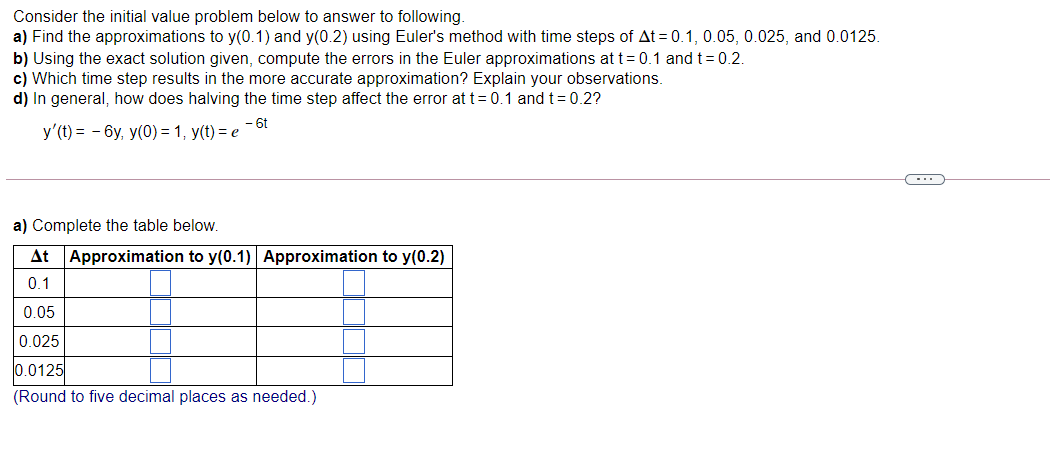
Consider the initial value problem below to answer to following. a) Find the approximations to \( y(0.1) \) and \( y(0.2) \) using Euler's method with time steps of \( \Delta t=0.1,0.05,0.025 \), and \( 0.0125 \). b) Using the exact solution given, compute the errors in the Euler approximations at \( t=0.1 \) and \( t=0.2 \). c) Which time step results in the more accurate approximation? Explain your observations. d) In general, how does halving the time step affect the error at \( t=0.1 \) and \( t=0.2 \) ? \[ y^{\prime}(t)=-6 y, y(0)=1, y(t)=e^{-6 t} \] a) Complete the table below. \begin{tabular}{|c|c|c|} \hline \( \boldsymbol{\Delta t} \) & Approximation to \( \mathbf{y} \mathbf{( 0 . 1 )} \) & Approximation to \( \mathbf{y}(\mathbf{0 . 2} \mathbf{2} \) \\ \hline \( 0.1 \) & \( \square \) & \( \square \) \\ \hline \( 0.05 \) & \( \square \) & \( \square \) \\ \hline \( 0.025 \) & \( \square \) & \( \square \) \\ \hline \( 0.0125 \) & \( \square \) & \( \square \) \\ \hline \end{tabular} (Round to five decimal places as needed.)
View Answer
divider
INSTANT ANSWER

For the given initial value problem, complete the table with \( y^{\prime}(t)=f(t, y)=2-y, y(0)=9 \) \begin{tabular}{|c|c|c|c|} \hline \( \mathbf{k} \) & \( \mathbf{t}_{\mathbf{k}} \) & \( \mathbf{u}_{\mathbf{k}} \) & Slope \( =\mathbf{f}\left(\mathbf{t}_{\mathbf{k}}, \mathbf{u}_{\mathbf{k}}\right) \) \\ \hline 0 & 0 & & \\ \hline 1 & \( 0.5 \) & & \\ \hline 2 & 1 & & \\ \hline \end{tabular} Complete the table. \begin{tabular}{|c|c|c|c|} \hline \( \mathbf{k} \) & \( \mathbf{t}_{\mathbf{k}} \) & \( \mathbf{u}_{\mathbf{k}} \) & Slope \( =\mathbf{f}\left(\mathbf{t}_{\mathbf{k}}, \mathbf{u}_{\mathbf{k}}\right) \) \\ \hline 0 & 0 & \( \square \) & \( \square \) \\ \hline 1 & \( 0.5 \) & \( \square \) & \( \square \) \\ \hline 2 & 1 & \( \square \) & \( \square \) \\ \hline \end{tabular}

View Answer
divider
INSTANT ANSWER

Complete the table. \begin{tabular}{|c|c|c|c|} \hline \( \mathbf{k} \) & \( \mathbf{t}_{\mathbf{k}} \) & \( \mathbf{u}_{\mathbf{k}} \) & Slope \( =\mathbf{f}\left(\mathbf{t}_{\mathbf{k}}, \mathbf{u}_{\mathbf{k}}\right) \) \\ \hline 0 & 0 & \( \square \) & \( \square \) \\ \hline 1 & \( 0.5 \) & \( \square \) & \( \square \) \\ \hline 2 & 1 & \( \square \) & \( \square \) \\ \hline \end{tabular}

View Answer
divider
ANSWERED

Supreeta N verified

Numerade educator

Shown above is a slope field for the differential equation ( frac{d y}{d x}=y^{2}left(4-y^{2} ight) ). If ( y=g(x) ) is the solution to the differential equation with the initial condition ( g(-2)=-1 ), then, ( lim _{x ightarrow infty} g(x) ) is (A) ( -infty ) (B) ( -2 ) (C) 0 (D) 2 (E) 3

View Answer
divider
INSTANT ANSWER

Shown above is a slope field for the differential equation \( \frac{d y}{d x}=y^{2}\left(4-y^{2}\right) \). If \( y=g(x) \) is the solution to the differential equation with the initial condition \( g(-2)=-1 \), then, \( \lim _{x \rightarrow \infty} g(x) \) is (A) \( -\infty \) (B) \( -2 \) (C) 0 (D) 2 (E) 3

View Answer
divider
ANSWERED

Charles Machakwa verified

Numerade educator

The slope field for a certain differential equation is shown above. Which of the following could be a specific solution to that differential equation? (A) y = x^2 (B) y = e^x (C) y = e^-x (D) y = cos x (E) y = ln x

View Answer
divider
INSTANT ANSWER

The upper half of the ellipse centered at the origin with axes of length \( 2 a \) and \( 2 b \) is described by \( y=\frac{b}{a} \sqrt{a^{2}-x^{2}} \) as shown in the figure. Find the area of the ellipse in terms of a and \( b \). The area of the ellipse is . (Type an exact answer in terms of \( \pi \).) \( \cdots \)

View Answer
divider