d)
How many solutions are there to the equation
x_(1)+x_(2)+cdots+x_(7)=102
where x_(i)inN and x_(i)<=44 for all i ?
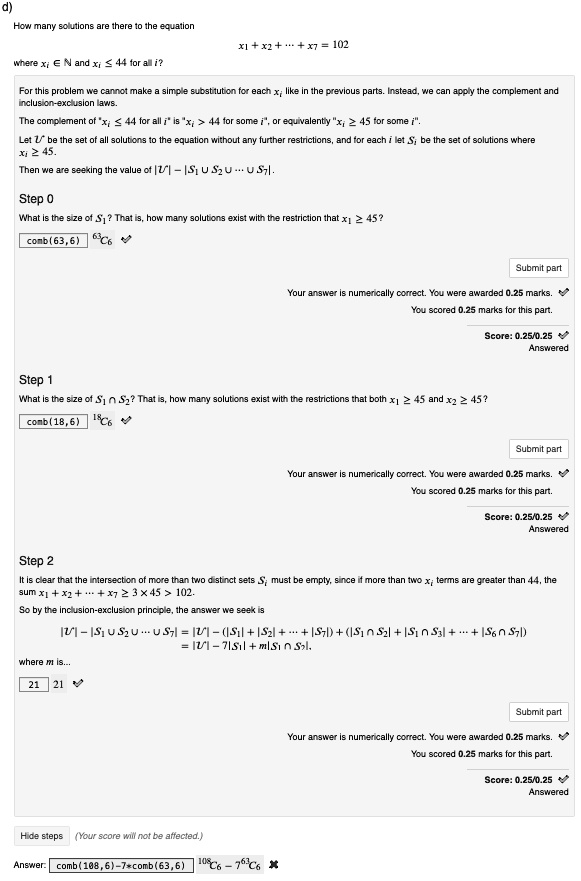
For this problem we cannot make a simple substitution for each x_(i) like in the previous parts. Instead, we can apply the complement and
inclusion-exclusion laws.
The complement of " x_(i)<=44 for all i^(**) is " x_(i)>44 for some i^(a), or equivalently " x_(i)>=45 for some i^().
Let V be the set of all solutions to the equation without any further restrictions, and for each i let S_(i) be the set of solutions where
x_(i)>=45.
Then we are seeking the value of |V|-|S_(1)cup S_(2)cup cdotscup S_(7)|.
Step 0
What is the size of S_(1) ? That is, how many solutions exist with the restriction that x_(1)>=45 ?
^(63)C_(6)
Your answer is numerically correct. You were awarded 0.25 marks.
You scored 0.25 marks for this part.
Score: (0.25)/(0.25)
Answered
Step 1
What is the size of S_(1)cap S_(2) ? That is, how many solutions exist with the restrictions that both x_(1)>=45 and x_(2)>=45 ?
^(18)C_(6)
Your answer is numerically correct. You were awarded 0.25 marks.
You scored 0.25 marks for this part.
Score: (0.25)/(0.25)
Answered
Step 2
It is clear that the intersection of more than two distinct sets S_(i) must be empty, since if more than two x_(i) terms are greater than 44 , the
sum x_(1)+x_(2)+cdots+x_(7)>=3 imes 45>102.
So by the inclusion-exclusion principle, the answer we seek is
|V|-|S_(1)cup S_(2)cup cdotscup S_(7)|=|V|-(|S_(1)|+|S_(2)|+cdots+|S_(7)|)+(|S_(1)cap S_(2)|+|S_(1)cap S_(3)|+cdots+|S_(6)cap S_(7)|)
=|V|-7|S_(1)|+m|S_(1)cap S_(7)|.
where m is...
Your answer is numerically correct. You were awarded 0.25 marks.
You scored 0.25 marks for this part.
Score: (0.25)/(0.25)
(Your score will not be affected.)
d) How many solutions are there to the equation
1 + x2 + + x7 = 102
where xi N and xi 44 for all i?
For this problem we cannot make a simple substitution for each x; like in the previous parts. Instead, we can apply the complement and inclusion-exclusion laws.
Let / be the set of all solutions to the equation without any further restrictions, and for each i let S; be the set of solutions where xi 45. Then we are seeking the value of |/| [S U S U -. Uy]
Step 0 What is the size of S? That is, how many solutions exist with the restriction that x 45? comb63,663C6
Submit part
Your answer is numerically correct. You were awarded 0.25 marks. You scored 0.25 marks for this part.
Score: 0.25/0.25 Answered
Step1 What is the size of S S,? That is, how many solutions exist with the restrictions that both 45 and x2 45? comb18,6C6
Submit part
Your answer is numerically correct. You were awarded 0.25 marks. You scored 0.25 marks for this part.
Score:0.25/0.25 Answered
Step 2 It is clear that the intersection of more than two distinct sets S; must be empty, since if more than two x terms are greater than 44, the I <+ x + +x + Ix ns So by the inclusion-exclusion principle, the answer we seek is
|/| |SUS U . US| = |/| (|S| + |S| + -. + |S|) + |S nS2| + |SnS3| +... + |S6nS|) =|V-7|Su+m|SSl
where I is...
2121
Submit part
Your answer is numerically correct. You were awarded 0.25 marks. You scored 0.25 marks for this part.
Score: 0.25/0.25 Answered
Hide steps (Your score will not be affected.)
Answer:comb(108,6)-7comb(63,6) 1086763C6