Experiment CK1: Thevenin's Theorem and Superposition Theorem
1.0 Objectives
To verify the Thevenin's theorem by using circuit theory experiment board.
To verify superposition theorem.
2.0 Introduction
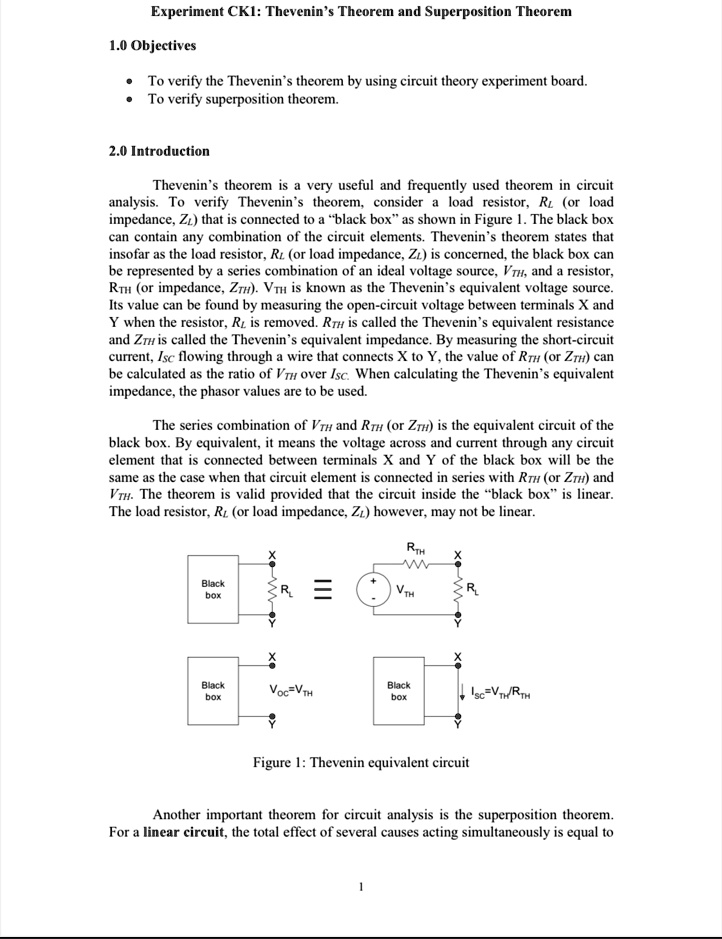
Thevenin's theorem is a very useful and frequently used theorem in circuit analysis. To verify Thevenin's theorem, consider a load resistor, R_(L) (or load impedance, Z_(L) ) that is connected to a "black box" as shown in Figure 1. The black box can contain any combination of the circuit elements. Thevenin's theorem states that insofar as the load resistor, R_(L) (or load impedance, Z_(L) ) is concerned, the black box can be represented by a series combination of an ideal voltage source, V_(TH), and a resistor, R_(TH) (or impedance, Z_(TH) ). V_(TH) is known as the Thevenin's equivalent voltage source. Its value can be found by measuring the open-circuit voltage between terminals x and Y when the resistor, R_(L) is removed. R_(TH) is called the Thevenin's equivalent resistance and Z_(TH) is called the Thevenin's equivalent impedance. By measuring the short-circuit current, I_(SC) flowing through a wire that connects x to Y, the value of R_(TH) (or Z_(TH) ) can be calculated as the ratio of V_(TH) over I_(SC). When calculating the Thevenin's equivalent impedance, the phasor values are to be used.
The series combination of V_(TH) and R_(TH) (or Z_(TH) ) is the equivalent circuit of the black box. By equivalent, it means the voltage across and current through any circuit element that is connected between terminals x and Y of the black box will be the same as the case when that circuit element is connected in series with R_(TH) (or Z_(TH) ) and V_(TH). The theorem is valid provided that the circuit inside the "black box" is linear. The load resistor, R_(L) (or load impedance, Z_(L) ) however, may not be linear.
Figure 1: Thevenin equivalent circuit
Another important theorem for circuit analysis is the superposition theorem. For a linear circuit, the total effect of several causes acting simultaneously is equal to
1
Experiment CK1: Thevenin's Theorem and Superposition Theorem
1.0 Objectives
To verify the Thevenins theorem by using circuit theory experiment board. To verify superposition theorem.
2.0 Introduction
Thevenin's theorem is a very useful and frequently used theorem in circuit analysis. To verify Thevenins theorem consider a load resistor, R or load impedance, Z) that is connected to a black box as shown in Figure 1. The black box can contain any combination of the circuit elements. Thevenins theorem states that insofar as the load resistor, Rz (or load impedance, Z) is concerned, the black box can be represented by a series combination of an ideal voltage source, Vr, and a resistor RrH (or impedance, Zr). VTH is known as the Thevenins equivalent voltage source. Its value can be found by measuring the open-circuit voltage between terminals X and Y when the resistor, R is removed. Rr is called the Thevenins equivalent resistance and Zrn is called the Thevenin's equivalent impedance. By measuring the short-circuit current, Isc flowing through a wire that connects X to Y, the value of Rr (or Zr) can be calculated as the ratio of Vrn over Isc. When calculating the Thevenin's equivalent impedance, the phasor values are to be used.
The series combination of Vrn and Rr or Zr is the equivalent circuit of the black box. By equivalent, it means the voltage across and current through any circuit element that is connected between terminals X and Y of the black box will be the same as the case when that circuit element is connected in series with Rrn (or Zr) and VrH. The theorem is valid provided that the circuit inside the black box is linear. The load resistor, R (or load impedance, Z) however, may not be linear.
RTH X
+
Black box
R
Y
Black box
Voc=VH
Black box
o>
Figure 1: Thevenin equivalent circuit
Another important theorem for circuit analysis is the superposition theorem For a linear circuit, the total effect of several causes acting simultaneously is equal to
1