Ace - AI Tutor
Ask Our Educators
Textbooks
My Library
Flashcards
Scribe - AI Notes
Notes & Exams
Download App
John John

John J.

Location pin Canby, Oregon
Divider

Books Assigned

Chemistry: Structure and Properties

Chemistry: Structure and Properties

Nivaldo Tro 2nd Edition
Achievement 1,145 solutions
Fundamentals of Physics

Fundamentals of Physics

David Halliday,… 10th Edition
Achievement 1,870 solutions
Chemistry The Central Science

Chemistry The Central Science

Theodore L.… 14th Edition
Achievement 1,052 solutions
Chemistry

Chemistry

Steven S.… 10th Edition
Achievement 1,395 solutions

Viewed Questions

Because $g$ varies so little over the extent of most structures, any structure's center of gravity effectively coincides with its center of mass. Here is a fictitious example where $g$ varies more significantly. Figure $12-25$ shows an array of six particles, each with mass $m$ , fixed to the edge of a rigid structure of negligible mass. The distance between adjacent particles along the edge is 2.00 $\mathrm{m}$ . The following table gives the value of $g$ $\left(\mathrm{m} / \mathrm{s}^{2}\right)$ at each particle's location. Using the
coordinate system shown, find (a) the $x$ coordinate $x_{\text { com }}$ and $(b)$ the $y$ coordinate $y_{\text { com }}$ of the center of mass of the six-particle system. Then find (c) the $x$ coordinate $x_{\text { cog }}$ and $(\mathrm{d})$ the $y$ coordinate $y_{\text { cog }}$ of the center of gravity of the six-particle system.
$$
\begin{array}{|c|c|c|c|}\hline \text { Particle } & {g} & {\text { Particle }} & {g} \\ \hline 1 & {8.00} & {4} & {7.40} \\ \hline 2 & {7.80} & {5} & {7.60} \\ \hline 3 & {7.60} & {6} & {7.80} \\ \hline\end{array}
$$

Because $g$ varies so little over the extent of most structures, any structure's center of gravity effectively coincides with its center of mass. Here is a fictitious example where $g$ varies more significantly. Figure $12-25$ shows an array of six particles, each with mass $m$ , fixed to the edge of a rigid structure of negligible mass. The distance between adjacent particles along the edge is 2.00 $\mathrm{m}$ . The following table gives the value of $g$ $\left(\mathrm{m} / \mathrm{s}^{2}\right)$ at each particle's location. Using the coordinate system shown, find (a) the $x$ coordinate $x_{\text { com }}$ and $(b)$ the $y$ coordinate $y_{\text { com }}$ of the center of mass of the six-particle system. Then find (c) the $x$ coordinate $x_{\text { cog }}$ and $(\mathrm{d})$ the $y$ coordinate $y_{\text { cog }}$ of the center of gravity of the six-particle system. $$ \begin{array}{|c|c|c|c|}\hline \text { Particle } & {g} & {\text { Particle }} & {g} \\ \hline 1 & {8.00} & {4} & {7.40} \\ \hline 2 & {7.80} & {5} & {7.60} \\ \hline 3 & {7.60} & {6} & {7.80} \\ \hline\end{array} $$

Fundamentals of Physics

What is a feature detector?

What is a feature detector?

Biological Psychology

Questions asked

INSTANT ANSWER

The system in the figure is in equilibrium. The angles are \( \theta_{1}=59.8^{\circ} \) and \( \theta_{2}=15.1^{\circ} \), and the ball has mass \( M=3.86 \mathrm{~kg} \). What is the tension in (a) string \( a b \) and (b) string \( b c \) ? (a) Number \( \square \) i \( \square \) Units \( \square \) N (b) Number \( \square \) i Units \( \square \) N

View Answer
divider
INSTANT ANSWER

In the figure, a 17 kg block is held in place via a pulley system. The person's upper arm is vertical; the forearm makes angle \( \theta=31^{\circ} \) with the horizontal. Forearm and hand together have a mass of 1.8 kg , with a center of mass at distance \( d_{1}=13 \mathrm{~cm} \) from the contact point of the forearm bone and the upper-arm bone (humerus). The triceps muscle pulls vertically upward on the forearm at distance \( d_{2}=2.5 \mathrm{~cm} \) behind that contact point. Distance \( d_{3} \) is 33 cm . Take the upward direction to be positive. What are the forces on the forearm from (a) the triceps muscle and (b) the humerus? (a) Number i i Units N (b) Number \( \square \) Units \( \square \) N

View Answer
divider
INSTANT ANSWER

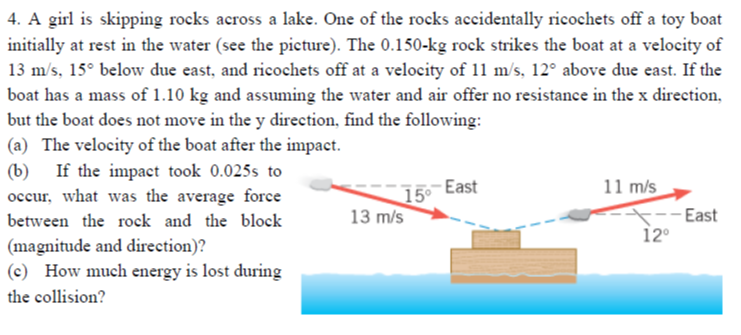
4. A girl is skipping rocks across a lake. One of the rocks accidentally ricochets off a toy boat initially at rest in the water (see the picture). The \( 0.150-\mathrm{kg} \) rock strikes the boat at a velocity of \( 13 \mathrm{~m} / \mathrm{s}, 15^{\circ} \) below due east, and ricochets off at a velocity of \( 11 \mathrm{~m} / \mathrm{s}, 12^{\circ} \) above due east. If the boat has a mass of 1.10 kg and assuming the water and air offer no resistance in the x direction, but the boat does not move in the \( y \) direction, find the following: (a) The velocity of the boat after the impact. (b) If the impact took 0.025 s to occur, what was the average force between the rock and the block (magnitude and direction)? (c) How much energy is lost during the collision?
View Answer
divider
INSTANT ANSWER

3. You are standing on a frictionless ice parking lot. Your mass is 70.0 kg . Your friend throws a 0.400 kg ball to you horizontally at a speed of \( 10.0 \mathrm{~m} / \mathrm{s} \). (a) what speed do you move if you catch the ball? (b) what speed do you move if the ball bounces off your hands and moves horizontally in the opposite direction at a speed of \( 8.00 \mathrm{~m} / \mathrm{s} \) ?

View Answer
divider
INSTANT ANSWER

2. To protect their young in the nest, peregrine falcons will fly into birds of prey (such as ravens) at high speed. In one such episode, a 600 gram falcon flying at \( 20.0 \mathrm{~m} / \mathrm{s} \) due south ran into a 1.50 kg raven flying at \( 9.00 \mathrm{~m} / \mathrm{s} \) due east. The falcon bounced back with a speed of \( 5.00 \mathrm{~m} / \mathrm{s} 30^{\circ} \) east of north. (These figures were estimated by an author of another physics textbook as he watched this attack occur in northern New Mexico.) (a) What is the net velocity of the raven after the collision? (b) What direction is the raven moving after the collision? (c) How much mechanical energy is lost during this collision?

View Answer
divider
INSTANT ANSWER

Problem: 1. A 0.140 kg baseball is thrown with a velocity of \( 20.7 \mathrm{~m} / \mathrm{s} \). It is struck with an average force of 5000.0 N , which results in a velocity of \( 37.0 \mathrm{~m} / \mathrm{s} \) in the opposite direction. How long were the bat and ball in contact?

View Answer
divider
INSTANT ANSWER

3. A \( 62.5-\mathrm{kg} \) skier coasts up a snow-covered hill that makes an angle of \( 22.2^{\circ} \) with the horizontal. The initial speed of the skier is \( 9.27 \mathrm{~m} / \mathrm{s} \). After coasting a distance of 2.35 m up the slope, the speed of the skier is 4.57 \( \mathrm{m} / \mathrm{s} \). (a) Find the work done by the kinetic frictional force that acts on the skis. (b) What is the magnitude of the kinetic frictional force?

View Answer
divider
INSTANT ANSWER

2. A skier starts from rest at the top of a hill. The skier coasts down the hill and up a second hill, as the drawing illustrates. The crest of the second hill is circular, with a radius of 28.6 m . Neglect friction and air resistance. What must be the height \( h \) of the first hill so that the skier just loses contact with the snow at the crest of the second hill?

View Answer
divider
INSTANT ANSWER

Problem: 1. The drawing shows a skateboarder moving at \( 5.23 \mathrm{~m} / \mathrm{s} \) along a horizontal section of a track that is slanted upward by \( 54.1^{\circ} \) above the horizontal at its end, which is 0.638 m above the ground. When she leaves the track, she follows the characteristic path of projectile motion. Ignoring friction and air resistance, find the maximum height \( H \) to which she rises above the end of the track.

View Answer
divider
ANSWERED

Supratim Pal verified

Numerade educator

5. A 5.4 kg block is projected by a spring up a plane that is inclined at 31° with the horizontal. The spring has a spring constant of 1800 N/m and is initially compressed 0.23 m. Assume there is no change in height and no friction while the spring is in contact with the block. a) How far up along the plane does the block go if the plane is frictionless? b) How far up along the plane does the block go if the coefficient of kinetic friction between the block and the plane is 0.44? c) If the block in part b) then slides back down against the frictional force, what is the block's speed when it reaches the original projection point?

View Answer
divider