14.(6 pts) Use this data set of clutch size (eggs/nest) data to answer the following.
1, 1, 2, 2, 2, 3, 3, 3, 3, 3, 3, 4, 4, 5, 16, 17
a) Range:
b) Interquartile range:
c) Mode:
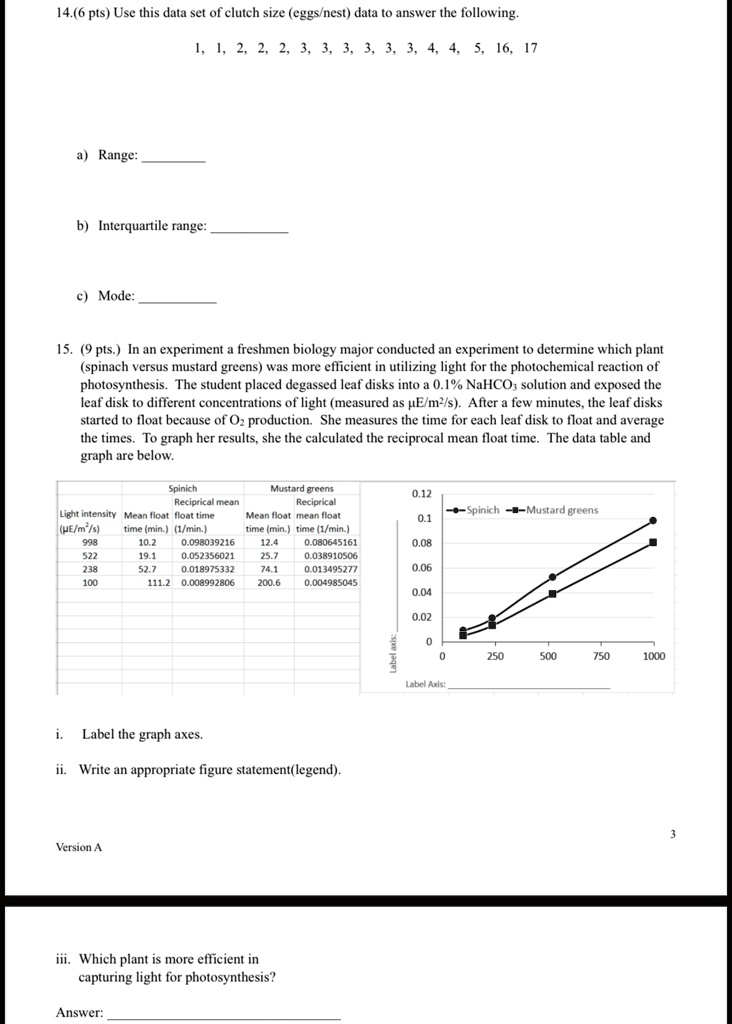
15. (9 pts.) In an experiment a freshmen biology major conducted an experiment to determine which plant
(spinach versus mustard greens) was more efficient in utilizing light for the photochemical reaction of
photosynthesis. The student placed degassed leaf disks into a 0.1% NaHCO3 solution and exposed the
leaf disk to different concentrations of light (measured as µE/m²/s). After a few minutes, the leaf disks
started to float because of O2 production. She measures the time for each leaf disk to float and average
the times. To graph her results, she the calculated the reciprocal mean float time. The data table and
graph are below.
Spinich
Reciprical mean
Mustard greens
Reciprical
0.12
Light intensity Mean float float time
Mean float mean float
--Spinich --Mustard greens
0.1
(με/m²/s)
time (min.) (1/min.)
time (min.) time (1/min.)
998
10.2
0.098039216
522
19.1
0.052356021
238
52.7
12.4 0.080645161
25.7 0.038910506
0.018975332 74.1 0.013495277
0.08
0.06
100
111.2 0.008992806
200.6 0.004985045
0.04
0.02
Label axis:
0
0
250
500
750
1000
i. Label the graph axes.
ii. Write an appropriate figure statement(legend).
Version A
iii. Which plant is more efficient in
capturing light for photosynthesis?
Answer:
Label Axis: