Learning Goal:
Application of Newton's Laws to Uniform Circular Motions
Students usually think circular motions are a separate topic. However,
circular motions belong to the broad applications of Newton's Laws,
with the following specific features:
(1) The direction of the centripetal acceleration is automatically known
- it always points toward the center of the circle.
(2) In problem solving, always choose one axis (either +x or +y)
toward the center of the circle.
(3) The magnitude of the centripetal acceleration has a special
formula = $v^2/r$
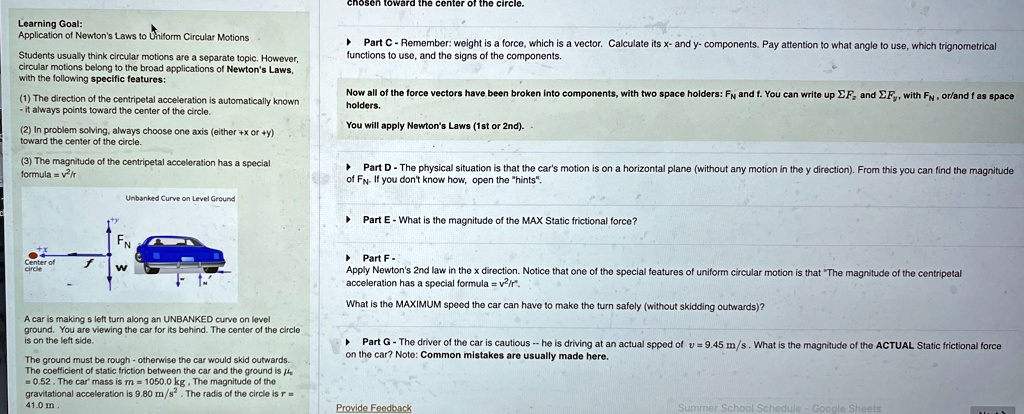
Unbanked Curve on Level Ground
▸ Part C - Remember: weight is a force, which is a vector. Calculate its x- and y- components. Pay attention to what angle to use, which trignometrical
functions to use, and the signs of the components.
Now all of the force vectors have been broken into components, with two space holders: $F_N$ and f. You can write up $\sum F_x$ and $\sum F_y$, with $F_N$, or/and f as space
holders.
You will apply Newton's Laws (1st or 2nd).
▸ Part D - The physical situation is that the car's motion is on a horizontal plane (without any motion in the y direction). From this you can find the magnitude
of $F_N$. If you don't know how, open the "hints".
$F_N$
Part E - What is the magnitude of the MAX Static frictional force?
A car is making s left turn along an UNBANKED curve on level
ground. You are viewing the car for its behind. The center of the circle
is on the left side.
The ground must be rough-otherwise the car would skid outwards.
The coefficient of static friction between the car and the ground is $\mu_s$
=0.52. The car' mass is m = 1050.0 kg, The magnitude of the
gravitational acceleration is 9.80 m/s². The radis of the circle is r =
41.0 m
▸ Part F-
Apply Newton's 2nd law in the x direction. Notice that one of the special features of uniform circular motion is that "The magnitude of the centripetal
acceleration has a special formula = $v^2/r$".
What is the MAXIMUM speed the car can have to make the turn safely (without skidding outwards)?
▸ Part G - The driver of the car is cautious -- he is driving at an actual spped of v = 9.45 m/s. What is the magnitude of the ACTUAL Static frictional force
on the car? Note: Common mistakes are usually made here.
Provide Feedback