CH 01HW - Exercises & Problems (i)
Part 2 of 3
1 point
Required information
Tableau Dashboard Activity: Interpret and Communicate 1-2 (Static) [Exercise 1-15; LO1-6]
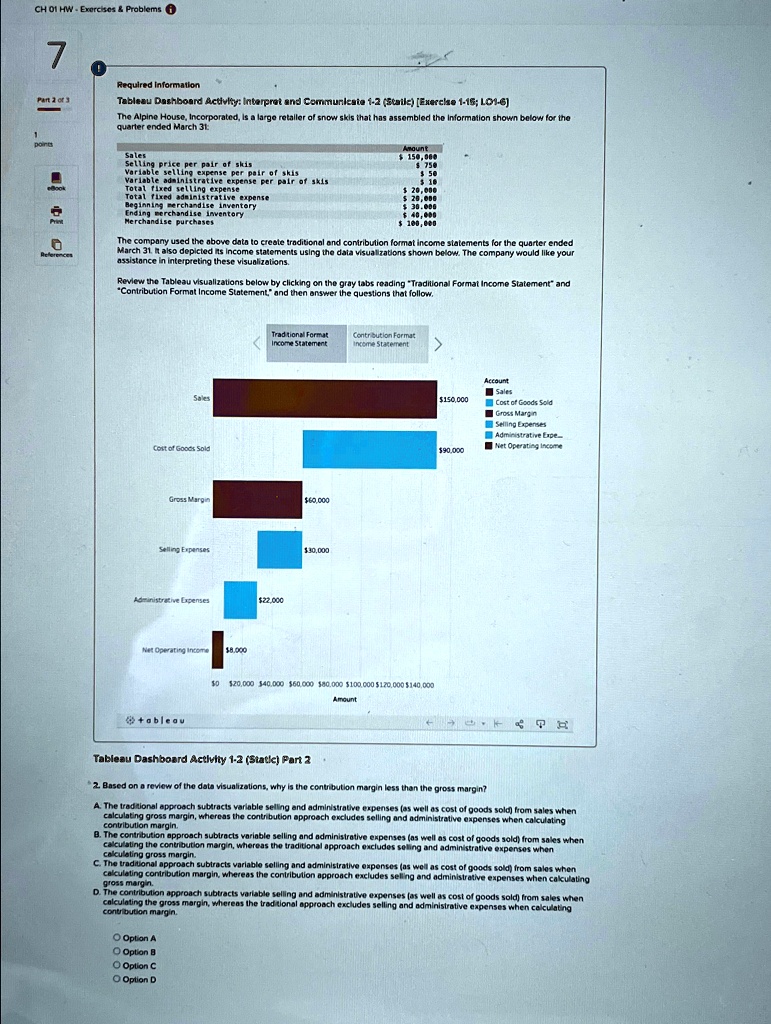
The Alpine House, Incorporated, is a large retailer of snow skis that has assembled the information shown below for the quarter ended March 31:
able[[,Amount],[Sales,$150,000
CH 01 HW Exercises Problems
Required information Tableau Dashboard Activity: Interpret and Communicate 1-2 Static [Exercise 1-15; LO1-6] The Alpine House, Incorporated, is a large retailer of snow skis that has assembled the information shown below for the quarter ended March 31:
Part 2 of 3
points
Sales Selling price of skis Variable selling expense per pair of skis Variable administrative expense per pair of skis Total fixed selling expense
$150,000 $750 $50 $10 $20,000 $26,000 $30,000 $40,000 $100,000
Beginning merchandise inventory Ending merchandise inventory Merchandise purchases
6
The company used the above data to create traditional and contribution format income statements for the quarter ended March 31. To depicted income statements using the data visualizations shown below. The company would like your assistance in interpreting these visualizations. Review the Tableau visualizations below by clicking on the gray tabs reading Traditional Format Income Statement and Contribution Format Income Statement and then answer the questions that follow.
Traditional Format Income Statement
Account Sales Cost of Goods Sold Gross Margin Selling Expenses Administrative Expenses Net Operating
$150,000
Cost of Goods Sold
Gross Margin
$150,000
$0
$20,000 $40,000 $60,000 $80,000 $100,000 $120,000 $140,000
Amount
Tableau
Tableau Dashboard Activity 1-2 Static Part 2
2. Based on a review of the data visualizations, why is the contribution margin less than the gross margin?
A. The traditional approach includes selling and administrative expenses when calculating gross margin whereas the contribution approach excludes selling and administrative expenses when calculating contribution margin.
B. The contribution approach subtracts variable selling and administrative expenses as well as cost of goods sold from sales when calculating the contribution margin whereas the traditional approach excludes selling and administrative expenses when calculating gross margin.
C. The traditional approach subtracts variable selling and administrative expenses (as well as cost of goods sold) from sales when calculating contribution margin whereas the contribution approach excludes selling and administrative expenses when calculating gross margin.
D. The contribution approach subtracts variable selling and administrative expenses (as well as cost of goods sold) from sales when calculating the gross margin whereas the traditional approach excludes selling and administrative expenses when calculating contribution margin.
Option A
Option D