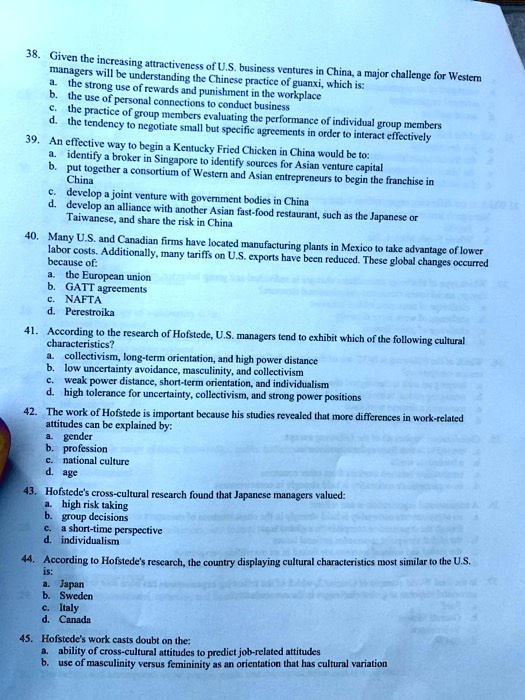
38. Given the increasing attractiveness of U.S. business ventures in China, a major challenge for Western
managers will be understanding the Chinese practice of guanxi, which is:
a. the strong use of rewards and punishment in the workplace
b. the use of personal connections to conduct business
c. the practice of group members evaluating the performance of individual group members
d. the tendency to negotiate small but specific agreements in order to interact effectively
39. An effective way to begin a Kentucky Fried Chicken in China would be to:
a. identify a broker in Singapore to identify sources for Asian venture capital
b. put together a consortium of Western and Asian entrepreneurs to begin the franchise in
China
c. develop a joint venture with government bodies in China
d. develop an alliance with another Asian fast-food restaurant, such as the Japanese or
Taiwanese, and share the risk in China
40. Many U.S. and Canadian firms have located manufacturing plants in Mexico to take advantage of lower
labor costs. Additionally, many tariffs on U.S. exports have been reduced. These global changes occurred
because of:
a. the European union
b. GATT agreements
c. NAFTA
d. Perestroika
41. According to the research of Hofstede, U.S. managers tend to exhibit which of the following cultural
characteristics?
a. collectivism, long-term orientation, and high power distance
b. low uncertainty avoidance, masculinity, and collectivism
c. weak power distance, short-term orientation, and individualism
d. high tolerance for uncertainty, collectivism, and strong power positions
42. The work of Hofstede is important because his studies revealed that more differences in work-related
attitudes can be explained by:
a. gender
b. profession
c. national culture
d. age
43. Hofstede's cross-cultural research found that Japanese managers valued:
a. high risk taking
b. group decisions
c. a short-time perspective
d. individualism
44. According to Hofstede's research, the country displaying cultural characteristics most similar to the U.S.
is:
a. Japan
b. Sweden
c. Italy
d. Canada
45. Hofstede's work casts doubt on the:
a. ability of cross-cultural attitudes to predict job-related attitudes
b. use of masculinity versus femininity as an orientation that has cultural variation