Ace - AI Tutor
Ask Our Educators
Textbooks
My Library
Flashcards
Scribe - AI Notes
Notes & Exams
Download App
peter larrea

peter l.

Divider

Questions asked

BEST MATCH

PART C 1. When a balloon is inflated at constant temperature, both the volume and the pressure will increase. Explain why Boyle's law is not applicable in this example. 2. Draw a graph to indicate how the graph obtained in PART B No. 8 will behave at very high pressure. 3. Consider the following graphs of pressure versus the reciprocal of volume for a given mass of a particular gas. P (kPa) 0 $$T_1$$ $$T_2$$ $$T_3$$ $$\frac{1}{V}$$ ($$cm^{-3}$$) Discuss what happened during this investigation. 4. The following diagrams represents a sealed piston which encloses a gas. 1 2 3 From observation of these diagrams,... 4.1. Which variable decreased when the change from diagram 1 to diagram 3 took place? (1) 4.2. Which variable stayed constant when the change from diagram 1 to diagram 3 took place? (1)

View Answer
divider
BEST MATCH

Calculate the daily maintenance fluids needs for an adolescent weighing 52kg?

View Answer
divider
BEST MATCH

monolithic application offers an easy way to add or change functionality true or false

View Answer
divider
BEST MATCH

Which of the following is an area of focus for a research risk management program? Group of answer choices Educating physicians regarding the differences in intent between clinical care and research, and the additional protections afforded to research participants Ensuring that the process of informed consent during research is comprehensive and dispels the notion of therapeutic misconception Systematically reviewing disclosed interests for conflicts of interests and managing, reducing, or eliminating all conflicts of interests A and B only All of the above

View Answer
divider
BEST MATCH

2 1 point Put the steps of phagocytosis in order 1 Recognition and attachment 2 Engulfment (endocytosis) 3 Phagosome maturation and phagolysosome formation 4 Destruction and digestion 5 Exocytosis 6 Chemotaxis 3 1 point Which of the following is NOT a way that antibodies assist the immune system in getting rid of pathogens? Labeling pathogens for phagocytosis Poking holes in the cell membrane and lysing bacteria directly Binding to flagella and fimbrae and preventing movement and adherence. Binding to viral coat proteins and preventing them from being able to enter cells

View Answer
divider
BEST MATCH

In the Chapter 17 outline, there's a note in the section about chemoreceptors, which states that chemoreceptors are activated by increases in H+ in the blood, which are caused by increases in CO2 in the blood. This could be caused by strenuous exercise. In the Chapter 16 outline, there's a note about how inhalation works, called "The big picture to remember", which states that muscle activity $\rightarrow$ volume changes $\rightarrow$ pressure changes I'd like you to connect the dots between these two concepts. Please review those two sections of your notes. Then briefly explain/discuss how the activation of chemoreceptors is connected to the note about muscle activity and inhalation. I'm just looking for a simple review of this connection (the connection is mentioned in the outlines). To help organize your Discussion, you can try to fill in some of the question marks in this sequence: Exercise $\rightarrow$ increased concentration of CO2 in blood $\rightarrow$ Increased concentration of H+ in blood $\rightarrow$ chemoreceptors activated $\rightarrow$ ??? $\rightarrow$ muscle activity and volume and pressure changes (which muscles? what change in activity?) $\rightarrow$ How does this then change the concentration of O2 and CO2 in the blood? You don't need to go deep into the cellular physiology or anything. You can do this Discussion assignment in just a few minutes if you can make that connection. Then don't forget to reply to someone else's post, to get full credit.

View Answer
divider
BEST MATCH

Part one: This part contains 20questions of multiple choice each one worth 2 points. Please cho answer and fill it in the above table. Q1.Let $f(x) = x^3 - 2x + 4$, and let $f^{-1}(c^3) = c$, then the value of $c$, is: A) -2 B) $-\frac{1}{2}$ C) $\frac{1}{2}$ D) 2 Q2.If the horizontal asymptote of the curve of the function $f(x) = \frac{3x^2 + 1}{x(Mx - 2)}$ is $y = \frac{1}{3}$, then the value of $M$ A) 6 B) 9 C) 12 D) 15 Q3. The slope of the tangent line of the curve $f(x) = (2x - 5)^{50}$, at $x = 2$ equals: A) 200 B) 100 C) -100 D) 102 Q4. Let $f(x) = \begin{cases} 2x^3 + 1 & \text{if } x \ge 1\\ x^6 + 1 & \text{if } x < 1 \end{cases}$, then which of the following statements is true: A) $f(x)$ is continuous and not differentiable at $x = 1$. B) $f(x)$ is discontinuous and not differentiable at $x = 1$. C) $f(x)$ is discontinuous and differentiable at $x = 1$. D) $f(x)$ is continuous and differentiable at $x = 1$. Q5. If $f(x) = \sqrt{x} g(x)$, $g(25) = -40$, and $g'(25) = 2$, then the value of $f'(25)$ is: A) 12 B) 16 C) 4 D) 6

View Answer
divider
BEST MATCH

How is bacterial cell wall synthesis impeded by beta-lactam antibiotics?

View Answer
divider
BEST MATCH

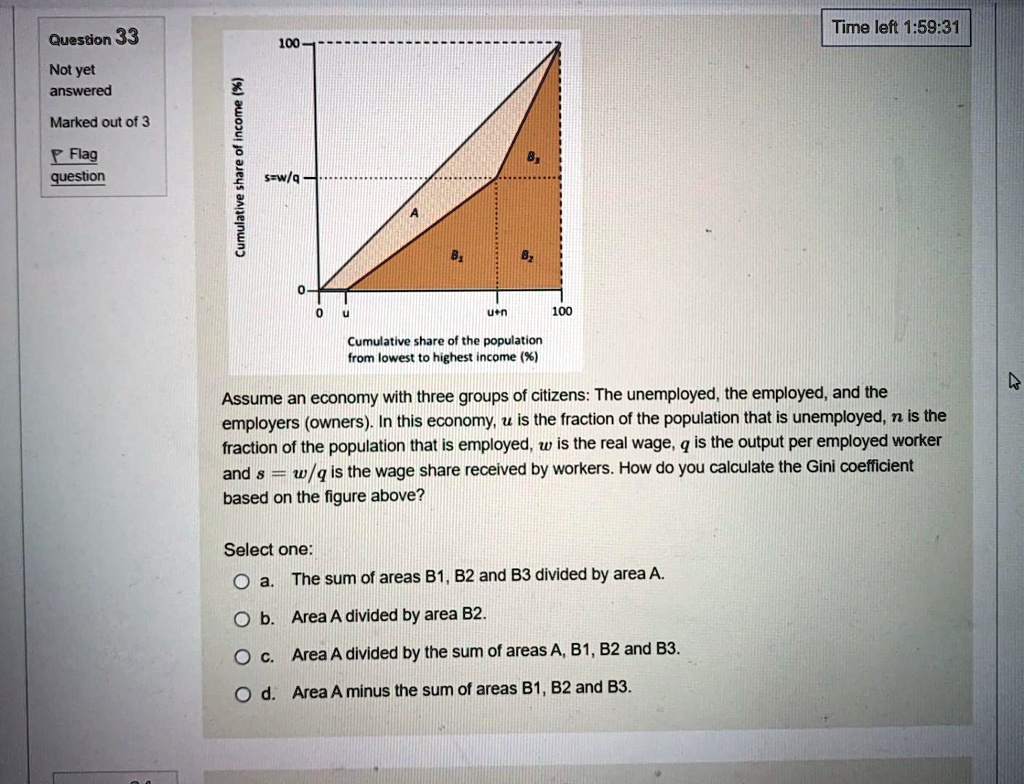
Question 33 Not yet answered Marked out of 3 Flag question Cumulative share of income (%) 100 s=w/q B? B? u+n 100 Time left 1:59:31 Cumulative share of the population from lowest to highest income (%) Assume an economy with three groups of citizens: The unemployed, the employed, and the employers (owners). In this economy, u is the fraction of the population that is unemployed, n is the fraction of the population that is employed, w is the real wage, q is the output per employed worker and s = w/q is the wage share received by workers. How do you calculate the Gini coefficient based on the figure above? Select one: Oa. The sum of areas B1, B2 and B3 divided by area A. Ob. Area A divided by area B2. Oc. Area A divided by the sum of areas A, B1, B2 and B3. Od. Area A minus the sum of areas B1, B2 and B3.
View Answer
divider
BEST MATCH

b) How many grams of iron is 6.88 x 10?² mol of Fe? 58. How many atoms are present in 0.470 mol of uranium? that relates mol and atoms: 1 mol of atoms = 6.02 x 10²³ atoms

View Answer
divider