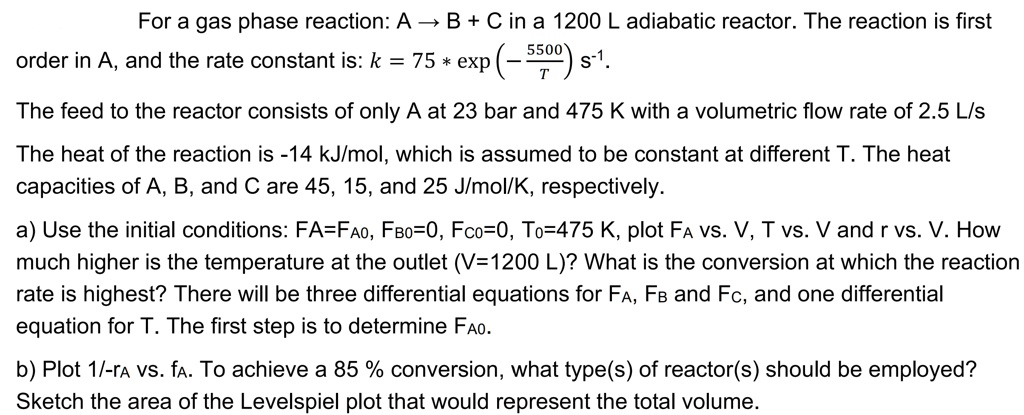
For a gas phase reaction: A?B + C in a 1200 L adiabatic reactor. The reaction is first order in A, and the rate constant is: $k = 75 \times exp(\frac{-5500}{T}) s^{-1}$. The feed to the reactor consists of only A at 23 bar and 475 K with a volumetric flow rate of 2.5 L/s The heat of the reaction is -14 kJ/mol, which is assumed to be constant at different T. The heat capacities of A, B, and C are 45, 15, and 25 J/mol/K, respectively. a) Use the initial conditions: $F_A = F_{A0}$, $F_{B0} = 0$, $F_{C0} = 0$, $T_0 = 475$ K, plot $F_A$ vs. V, T vs. V and r vs. V. How much higher is the temperature at the outlet (V=1200 L)? What is the conversion at which the reaction rate is highest? There will be three differential equations for $F_A$, $F_B$ and $F_C$, and one differential equation for T. The first step is to determine $F_{A0}$. b) Plot $1/-r_A$ vs. $f_A$. To achieve a 85 % conversion, what type(s) of reactor(s) should be employed? Sketch the area of the Levelspiel plot that would represent the total volume.