7. [ /13 Points]
DETAILS
EPPDISCMATHS 7.2.012.
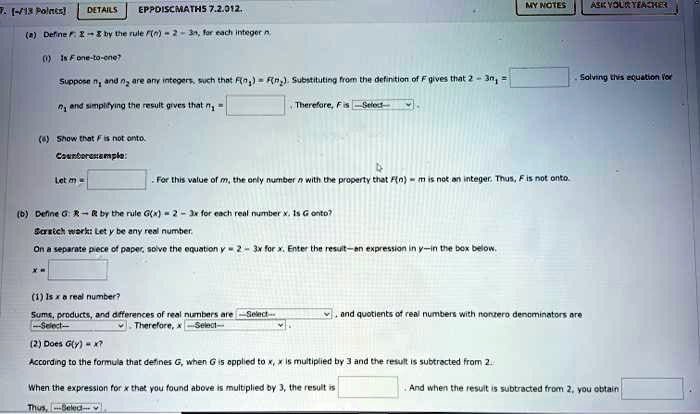
(a) Define \(F: \mathbb{Z} \to \mathbb{Z}\) by the rule \(F(n) = 2 - 3n\), for each integer \(n\).
(1) Is \(F\) one-to-one?
Suppose \(n_1\) and \(n_2\) are any integers, such that \(F(n_1) = F(n_2)\). Substituting from the definition of \(F\) gives that \(2 - 3n_1 = \)
\(n_1\) and simplifying the result gives that \(n_1 = \)
Therefore, \(F\) is \(\text{-Select-}\)
(b) Show that \(F\) is not onto.
Counterexample:
Let \(m = \)
For this value of \(m\), the only number \(n\) with the property that \(F(n) = m\) is not an integer. Thus, \(F\) is not onto.
(b) Define \(G: \mathbb{R} \to \mathbb{R}\) by the rule \(G(x) = 2 - 3x\) for each real number \(x\). Is \(G\) onto?
Scratch work: Let \(y\) be any real number.
On a separate piece of paper, solve the equation \(y = 2 - 3x\) for \(x\). Enter the result—an expression in \(y\)—in the box below.
\(x = \)
(1) Is \(x\) a real number?
Sums, products, and differences of real numbers are \(\text{-Select-}\)
Therefore, \(x\) \(\text{-Select-}\)
and quotients of real numbers with nonzero denominators are
(2) Does \(G(x) = y\)?
According to the formula that defines \(G\), when \(G\) is applied to \(x\), \(x\) is multiplied by 3 and the result is subtracted from 2.
When the expression for \(x\) that you found above is multiplied by 3, the result is
Thus, \(\text{-Select-}\)