Coursework Description: Sliding puzzles
In this coursework, you are supposed to use path finding to solve a type of puzzle that occurs in many video games. The basic version that we will be dealing with is this:
.....0...S
....0.....
0.....0..0
...0....0.
.F......0.
.0........
.......0..
.0.0..0..0
0.........
.00.....0.
The player starts at the location labelled " S " and wants to reach the finish, labelled " F ". Each turn they choose one of the four cardinal directions to move. However, except for S and F the floor is covered in frictionless ice, so they will keep sliding in the chosen direction until they hit the wall surrounding the area, or one of the rocks (labelled " 0 "). For example, starting in the map given above:
.....0... @
.... 0.....
0.....0..0
... 0.... 0.
. F..... .0.
. 0...... . .
....... 0..
. 0.0..0..0
0.........
.00.....0.
the player (“@”) moving left would end up here:
.....0@.. S
.... 0.....
0.....0..0
... 0.... 0.
. F..... .0.
. 0........
...... .0..
. 0.0..0..0
0.........
. 00.....0.
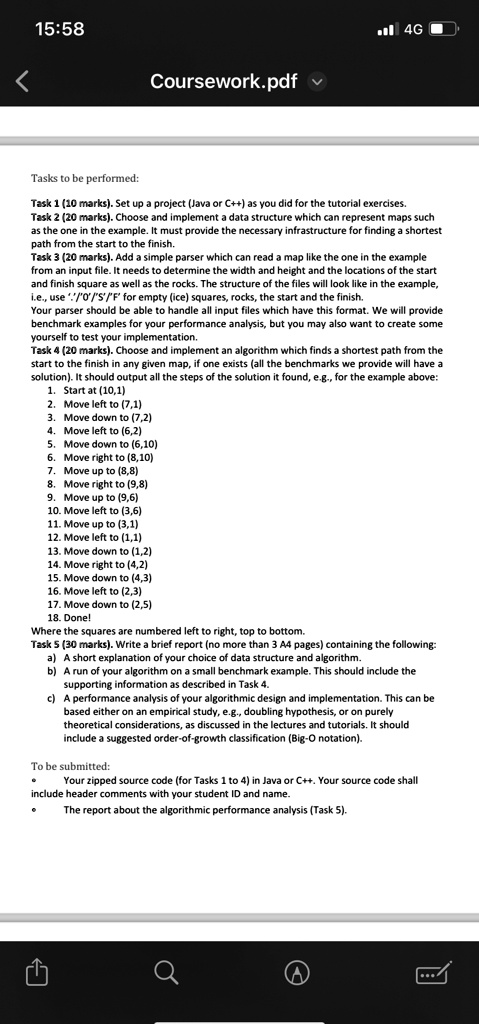
Tasks to be performed:
Task 1 (10 marks). Set up a project (Java ) as you did for the tutorial exercises. Task 2 (20 marks). Choose and implement a data structure which can represent maps such as the one in the example. It must provide the necessary infrastructure for finding a shortest path from the start to the finish.
Task 3 (20 marks). Add a simple parser which can read a map like the one in the example from an input file. It needs to determine the width and height and the locations of the start and finish square as well as the rocks. The structure of the files will look like in the example, i.e., use '.'/'0'/'S'/'F' for empty (ice) squares, rocks, the start and the finish.
Your parser should be able to handle all input files which have this format. We will provide benchmark examples for your performance analysis, but you may also want to create some yourself to test your implementation.
Task 4 (20 marks). Choose and implement an algorithm which finds a shortest path from the start to the finish in any given map, if one exists (all the benchmarks we provide will have a solution). It should output all the steps of the solution it found, e.g., for the example above:
Start at (10,1)
Move left to (7,1)
Move down to (7,2)
Move left to (6,2)
Move down to (6,10)
Move right to (8,10)
Move up to (8,8)
Move right to (9,8)
Move up to (9,6)
Move left to (3,6)
Move up to (3,1)
Move left to (1,1)
Move down to (1,2)
Move right to (4,2)
Move down to (4,3)
Move left to (2,3)
Move down to (2,5)
Done!
Where the squares are numbered left to right, top to bottom.
Task 5 (30 marks). Write a brief report (no more than 3 A4 pages) containing the following:
a) A short explanation of your choice of data structure and algorithm.
b) A run of your algorithm on a small benchmark example. This should include the supporting information as described in Task 4.
c) A performance analysis of your algorithmic design and implementation. This can be based either on an empirical study, e.g., doubling hypothesis, or on purely theoretical considerations, as discussed in the lectures and tutorials. It should include a suggested order-of-growth classification (Big-O notation).
To be submitted:
Your zipped source code (for Tasks 1 to 4) in Java or C++. Your source code shall include header comments with your student ID and name.
, The report about the algorithmic performance analysis (Task 5).
So we are dealing with the problem of finding a path from S to F, but the reachability relation between points is not the usual one.
15:58
4C
Coursework.pdf
Tasks to be performed:
Task 1 (0 marks). Set up a project (Java or C++) as you did for the tutorial exercises. Task 2 (20 marks). Choose and implement a data structure which can represent maps such
path from the start to the finish. Task 3 (20 marks). Add a simple parser which can read a map like the one in the example from an input file. It needs to determine the width and height and the locations of the start and finish square as well as the rocks. The structure of the files will look like in the example, i.e., use .'/'0'/'S'/'F' for empty (ice) squares, rocks, the start and the finish. Your parser should be able to handle all input files which have this format. We will provide benchmark examples for your performance analysis, but you may also want to create some yourself to test your implementation. Task 4 (20 marks). Choose and implement an algorithm which finds a shortest path from the start to the finish in any given map, if one exists (all the benchmarks we provide will have a solution). It should output all the steps of the solution it found, e.g., for the example above: Start at (10,1) 2. Move left to 7,1 3. Move down to (7,2) Move left to (6,2) 5. Move down to (6,10) 6. Move right to (8,10) Move up to (8,8) 8. Move right to (9,8) 9. Move up to (9,6) 10. Move left to (3,6) 11. Move up to (3,1) 12. Move left to (1,1) 13. Move down to (1,2) 14. Move right to (4,2) 15. Move down to (4,3) 16. Move left to (2,3) 17. Move down to (2,5) 18. Done! Where the squares are numbered left to right, top to bottom. Task 5 (30 marks). Write a brief report (no more than 3 A4 pages) containing the following: a) A short explanation of your choice of data structure and algorithm. b) A run of your algorithm on a small benchmark example.This should include the supporting information as described in Task 4. A performance analysis of your algorithmic design and implementation. This can be based either on an empirical study,e.g., doubling hypothesis, or on purely theoretical considerations, as discussed in the lectures and tutorials. It should include a suggested order-of-growth classification (Big-O notation).
To be submitted: Your zipped source code (for Tasks 1 to 4) in Java or C++. Your source code shall include header comments with your student ID and name. The report about the algorithmic performance analysis (Task 5)
.../