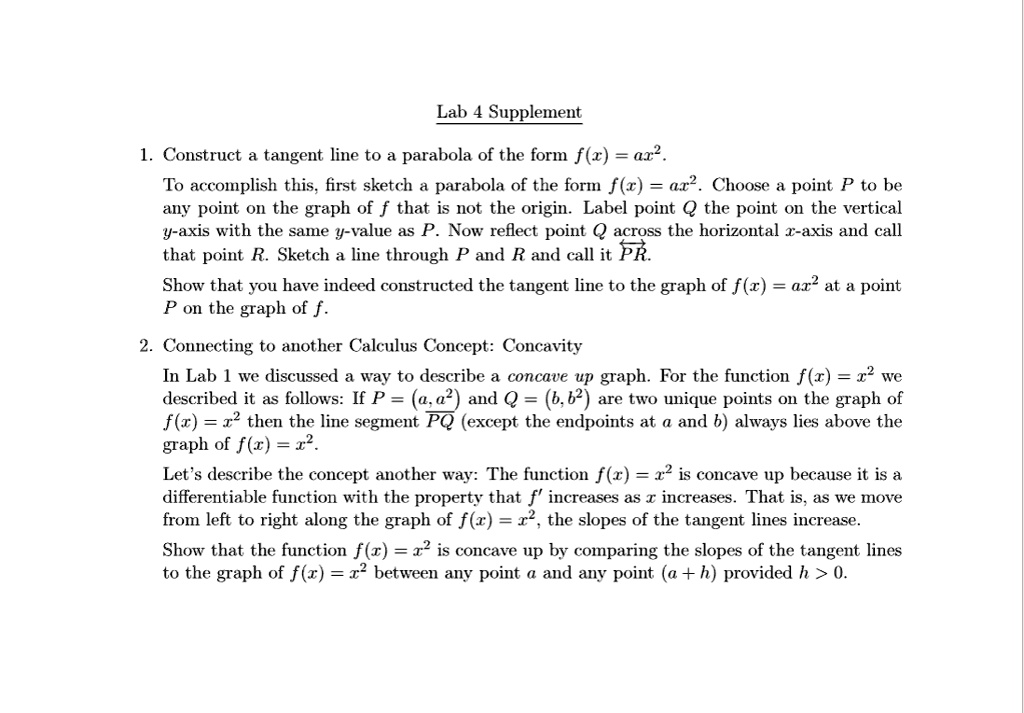
Lab 4 Supplement
1. Construct a tangent line to a parabola of the form $f(x) = ax^2$.
To accomplish this, first sketch a parabola of the form $f(x) = ax^2$. Choose a point P to be
any point on the graph of $f$ that is not the origin. Label point Q the point on the vertical
y-axis with the same $y$-value as P. Now reflect point Q across the horizontal x-axis and call
that point R. Sketch a line through P and R and call it $\overrightarrow{PR}$.
Show that you have indeed constructed the tangent line to the graph of $f(x) = ax^2$ at a point
P on the graph of $f$.
2. Connecting to another Calculus Concept: Concavity
In Lab 1 we discussed a way to describe a concave up graph. For the function $f(x) = x^2$ we
described it as follows: If $P = (a, a^2)$ and $Q = (b,b^2)$ are two unique points on the graph of
$f(x) = x^2$ then the line segment PQ (except the endpoints at a and b) always lies above the
graph of $f(x) = x^2$.
Let's describe the concept another way: The function $f(x) = x^2$ is concave up because it is a
differentiable function with the property that $f'$ increases as $x$ increases. That is, as we move
from left to right along the graph of $f(x) = x^2$, the slopes of the tangent lines increase.
Show that the function $f(x) = x^2$ is concave up by comparing the slopes of the tangent lines
to the graph of $f(x) = x^2$ between any point a and any point $(a + h)$ provided $h > 0$.