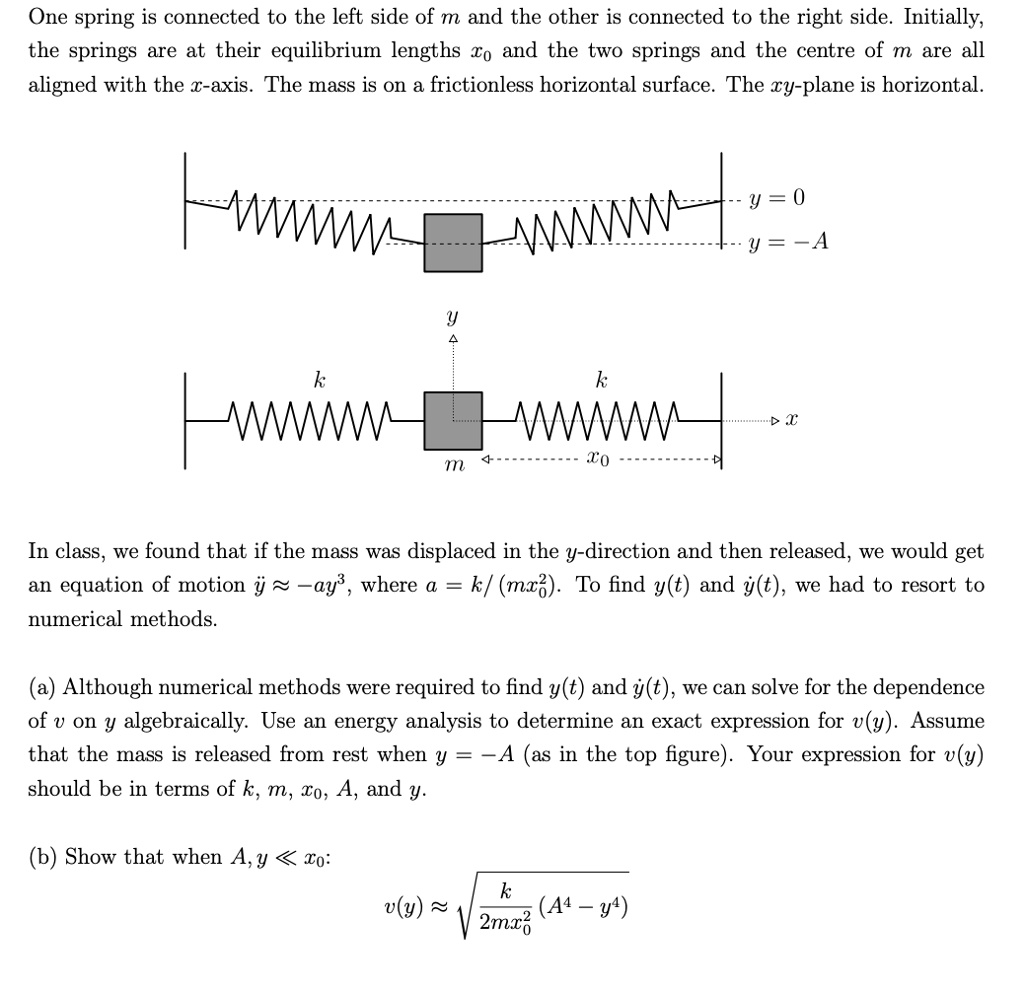
One spring is connected to the left side of m and the other is connected to the right side. Initially, the springs are at their equilibrium lengths $x_0$ and the two springs and the centre of m are all aligned with the x-axis. The mass is on a frictionless horizontal surface. The xy-plane is horizontal.
y = 0
y = -A
k
x
m
$x_0$
In class, we found that if the mass was displaced in the y-direction and then released, we would get an equation of motion $\ddot{y} \approx -ay^3$, where $a = k / (mx_0^2)$. To find $y(t)$ and $\dot{y}(t)$, we had to resort to numerical methods.
(a) Although numerical methods were required to find $y(t)$ and $\dot{y}(t)$, we can solve for the dependence of v on y algebraically. Use an energy analysis to determine an exact expression for $v(y)$. Assume that the mass is released from rest when $y = -A$ (as in the top figure). Your expression for $v(y)$ should be in terms of k, m, $x_0$, A, and y.
(b) Show that when A, y $<< x_0$:
$v(y) \approx \sqrt{\frac{k}{2mx_0^2}(A^4 - y^4)}$